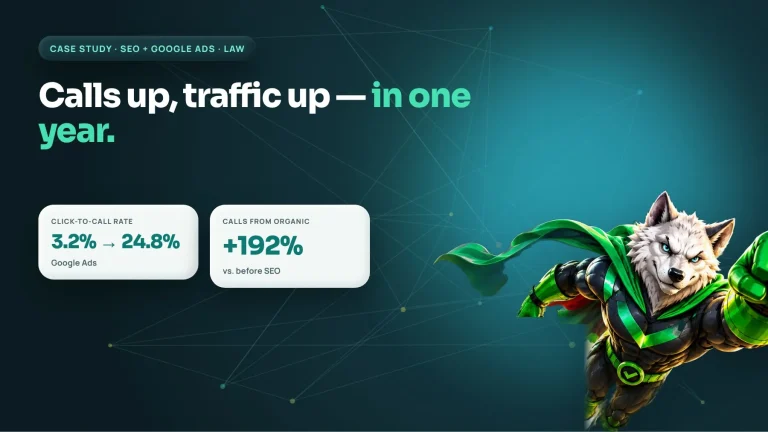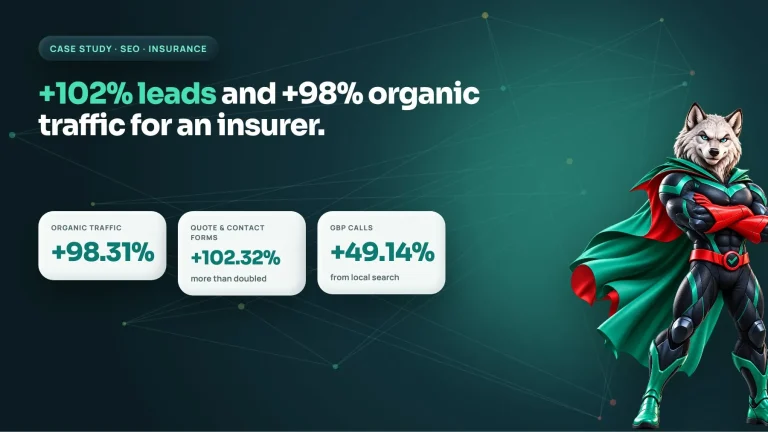
A law firm came to us while its previous SEO agency still controlled the old website. Rather than wait, we scraped the existing site, rebuilt it on a structure designed for multi-location SEO, and ran a full organic growth program around it. The outcome over two years: a 152% increase in new users every month, a 46.06% increase in leads year over year (2020 to 2021) and a 4098.18% increase in indexed keywords.
At a glance
- Client: Multi-location law firm
- Services: Website development, SEO, content strategy, Google Business Profile and local SEO, link building, offline/online integration
- Timeframe: Two years; lead growth measured 2020 to 2021
- Key results: +152% new users per month; +46.06% leads YOY; +4098.18% indexed keywords
The challenge: a site they did not own and keywords they could not crack
The firm’s situation was awkward. Their old agency kept ownership of the website, which meant the firm could not simply hand the existing site over and start improving it. Anything we built had to stand on its own.
On top of that, two problems were holding growth back:
- The site was not built for multiple locations. Law firms with more than one office need each location to rank in its own area. A single “contact us” page with a list of addresses does not do that. Google needs a clear, crawlable page per location, with consistent details and local relevance.
- The firm could not reach the top spots for its important keywords. In legal, the top few organic and map positions take most of the clicks. Being on page two for “personal injury lawyer near me” or a practice-area term is, commercially, close to being invisible.
For a law firm, every new client can be worth a great deal, and prospective clients often call the first credible firm they find. That makes visibility in search, and particularly in the local map results, one of the most valuable assets the firm can own.
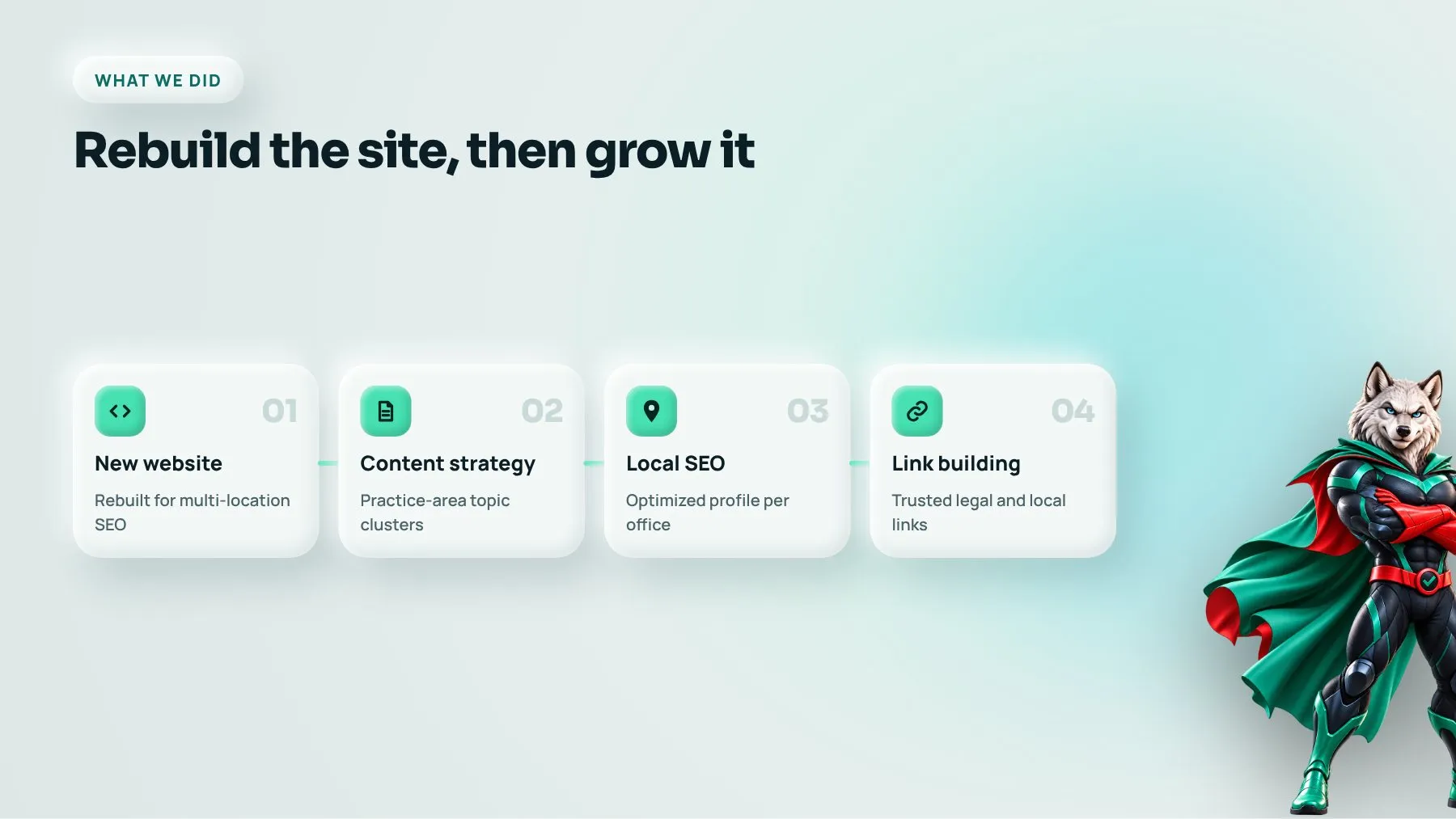
What we did: rebuild, then grow
Rebuilding and restructuring the website
Because the old site belonged to the previous agency, we scraped its content and rebuilt the website from the ground up. That turned a problem into an opportunity: rather than patching an old structure, we designed one around how the firm actually wins clients.
- A location page for each office, with its own address, phone number, map, practice areas served and locally relevant content, so each office had a page that could rank in its own area.
- Practice-area pages organized in a clear hierarchy and linked to the locations that offer them.
- Clean internal linking, so authority flowed from the homepage to practice areas and location pages rather than getting stuck in blog posts.
- Technical foundations: fast loading, mobile-first layouts, clean URLs, correct redirects and legal-service schema markup so search engines understand who the firm is and where it operates.
See how we approach builds like this on our website development page.
Content strategy
The jump in indexed keywords came largely from content. We planned content around the questions prospective clients ask before they call a lawyer, grouped into clusters by practice area. Each cluster had a main practice-area page supported by detailed articles that answered specific questions and linked back to it. This builds topical authority, the signal that tells Google the firm is a genuine expert in a subject, not just a page that mentions it.
Google Business Profile optimization and local SEO
For a multi-location firm, Google Business Profile (formerly Google My Business) is often where the first call comes from. We optimized each profile: correct primary and secondary categories, complete service lists, accurate hours, photos, and a link to the matching location page rather than the homepage. We also made sure the firm’s name, address and phone number were consistent across the website, profiles and key directories, because inconsistency weakens local rankings.
Link building
Competitive legal keywords are rarely won without authority. We built links the slow, safe way: legal and local directories, relevant local organizations, and content that other sites had a reason to reference. In law, the quality and relevance of links matters far more than the volume; a handful of trusted links outperforms hundreds of low-quality ones and carries no penalty risk.
Integrating offline and online marketing
Law firms often already do offline marketing: community events, referrals, sponsorships, print. We connected these efforts to the website so that offline activity produced online signals, such as branded searches, local mentions and links, and so the firm could see which channels actually brought in enquiries.
The results
- 152% increase in new users every month. Monthly new visitors more than doubled, which is where the headline “doubled monthly users” comes from. These are people discovering the firm for the first time.
- 46.06% increase in leads year over year (2020 to 2021). Traffic only matters if it turns into enquiries. Nearly half as many leads again, year on year, is a meaningful change in caseload potential.
- 4098.18% increase in indexed keywords. The firm went from being found for a narrow set of terms to being visible across a far wider range of searches, including the long, specific questions that often signal a serious prospect.
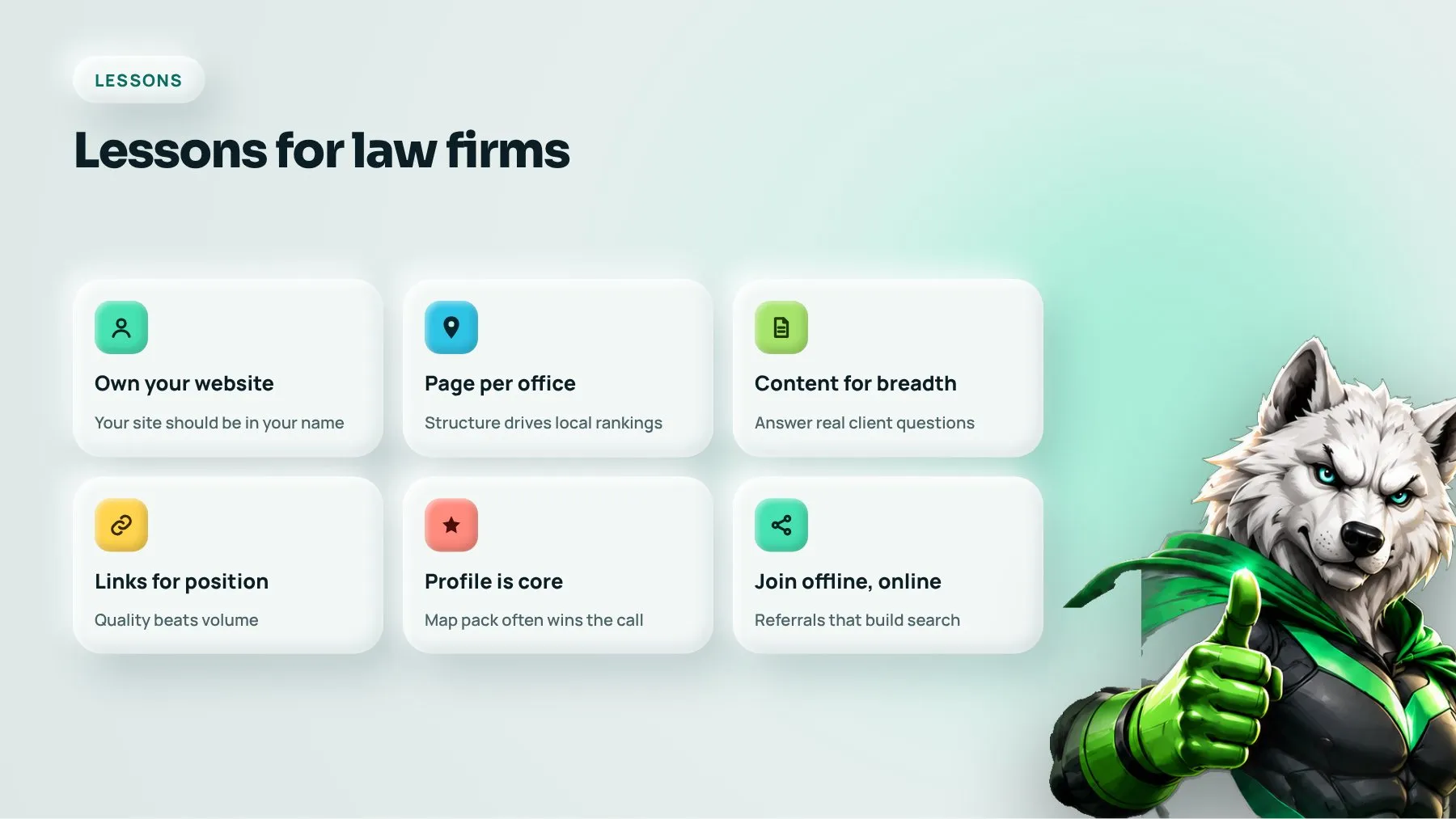
Lessons for law firms
Own your website
If an agency controls your site, it controls your most valuable marketing asset. Make sure your domain, hosting and site are in your name.
Structure decides local rankings
Multi-location firms need a real page per office. Without it, even good content struggles to rank locally.
Content earns breadth; links earn position
Content widened the firm’s visibility; authority from quality links helped push important terms upward. You need both.
Treat Google Business Profile as a core asset
For legal searches with local intent, the map pack is often the first thing a prospect sees.
Connect offline and online
Referrals and community work become stronger when they also build search signals.
How to apply this to your firm
- Confirm you own your domain, hosting and website files.
- Create a dedicated, unique page for every office location.
- Build practice-area content clusters around real client questions.
- Optimize every Google Business Profile and link each to its location page.
- Audit your name, address and phone consistency across the web.
- Pursue relevant, trusted links rather than volume.
FAQ
How long does SEO take for a law firm?
Most firms start to see movement within 3 to 6 months, with stronger results building over 12 months and beyond. This case played out over two years, which is typical for competitive legal markets where authority compounds over time.
Can we switch SEO agencies if our old agency owns the site?
Yes. It is more work, but as this case shows, content can be recovered and a better site rebuilt. Ideally, though, negotiate ownership of your website and domain before you sign with any agency.
Do multi-location firms need separate websites for each office?
Usually not. One strong website with a well-built page per location, plus a Google Business Profile for each office, is normally the most effective and easiest to maintain.
Want the same growth for your firm? See our SEO services or book a strategy call.