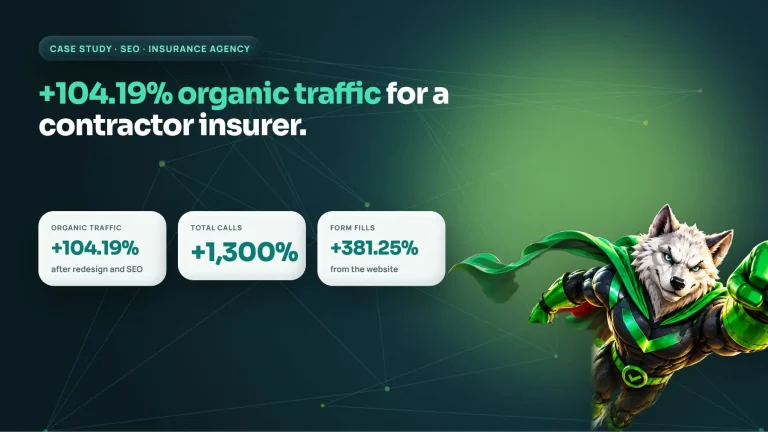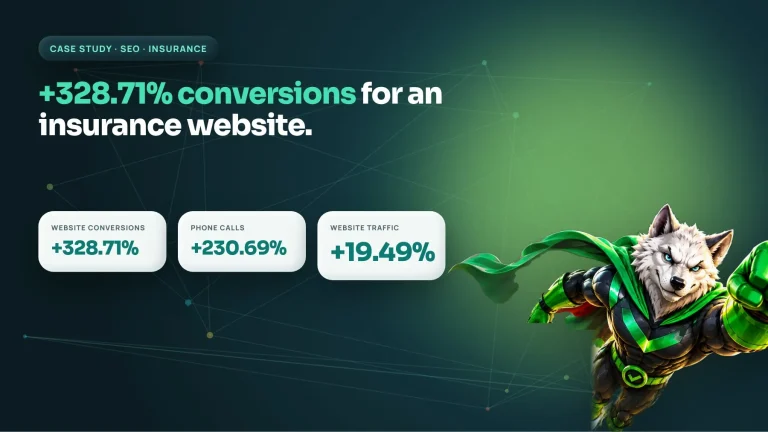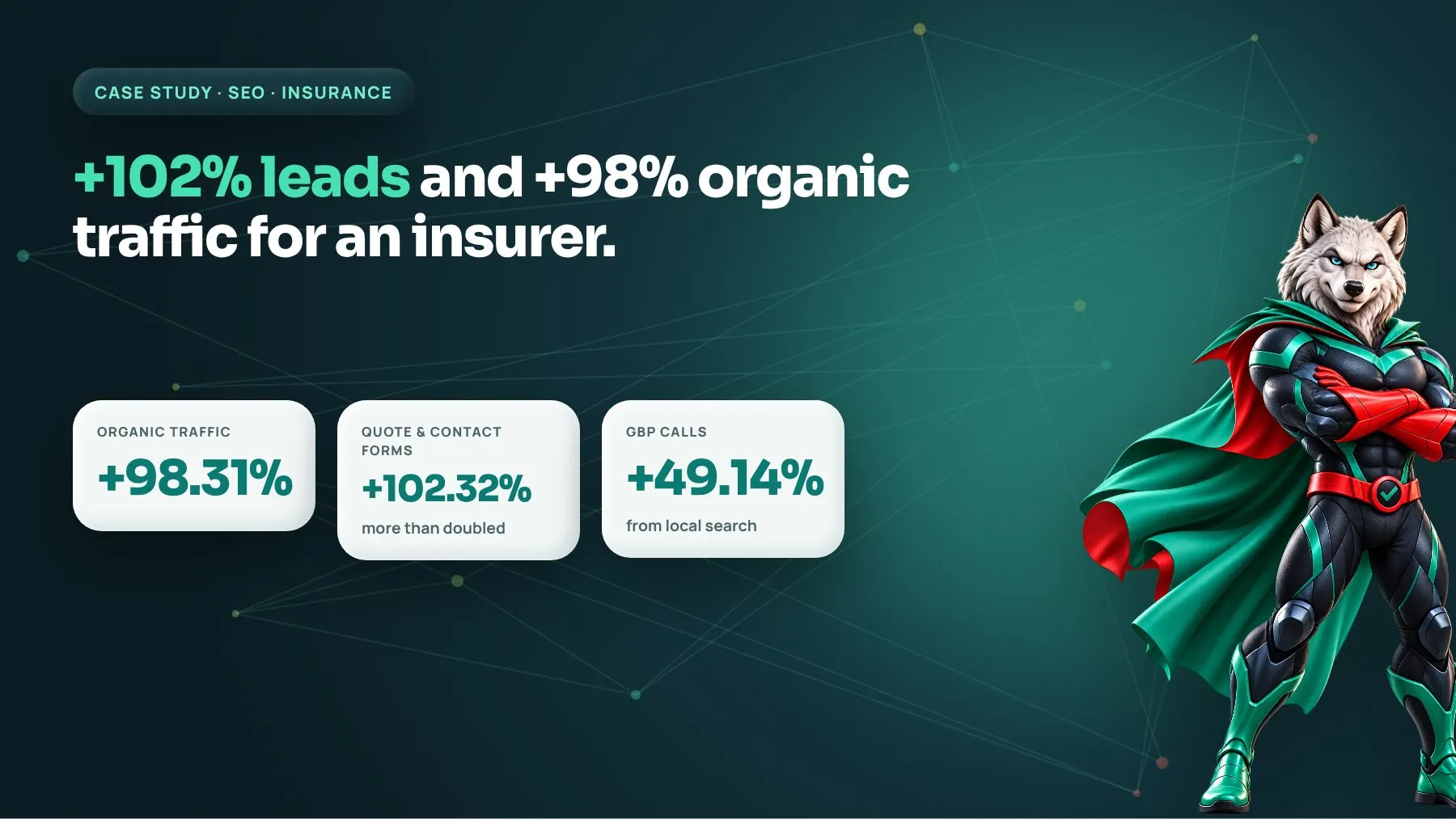
An insurance company hired us to improve how its website performed, with a clear brief: a stronger design and a proper SEO strategy. After a full audit and a program that covered the website, content, local search, links and brand awareness, organic traffic rose by 98.31% and contact and quote form submissions rose by 102.32%.
At a glance
- Client: Insurance company
- Services: Website redesign, SEO, content strategy, Google Business Profile, link building, brand awareness campaigns
- Key results: +98.31% organic traffic; +141.34% new users; +102.32% contact and quote form submissions; +49.14% calls from Google Business Profile
The challenge: a website that was not pulling its weight
Insurance is a trust business. People are buying a promise about the future, often for their home, car, health or company, and they want to feel sure about who they are dealing with before they hand over details. The website is usually where that judgment is made, long before anyone picks up the phone.
Our SEO audit found four groups of problems:
- Website setup issues. The foundations of the site were holding it back: how it was built, structured and configured for search engines.
- On-site issues. Pages were not clearly targeting the searches potential customers use, and content and page elements needed work.
- Poor local visibility. The company was not showing up well when people nearby searched for insurance, which is where many of the highest-intent searches happen.
- Unclear goals and objectives. The site lacked a defined purpose for each page and clear measures of success, so it was hard to tell what was working.
Commercially, this mattered a great deal. Insurance is one of the most competitive categories in search, with comparison sites and national brands spending heavily for visibility. A smaller insurer cannot outspend them, so it has to out-earn them: rank for the specific and local searches the big players neglect, and convert a higher share of visitors into quote requests.
What we did
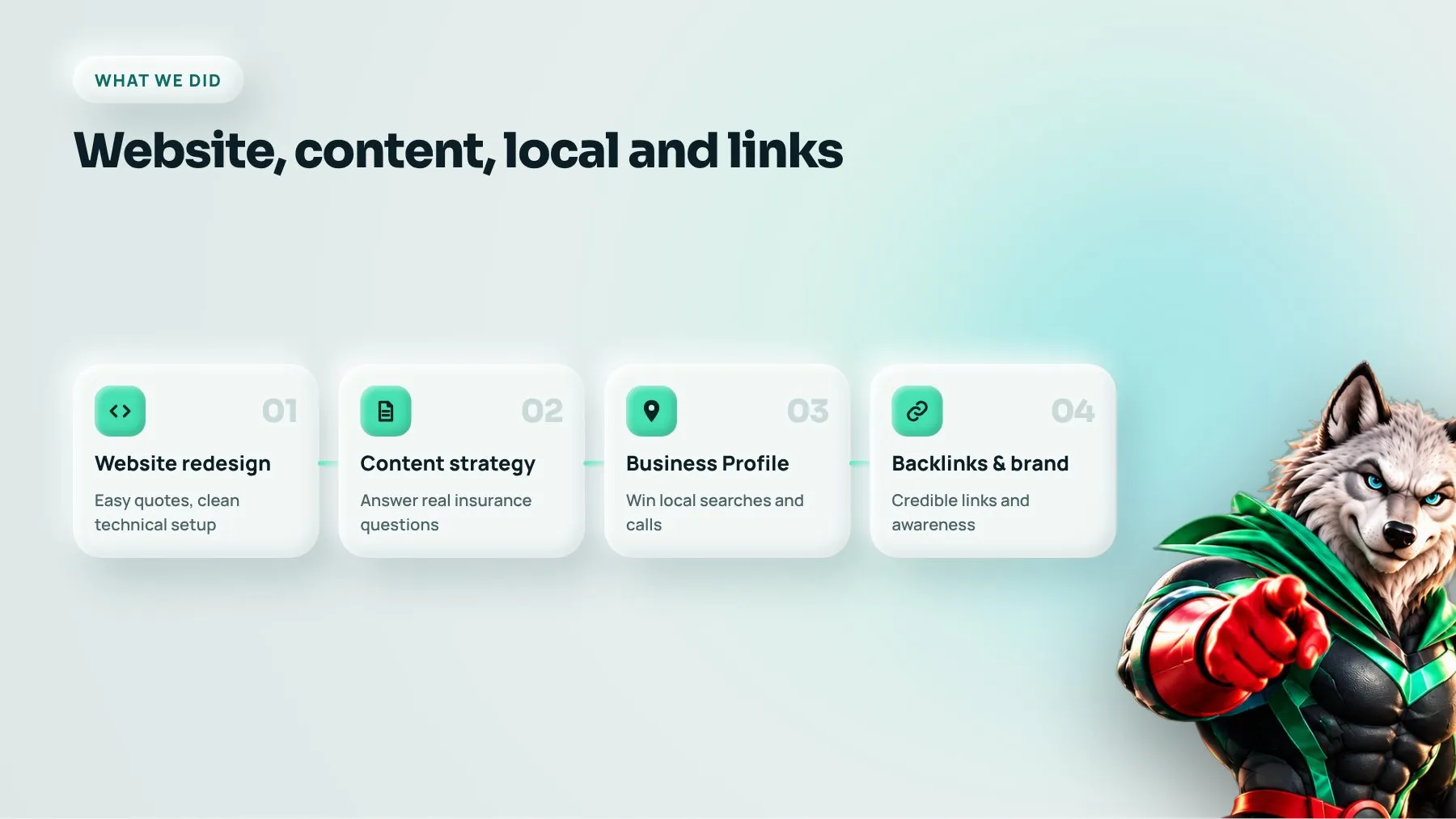
Redesigned the website
We started with the site itself, because more traffic to a weak website just means more visitors leaving. The redesign addressed the setup issues and built for both search engines and people:
- A clear structure with a dedicated page for each insurance product or customer type, so each page can target its own set of searches.
- Quote and contact forms that are easy to find and quick to complete, with calls to action placed where a visitor is ready to act.
- Trust signals throughout, such as accreditations, clear explanations of cover and easy ways to reach a real person.
- Clean technical foundations: fast-loading pages, mobile-friendly layouts, sensible URLs, proper headings and an XML sitemap so search engines can crawl everything that matters.
Content strategy and marketing
Insurance buyers have questions, and the company that answers them well earns both rankings and trust. We planned content around what people actually search at each stage of the decision: what a policy covers, how much it typically costs to insure a particular risk, what to do when making a claim, and how to compare options.
Each piece was mapped to a primary keyword and linked to the relevant product page, so informational content passed authority and visitors toward pages that generate quotes. This also positions the business well for AI-driven search results, which tend to draw on clear, well-structured answers. Our work on AI Overviews optimization builds on exactly this kind of content.
Google Business Profile
To fix the poor local visibility, we optimized the company’s Google Business Profile. That means choosing the most accurate primary and secondary categories, writing a complete business description, listing services, adding photos, keeping hours and contact details consistent with the website, and encouraging and responding to customer reviews. Regular posts keep the profile active. For an insurer, the profile often produces the most direct leads of all, because people searching locally can call straight from the results.
Backlink building
Links from reputable websites remain one of the strongest signals of authority, and authority matters in a category Google treats with extra care, since insurance decisions affect people’s finances. We focused on relevant, credible sources such as local business organizations, industry publications and partner websites, rather than volume.
Brand awareness campaigns
Finally, we ran brand awareness campaigns so more people knew the company’s name. This has a knock-on effect on search: as awareness grows, more people search for the brand directly, and those searches convert well because the person already intends to deal with you.
The results
- +98.31% organic traffic. Nearly double the visitors from unpaid search, without paying per click.
- +141.34% new users. The site reached far more people who had never visited before, which is exactly what a growing insurer needs.
- +102.32% contact and quote form submissions. Leads more than doubled. Notably, this outpaced the traffic growth, which shows the redesign improved conversion as well as reach.
- +49.14% calls from Google Business Profile. Local visibility turned directly into phone calls from nearby customers.
The most important number here is the lead growth. Traffic is only useful if it produces enquiries, and in this case each improvement to the site multiplied the value of the extra visitors that SEO brought in.
What made the difference: lessons for insurance businesses
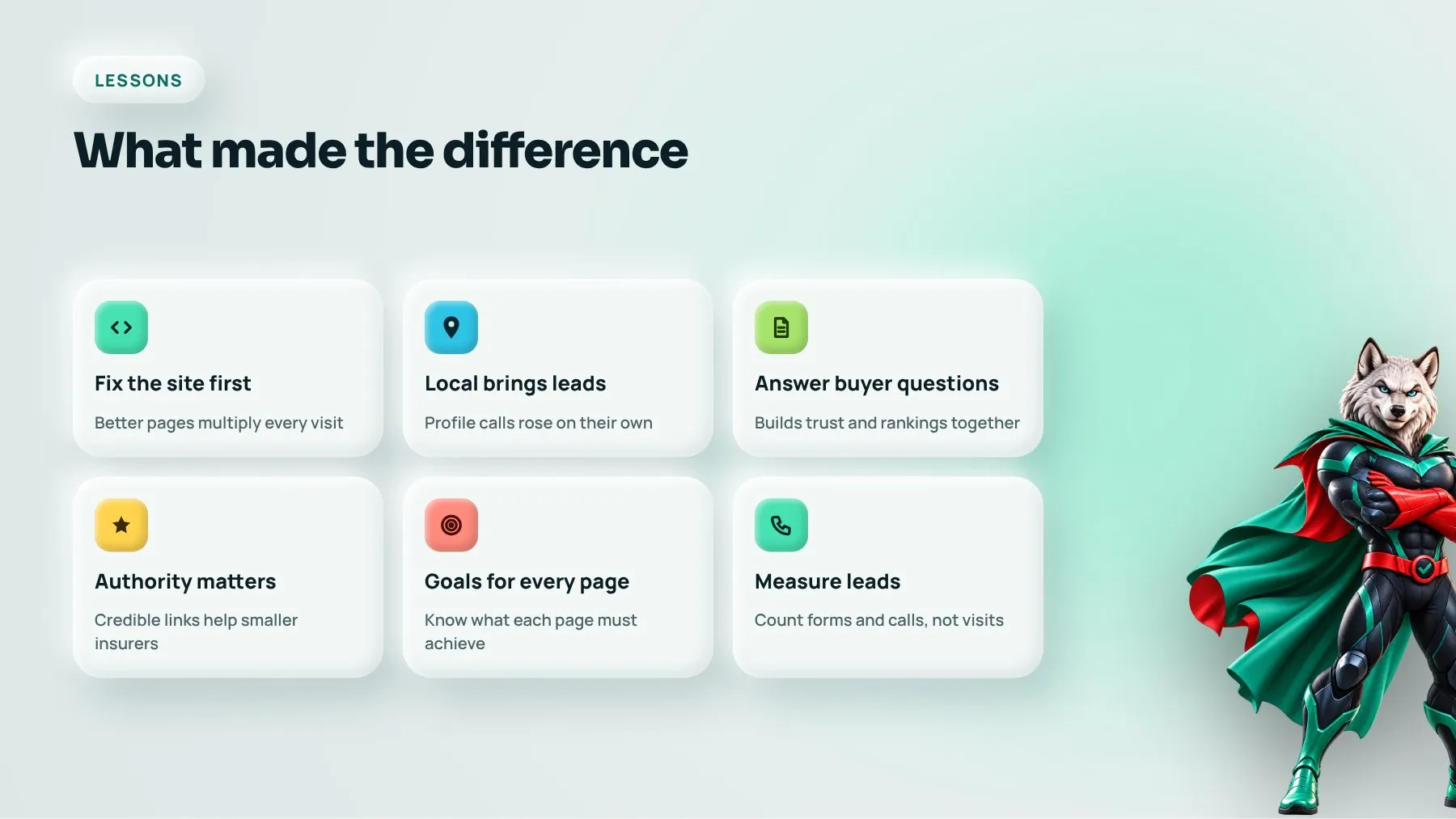
- Fix the website before you push traffic to it. A redesign that makes quoting easy multiplies the value of every visitor that follows.
- Local search is a lead channel in its own right. A well-managed Google Business Profile produced a meaningful rise in calls on its own.
- Answer the questions buyers ask. Helpful content builds trust and rankings at the same time, and gives the business a voice in AI search answers.
- Authority matters more in financial categories. Credible links and a recognizable brand help a smaller insurer compete with much larger names.
- Set goals for every page. Clear objectives make it obvious what to measure and what to improve next.
How to apply this to your business
- Audit your website for technical, on-page and local issues before you spend on traffic.
- Give each product or service its own page with a clear call to action.
- Make your quote or contact form short and visible on every key page.
- Complete and maintain your Google Business Profile, and ask happy customers for reviews.
- Build a content plan around the real questions your customers ask.
- Measure leads and calls, not just visits.
FAQ
How long does SEO take for an insurance company?
Technical fixes and local profile improvements can show results within a few weeks to a few months. Competitive insurance keywords typically take 3–6 months or longer, depending on how strong your competitors are and where your site starts from.
Do we need a new website to improve SEO?
Not always. Sometimes the existing site can be fixed. But if the audit shows serious setup issues or the site makes it hard to request a quote, a redesign is often faster and more effective than patching problems one by one.
Can a smaller insurer compete with comparison sites in Google?
Yes, by focusing on specific products, customer types and local searches where comparison sites are weaker, and by building trust signals they cannot match, such as a real local presence and personal service.
Want the same for your insurance business? See our SEO services, learn about our lead generation work or book a strategy call.