Most experienced SEO professionals begin a campaign the same way: with a comprehensive audit of the website. There is a good reason for that. A thorough assessment shows what has to happen for the site to meet its objectives, and it stops you from spending months on tactics that do not matter.
This guide walks through how we turn an audit into a strategy that works, in four stages: understanding the business, identifying problems, building solutions, and setting objectives. It is written for business owners as much as marketers, because the best SEO strategies start with commercial goals, not keywords. We have also added what has changed by 2026, when search increasingly includes AI-generated answers alongside traditional results.
What a proper SEO audit covers
An audit is not a single report from a tool. It is a structured review across six areas:
- Competitor analysis and research. Who ranks for the searches you want, what are they doing well, and where are they weak?
- Keyword and SERP study. Which searches matter to your business, what intent sits behind them, and what does the results page actually look like (ads, map pack, product listings, AI Overviews, videos)?
- User experience (UX) analysis. Can visitors find what they need, trust what they see and take the next step easily?
- Technical and site-wide analysis. Crawling, indexing, site speed, mobile usability, structured data, redirects and site architecture.
- Page and content-level analysis. Does each important page clearly answer the query it targets, and is the content better than what already ranks?
- Link analysis. How much authority does the site have, where does it come from, and are there risky links that need attention?
Together, these answer the core questions of strategy development.
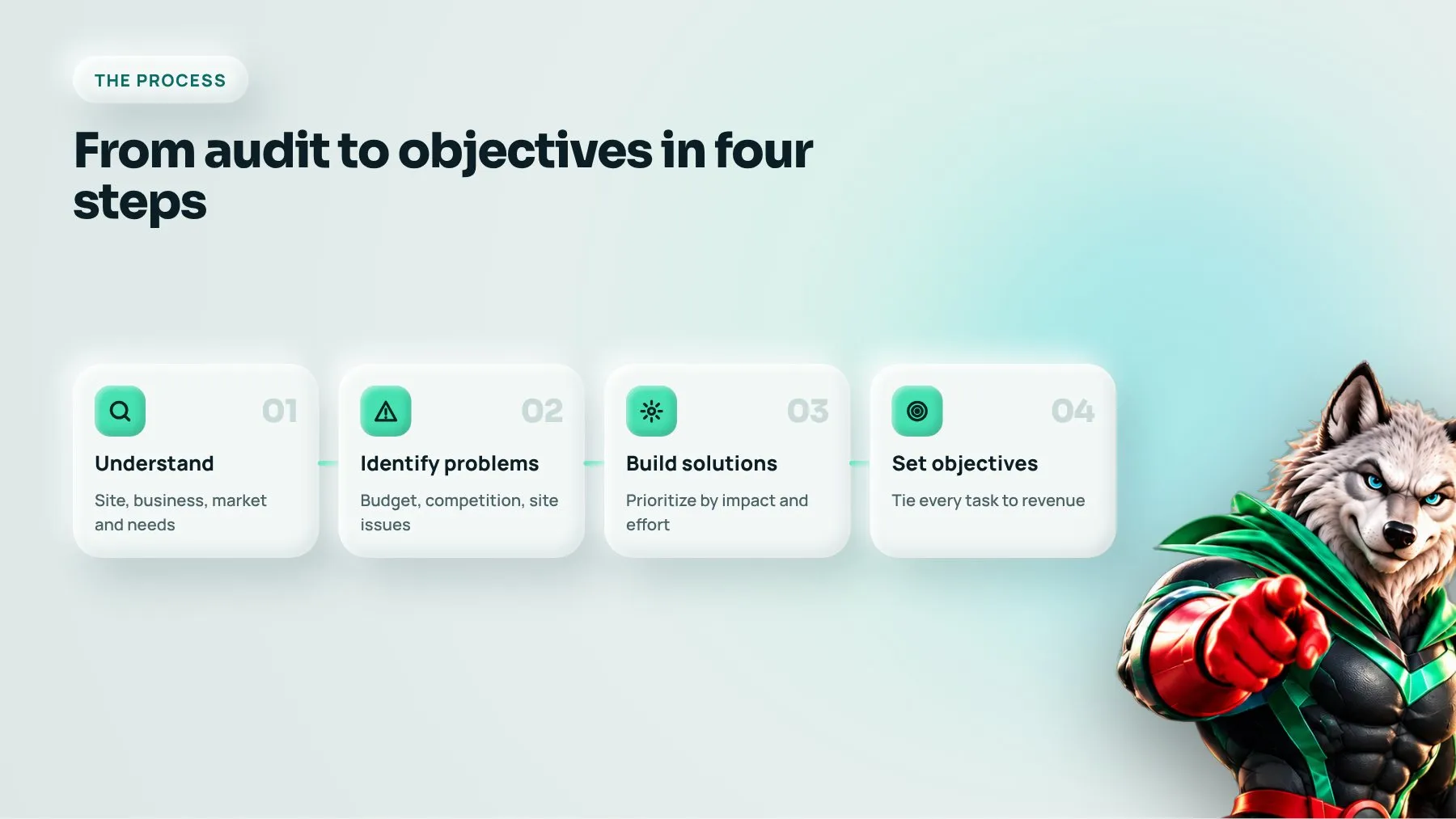
Step 1: Understand the website, the business, the market and the real needs
Understanding everything about the website and business is the first step in any good SEO campaign. This defines the goals of the campaign by establishing:
- Website type and size. A 20-page local service site needs a very different strategy from a 20,000-product ecommerce store or a multi-language international site.
- Nature of the business. Does it sell to consumers or businesses? Locally, nationally or internationally? Is the sale made online, by phone or in person?
- Real demands. What does the business actually need: more leads, more online sales, more calls, entry into a new market, or brand awareness? “More traffic” is rarely the real goal.
- Current situation. What is working already, what has been tried, what budget and resources exist, and what history (good or bad) does the site carry?
Example: a law firm with three offices and an ecommerce brand selling across Europe may both say they “want to rank higher”. The law firm needs location pages, Google Business Profiles and local authority. The ecommerce brand needs category structure, product page optimization and international targeting. Same request, completely different strategies.
Step 2: Identify problems and challenges
Once the initial audit is complete, it becomes much easier to pinpoint the constraints. They usually fall into three groups:
- Budget. What can realistically be done each month, and what should come first?
- Competition. How strong are the sites that currently rank? Some searches can be won in months; others take years.
- Site issues. The technical, content and UX problems you will mostly discover with checklists during the audit.
Use checklists suited to the site’s profile and needs:
- Local SEO: Google Business Profile setup and categories, consistent name, address and phone details, location pages, reviews.
- Technical SEO: crawlability, indexing, Core Web Vitals, canonical tags, redirects, XML sitemaps, structured data.
- Ecommerce SEO: category and filter structure, duplicate product content, out-of-stock handling, product schema.
- Mobile SEO: mobile layout, tap targets, page speed on mobile networks. Google indexes the mobile version of a site, so mobile problems are ranking problems.
Step 3: Come up with solutions
Your audit findings and analysis should then be pulled together into a plan that addresses three things:
- Opportunities to capitalize on to gain traction. Pages ranking on page two that need a push, high-intent keywords competitors neglect, content gaps, quick technical wins.
- The site’s main problems. Anything that holds back the whole site, such as indexing errors, slow templates, thin or duplicated content, or toxic links.
- Actions that meet the site’s current needs. The work that directly supports the business goal identified in step 1.
Prioritize items that produce both immediate and long-term results. A simple way to do this is to score each task by impact and effort. High-impact, low-effort tasks go first because they build momentum and confidence. High-impact, high-effort tasks, such as a site restructure or a content program, are planned in phases. Low-impact tasks wait.
Combining short-term wins with long-term investments is how you plan and implement result-driven SEO.
Step 4: Set strategic objectives for the campaign
Every role and activity in the plan should line up with the business objectives. Make sure each weekly target supports the campaign’s long-term goals: build on small wins to get big wins.
Typical strategic objectives look like this:
- Improve the overall quality of the site by improving its design, content and authority (links).
- Increase revenue or brand awareness by increasing search visibility for the searches that matter.
- Grow organic traffic by improving content quality and consistency and the user experience.
Then translate them into measurable targets: leads or sales from organic search, rankings for a defined set of priority keywords, visibility in local results, and conversion rate from organic visitors. Traffic is a useful indicator, but revenue and leads are what a business owner should judge SEO by.
With the right mindset, strategy and tactics in place, well-set targets are achievable.
What has changed by 2026
The principles above have not changed, but the search results page has. Google now shows AI Overviews for many queries, and more people ask questions in AI assistants such as ChatGPT, Gemini and Perplexity. A modern SEO strategy should add:
- Answer-first content. Clear, direct answers near the top of pages, supported by depth below, make content easier for both search engines and AI systems to quote.
- Entity and brand clarity. Consistent information about who you are, what you do and where you operate, across your site, profiles and the wider web.
- Structured data that helps machines understand your pages.
- Measuring visibility in AI answers, not just blue links.
We cover this in more detail on our AI Overviews optimization and generative engine optimization pages.
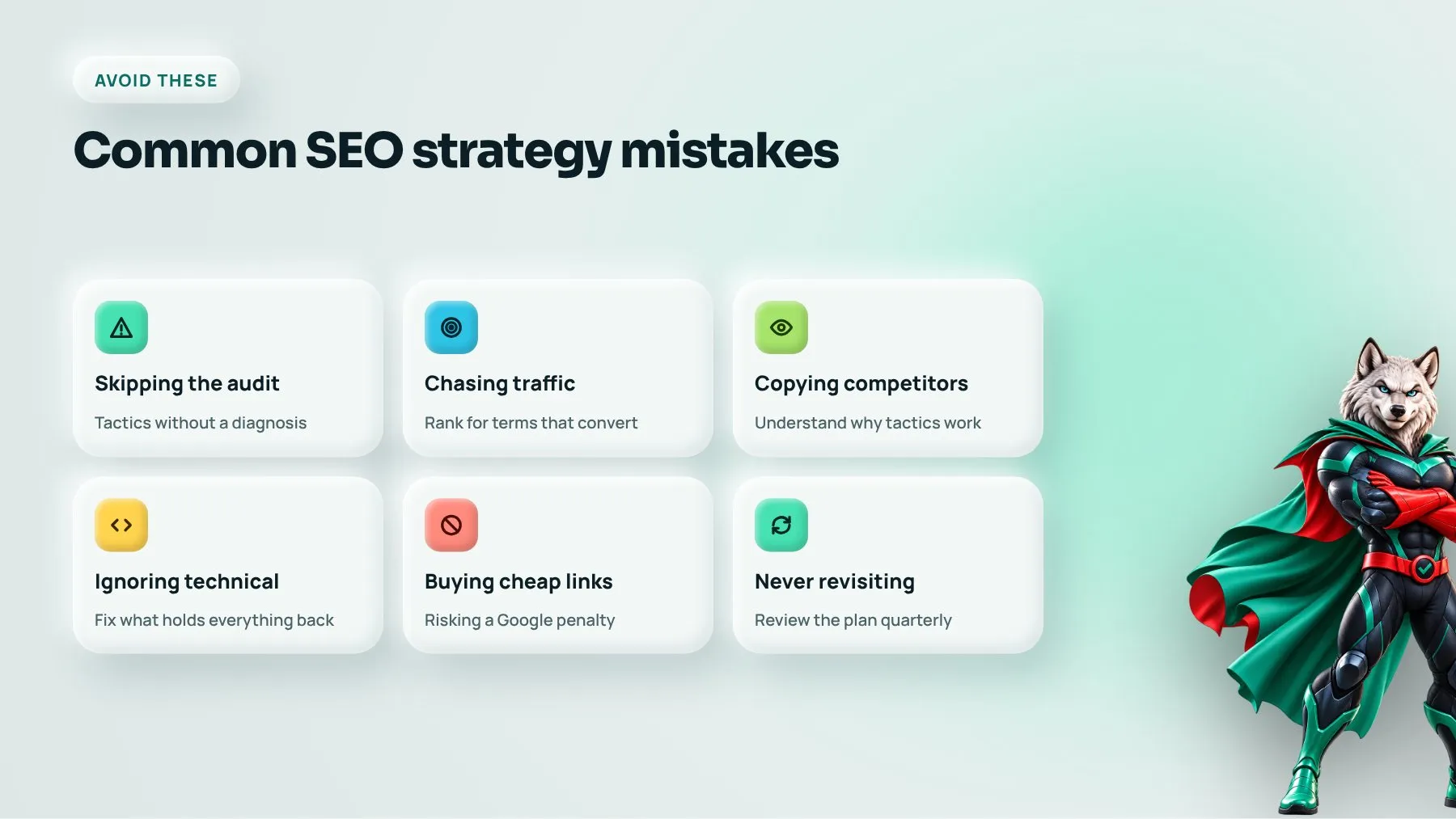
Common mistakes
- Skipping the audit and jumping straight to keywords or links.
- Chasing traffic instead of revenue, ranking for terms that never convert.
- Copying competitors’ tactics without understanding why they work.
- Ignoring technical problems that hold back every other effort.
- Buying cheap links, which can lead to penalties.
- Never revisiting the plan. A strategy should be reviewed at least quarterly.
FAQ
How long does it take to build an SEO strategy?
A proper audit and strategy for a small to mid-size site usually takes a few weeks. Larger or international sites take longer. The time is well spent, because it prevents months of misdirected work.
How long before an SEO strategy shows results?
Quick technical and on-page wins can show within weeks, but most strategies take 3 to 6 months to show meaningful movement and 6 to 12 months or more to reach their potential in competitive markets.
Do I still need SEO with AI search?
Yes. AI answers draw heavily on pages that already rank well and are clearly structured. Strong SEO is the foundation for visibility in AI search, not a replacement for it.
Want a strategy built around your business goals? See our SEO services or book a strategy call.