SEO trends come and go, but the ones that last are usually about the same thing: making a website easy for search engines to understand and easy for people to use. This guide covers four trends we first wrote about a few years ago (page speed, internal linking, crawling and featured snippets), explains why each still matters in 2026, and shows how AI-driven search has changed what “ranking” means.
What SEO is, in plain terms
Search engine optimization is the work of increasing the quality and quantity of visitors who reach your website from unpaid search results. It does not include paid ads. When it works, your pages appear when potential customers search for what you sell, and that traffic keeps arriving without a cost per click.
For a business owner, the value of SEO is compounding. A well-optimized page can bring in enquiries for years. The trade-off is time: results usually build over months, not days, which is why it pays to focus on the factors that actually move rankings.
When we first wrote about this topic, the big developments were mobile search, featured snippets and voice search. Mobile is now simply the default, voice search has largely folded into conversational and AI-assisted search, and featured snippets now sit alongside AI-generated answers. The fundamentals below are what connect all of these.
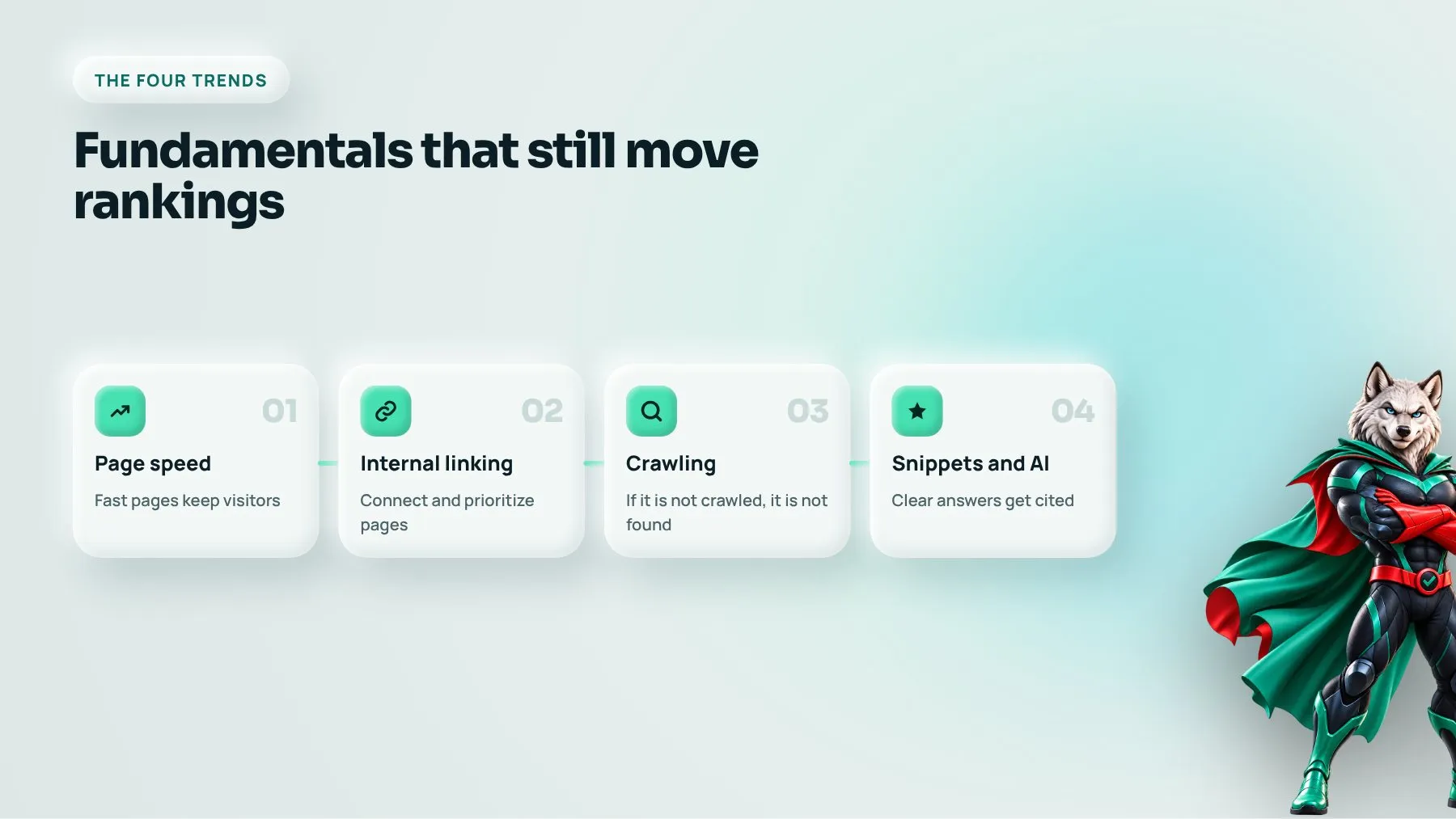
Trend 1: Page speed and user experience
Why it matters
People expect pages to load almost instantly. A slow site frustrates visitors, and frustrated visitors leave, often before they have seen what you offer. The longer a page takes to load, the more likely people are to abandon it. Search engines have treated page experience as a ranking consideration for years, and Google measures it through Core Web Vitals: how quickly the main content loads, how quickly the page responds to interaction, and how stable the layout is while loading.
Speed rarely wins rankings on its own, but a slow site loses ground it should have kept, and it wastes paid and organic traffic alike.
How to improve it
- Compress and correctly size images, and use modern formats.
- Remove or delay scripts you do not need, especially third-party widgets.
- Use caching and a content delivery network.
- Test on a mid-range phone over mobile data, not just on an office computer.
- Check the Core Web Vitals report in Google Search Console and fix the worst page templates first.
Common mistake
Chasing a perfect speed score instead of real user experience. A page that loads its main content fast and responds quickly is what matters, not a number in a testing tool.
Trend 2: Internal linking
Why it matters
Internal links connect one page on your site to another. They help Google discover pages, understand how your site is organized, and judge which pages are most important. A page buried deep in the site with few links pointing to it is hard for both search engines and visitors to find, and it tends to be treated as less important.
Internal linking is one of the most overlooked SEO levers because it costs nothing and is entirely in your control.
How to do it well
- Make sure every important page can be reached within a few clicks of the homepage.
- Link from high-traffic pages to the pages you most want to rank.
- Use descriptive anchor text that tells people what they will find, not “click here.”
- Group related content into topic clusters: a main guide linked to and from supporting articles.
- Find and fix orphan pages that have no internal links at all.
Common mistake
Adding dozens of links to every page. Links work best when they are relevant and help the reader take the next logical step.
Trend 3: Crawling and crawl budget
Why it matters
Crawling is how search engines discover new and updated content. Automated programs, often called crawlers or spiders, follow links from page to page and collect what they find, whether that is a web page, a PDF, an image or a video. If a page cannot be crawled, it cannot be indexed, and if it is not indexed, it cannot appear in search results.
Search engines also limit how many URLs they crawl on a site in a given period, often called crawl budget. For most small sites this is not a constraint. For larger sites, such as ecommerce stores with filters or sites with thousands of pages, wasted crawling on duplicate or low-value URLs can mean important pages are found late or not at all.
How to manage it
- Keep an up-to-date XML sitemap listing only pages you want indexed.
- Fix broken links and long redirect chains.
- Stop crawlers wasting time on endless filter and parameter URLs.
- Use the Page indexing report in Google Search Console to see which pages are excluded and why.
- Make sure important content is linked from other pages, not only listed in a sitemap.
Common mistake
Blocking pages in robots.txt and assuming that removes them from search. Blocking crawling and preventing indexing are different things, and mixing them up causes problems.
Trend 4: Featured snippets and AI answers
Why it matters
Featured snippets are short answers that Google shows in a box at or near the top of results, pulled from a ranking page. They come in several formats: paragraphs, lists, numbered steps, tables and videos. Winning one puts your brand in front of searchers before the usual list of results.
In 2026 this has expanded. Google’s AI Overviews and other AI assistants now summarize answers from several sources and cite them. The skills that win featured snippets, clear structure, direct answers and genuine expertise, are the same skills that get content cited in AI answers. That work is now often called answer engine optimization or generative engine optimization.
How to optimize for it
- Answer the main question directly in the first sentence or two under a relevant heading.
- Use lists and tables where the content naturally fits them.
- Write headings that mirror the questions people actually ask.
- Show expertise: real experience, specific detail and clear authorship.
- Use structured data where relevant, such as FAQ, product or local business markup.
- Keep content accurate and updated, because AI systems favor trustworthy sources.
Common mistake
Writing for the snippet and forgetting the click. Give a complete short answer, then make it obvious that the page offers more depth worth reading.
What has changed since we first wrote this
The fundamentals have not changed, but the stage has:
- Mobile-first is standard. Google indexes the mobile version of your site, so mobile quality is site quality.
- AI search is mainstream. Visibility now includes being cited in AI Overviews and assistants, not just ranking in the blue links. Our AI Overviews optimization work focuses on exactly this.
- Trust signals matter more. Experience, expertise and clear authorship help both rankings and AI citations.
- Technical health is the entry ticket. Speed, crawlability and clean structure do not guarantee rankings, but problems in these areas hold everything else back.
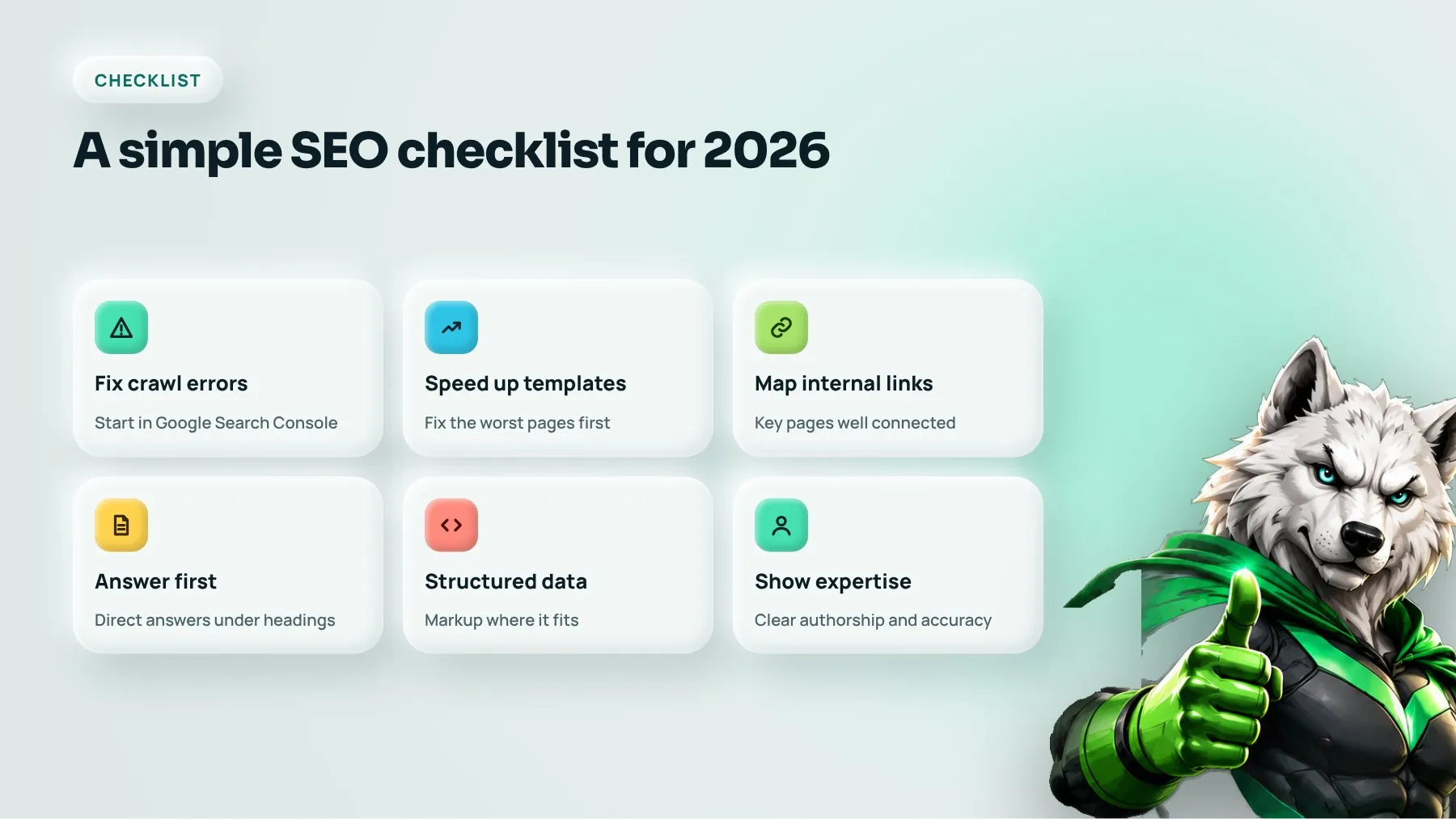
A simple SEO checklist for 2026
- Run your site through Google Search Console and fix crawl and indexing errors.
- Improve load speed on your most important page templates.
- Map internal links so key pages are well connected.
- Rewrite the opening of key pages to answer the main question directly.
- Add structured data where it fits.
- Review content for accuracy, expertise and clear authorship.
FAQ
Are these SEO trends still relevant in 2026?
Yes. Page speed, internal linking, crawlability and clear answers are the foundations that both traditional search results and AI-generated answers depend on. The way results are displayed has changed, but the fundamentals have not.
How does AI search affect SEO?
AI search summarizes information and cites sources, so the goal now includes being one of those sources. Clear structure, direct answers, expertise and technical health all improve your chances of being cited as well as ranked.
How long does it take to see SEO results?
SEO results usually start to show in three to six months, depending on competition and the state of the site. Technical fixes can produce faster gains when they unblock pages that search engines were struggling to reach.
Want a site that ranks in search and gets cited by AI? See our SEO services, read more on our blog or book a strategy call.