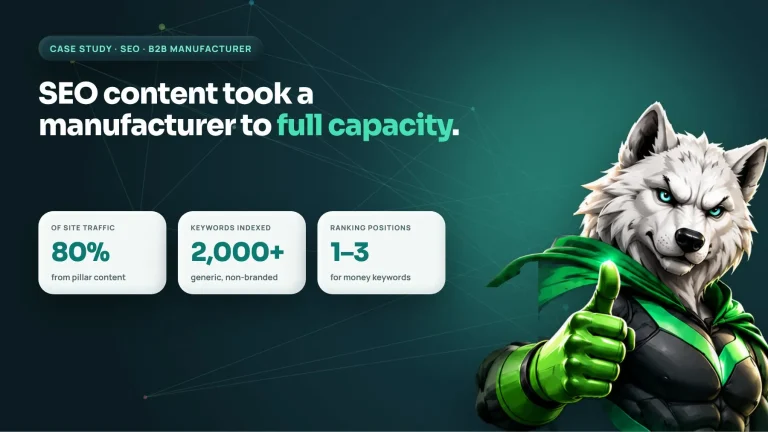
In early October 2018, a plastics manufacturer from Spain came to us for help. After more than eight months of paying two different SEO companies, the website was not generating any leads, and by then it had been penalized by Google and had almost no traffic at all. We cleaned up the damage, rebuilt the site’s SEO properly and separated its Spanish and English versions. The site came out of the penalty in early 2019, and the manufacturer has since expanded its sales support team to handle dozens of genuine leads per week.
At a glance
- Client: Plastics manufacturer, Spain
- Services: SEO, penalty recovery, technical SEO, content, international and local SEO
- Timeframe: Took over in late October 2018; penalty lifted in early 2019
- Key results: Recovered from Google penalty; traffic growing steadily since; dozens of genuine leads per week from local and global buyers; visible for hundreds of high-intent product searches
The challenge: two agencies, eight months, zero leads
What the previous agencies had been doing
When we ran a high-level audit, we found that both previous SEO agencies had been doing almost nothing except spammy link building. They had also created dozens of thin, useless articles using an “article spinner”, software that rewrites the same article into many low-quality variations. These were published on free blog platforms such as Blogspot, Medium and hosted WordPress, each linking back to the client’s site with exact-match anchor text.
This is a classic Web 2.0 blackhat technique that was common among cheap SEO services. It rests on an outdated idea: if lots of sites link to you, you must be popular and deserve to rank. Google has spent years getting better at spotting and punishing exactly this pattern.
What happened next
At first, traffic to the site went up. But it was worthless traffic: untargeted visits, mostly from spammers, not buyers. Then, in July, the site was penalized by Google and traffic almost completely stopped.
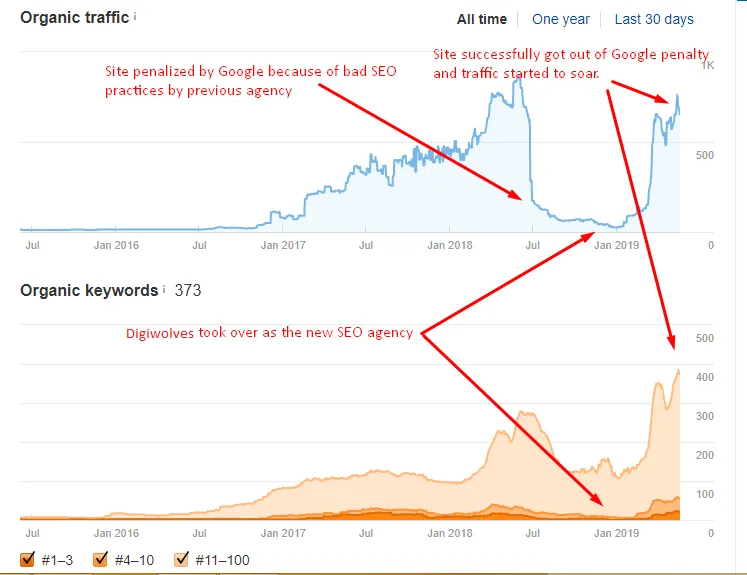
The client did not feel the penalty immediately, because even when traffic was coming in, none of it turned into leads. After the penalty, there were still no leads, and now there was no traffic either. Eight months of fees had produced a site that Google actively distrusted.
A second, hidden problem: languages competing with each other
The site had Spanish and English versions, and they were cannibalizing each other’s keyword rankings. Google could not tell which page to show for a given search, so rankings flickered between versions, the so-called “Google dance”. Neither language version could build stable visibility.
For a manufacturer selling both in Spain and internationally, this mattered a great deal. Spanish buyers and international buyers search differently, in different languages and in different Google databases. The site needed to serve both clearly.
What we did: clean up, then build properly
We took over in late October 2018 and started immediately.
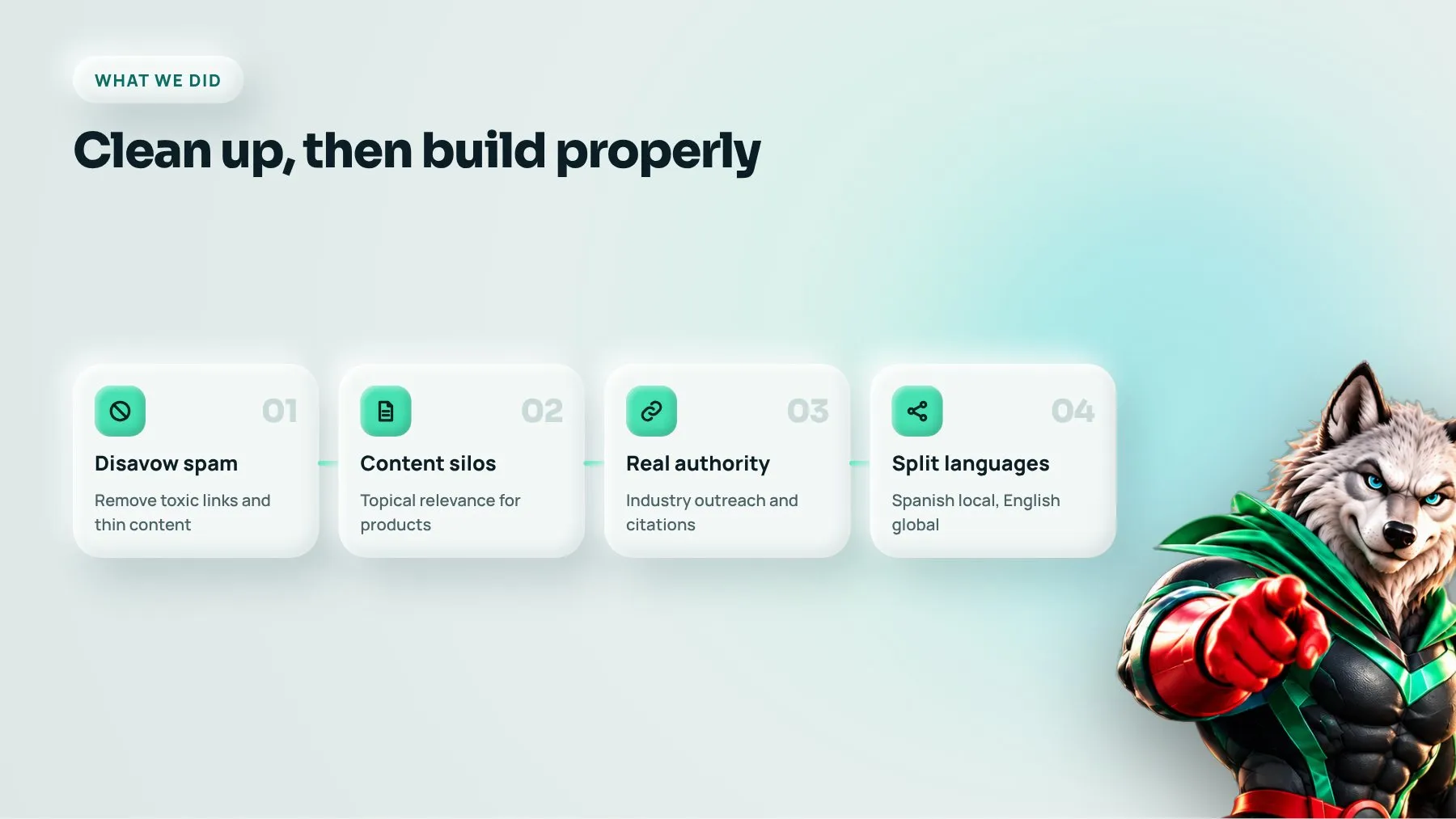
1. Removing the toxic links and thin content
The first priority was to deal with the damage. We disavowed all the spammy backlinks and the thin spun content linking to the site, using Google’s disavow process, which tells Google to ignore specific links when assessing a site. Penalty recovery depends on showing Google that the manipulative links are no longer counting in the site’s favor.
2. Strong content, siloed around product pages
Next, we created strong, genuinely useful content and organized it in silos around the important product pages. A content silo groups related pages together and links them in a clear hierarchy, so each product page is supported by content on the same topic. This gives each product “topical relevance”: Google can see that the site covers that product area in depth, not in passing.
For a manufacturer, this is especially effective. Industrial buyers search for specific materials, processes and applications. Content that answers those questions and links to the right product page brings in buyers who already know what they need.
3. Real link building and citations
We replaced spam with legitimate authority: outreach to related industry blogs and sites, and more local and international business citations. A few relevant links from real industry sources are worth more than thousands of spun blog links, and they carry no penalty risk.
4. Technical improvements
Our team sped up the site by reworking its internal structure, and optimized every page with proper schema markup, header tags, meta descriptions and other on-page elements. Faster, cleaner, well-structured pages are easier for Google to crawl and understand, and easier for buyers to use.
Our SEO solution for the language problem
We split the site into two subdomains and optimized each separately:
- The Spanish version was optimized for local search in Spain.
- The English version was optimized for international search.
Each version now had a clear job and a clear audience, so the two stopped competing for the same rankings.
We also helped the client claim its Google Business Profile (then called Google My Business) and linked it to the Spanish version of the site. This helped the business rank highly in local Spanish search and on Google Maps.
Today, alongside subdomains, many international sites use subfolders with hreflang tags to signal language and region. The right choice depends on the business, but the principle is the same: each language version needs a clear target market so Google knows which page to show to whom.
The results
After we took over, the site came out of the Google penalty in early 2019, and traffic has been growing ever since.
More importantly, that traffic converts. The manufacturer has expanded its sales support team just to reply to dozens of genuine incoming leads every week. These come from both local and global buyers who found the website through hundreds of high-intent product searches on Google.
Lessons for manufacturers
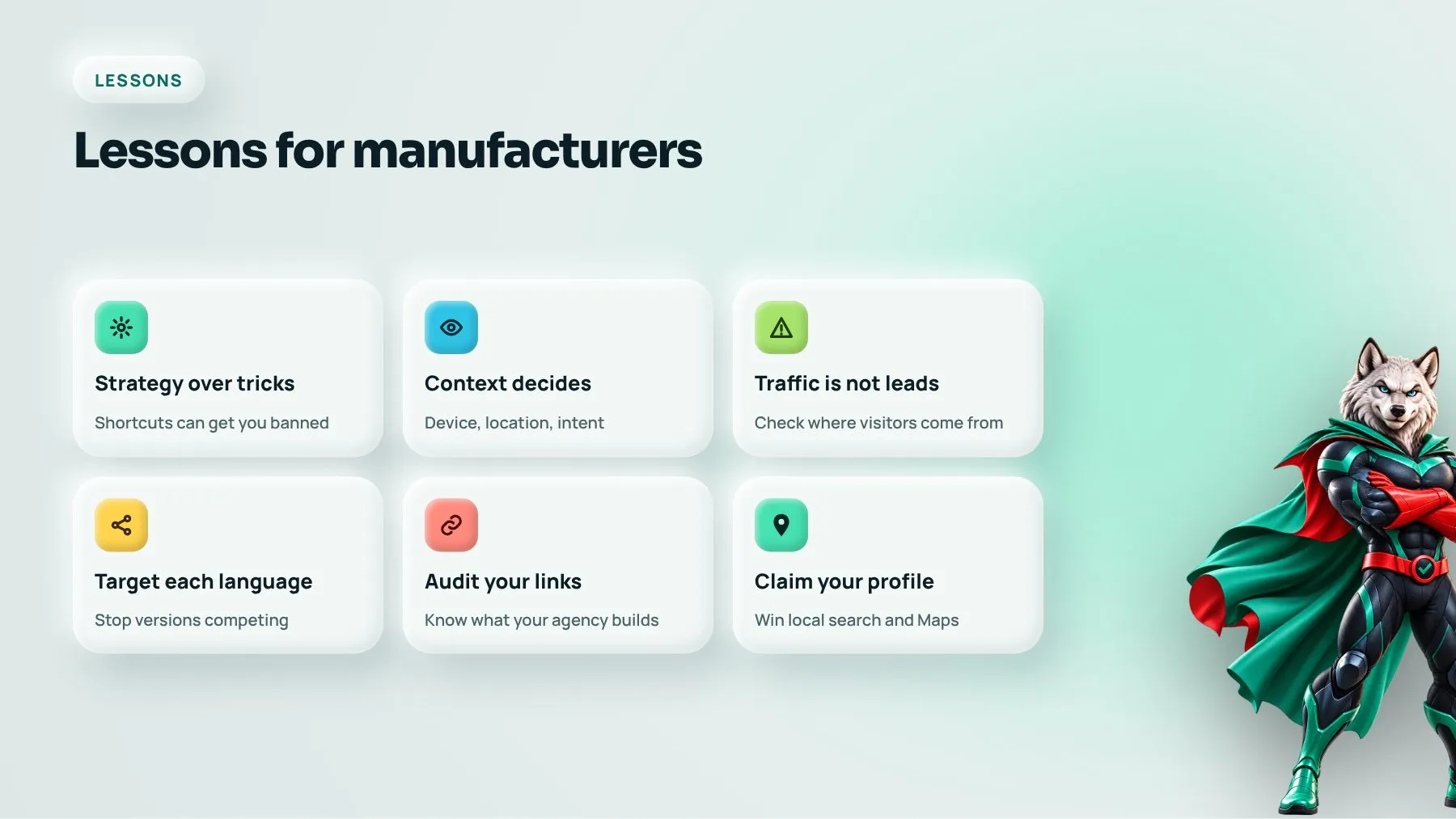
SEO is a strategy, not a set of tricks
SEO is not just tweaking page titles, header tags, meta descriptions or stuffing in keywords. Cheap, bundled SEO packages often rely on link spam because it can be outsourced cheaply to freelancers. Those are crude tactics with no strategy behind them, and they can get your site penalized.
Context decides what works
Google uses a very large number of ranking signals, weighted differently by situation. A strategic SEO partner considers questions like these:
- Is the search happening on mobile or desktop?
- Is it a local or international query?
- What is the searcher’s intent: to buy, research, compare or watch?
- How competitive is the query?
An agency that only works at the tactical level often reaches for aggressive shortcuts, and those shortcuts can get your site banned.
Traffic without leads is a warning sign
If traffic rises but enquiries do not, ask where the traffic is coming from.
Multilingual sites need clear targeting
Language versions must be separated and targeted, or they compete with each other.
How to apply this to your business
- Ask any SEO agency exactly what links they build and where.
- Review your backlink profile for spun content and exact-match anchor spam.
- Measure SEO by leads and sales, not traffic alone.
- Organize content around your key product or service pages.
- Give each language version its own clear target market.
- Claim and optimize your Google Business Profile.
FAQ
Can a website recover from a Google penalty?
Yes, in most cases. Recovery means removing or disavowing the harmful links or content, fixing the underlying issues and then building genuine quality. Here, the site came out of the penalty in early 2019, a few months after we took over.
How do I know if my SEO agency is using risky tactics?
Warning signs include very cheap packages promising lots of links, reports full of links from unrelated blogs, and traffic rising with no matching rise in enquiries. Ask for a list of links built and check them yourself.
Does a manufacturer need separate sites for different countries?
Not necessarily separate sites, but each language or market should have its own clearly targeted section, using subdomains, subfolders or country domains with the right technical signals.
Worried your SEO is doing more harm than good? See our SEO services, read more case studies, or book a strategy call.