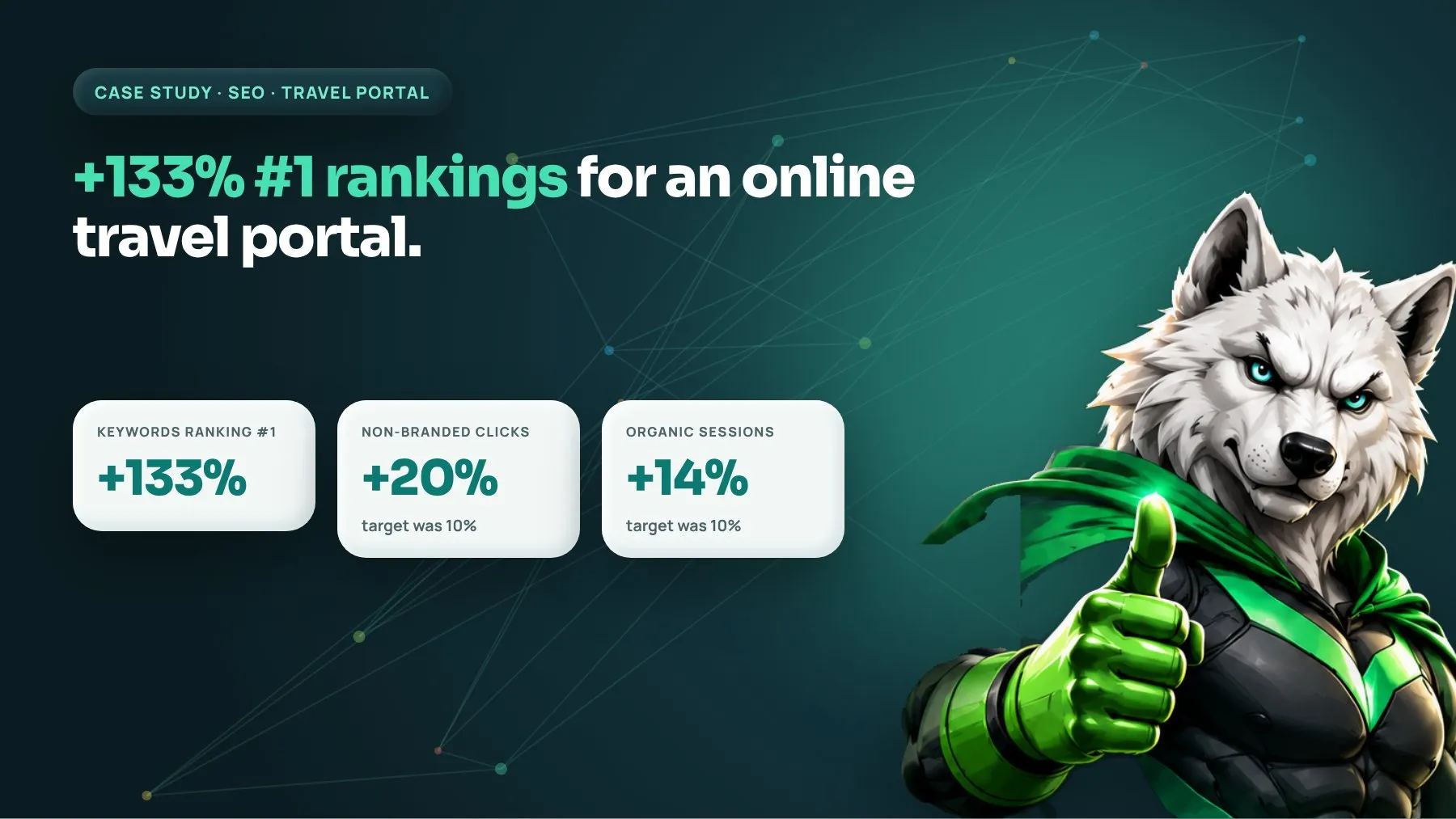
Our client is an online travel portal that helps people organize, book and track trips, with real-time ticket pricing and availability for flights, trains and buses. The goal was more non-branded search traffic in the first four months. By fixing the gap between the desktop and mobile sites, rebuilding internal linking and tightening on-page signals, we delivered a 133% increase in keywords ranking in position #1, 20% more non-branded clicks and 14% more organic sessions, beating both targets.
At a glance
- Client: Online travel booking and trip-tracking portal
- Service: Search engine optimization (technical and on-page)
- Timeframe: Targets set for the first four months of engagement
- Key results: +133% keywords ranking #1, +20% non-branded clicks, +14% organic sessions
The challenge: a site that grew faster than its structure
Travel is one of the most competitive spaces in search. Large aggregators, airlines and rail operators all compete for the same queries, and much of the demand is non-branded: people searching for a route, a fare or a schedule rather than a company name. A travel portal that only wins searches for its own brand is fishing in a very small pond.
The client set two clear objectives for the first four months:
- Increase non-branded clicks by 10%
- Increase organic sessions by 10%
Our audit found two problems standing in the way.
Desktop and mobile told Google different stories
There was a discrepancy between the desktop and mobile versions of the website. Google indexes and ranks primarily from the mobile version of a page. If the mobile site carries less content, fewer links or different headings than desktop, Google ranks the weaker version. For a travel portal, where a large share of searches and bookings happen on phones, this hurt both rankings and the experience of real users.
Internal links did not reflect how topics connect
Internal linking was improper and non-contextual. Links existed, but they were not placed where they made sense to the reader or helped search engines understand which pages mattered most. On a large site with many route, destination and transport pages, internal links are how authority flows. Without a deliberate structure, important pages sat too deep and received too little of it.
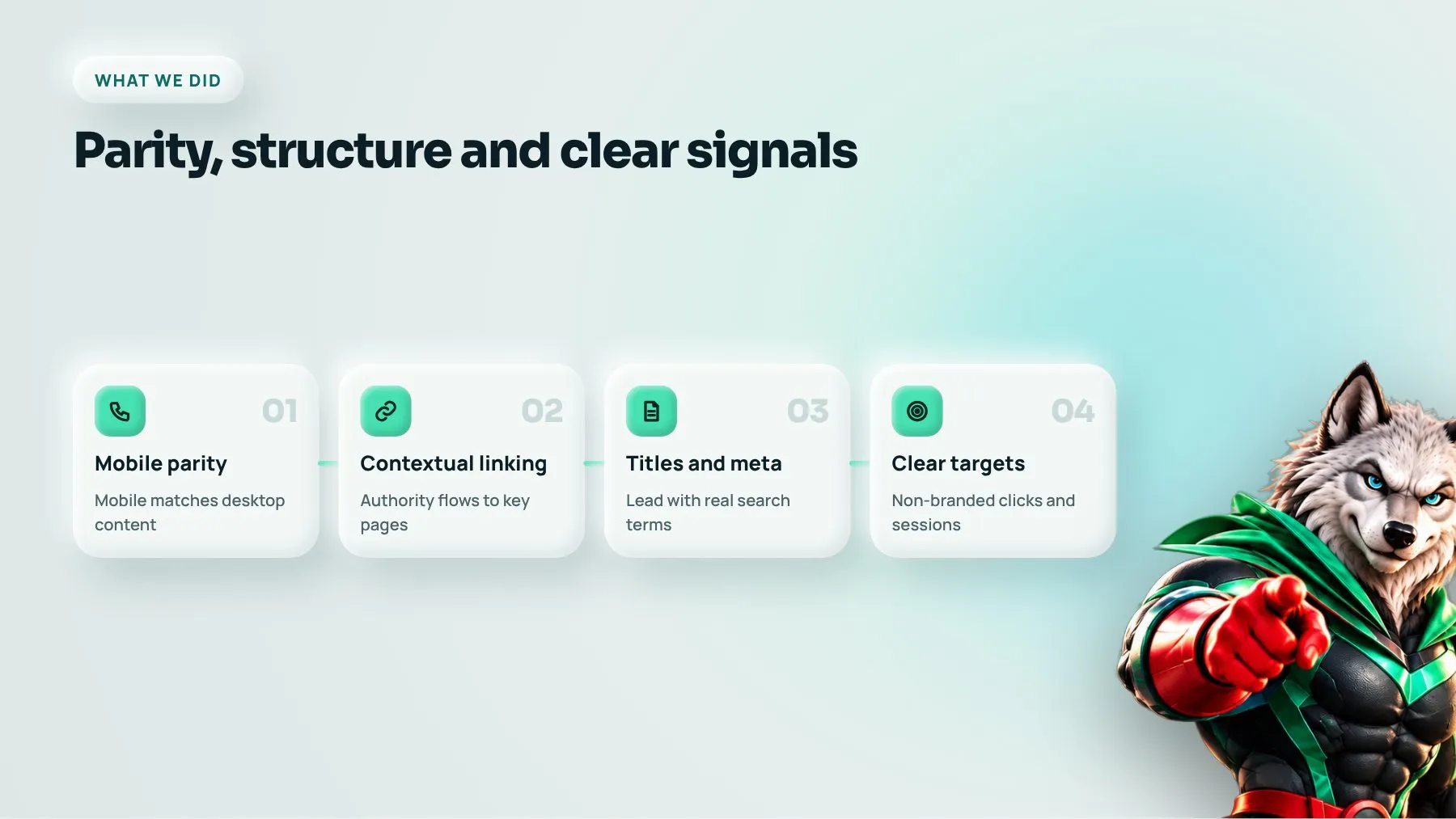
Our approach: parity, structure and clear signals
We addressed the problems in the order that would unlock the most value fastest.
Making the site properly mobile-friendly
We brought the mobile experience into line with desktop so that the content, headings, internal links and structured information Google saw on mobile matched what we wanted ranked. That meant checking that key content was not hidden or stripped on smaller screens, that navigation exposed the important sections, and that pages were usable with a thumb on a small display. Fixing parity is often the single biggest technical win for a site that has drifted, because it makes everything else Google evaluates more accurate.
Contextual internal linking
We rebuilt internal linking around relevance. In practice that meant:
- Linking from content to the most relevant route, destination or service page, with anchor text that describes the destination page naturally
- Making sure high-value pages were reachable within a few clicks from the homepage and from related sections
- Connecting related pages, such as different transport options for the same destination, so users and search engines could move between them
- Removing or replacing links that pointed to low-value or redundant pages
Done well, contextual linking helps Google understand topical relationships across the site and sends authority to the pages that earn bookings.
Header, title and meta tag optimization
Finally, we optimized page titles, meta descriptions and header tags. Titles were rewritten to lead with the search terms people actually use and to stay readable in search results. Meta descriptions were written to earn the click, highlighting what the page offers such as live prices or availability. Header tags were restructured so each page had a clear, logical hierarchy. These are basic elements, but on a site with many similar pages, getting them distinct and specific is what separates pages that rank from pages that compete with each other.
The results: targets beaten on both fronts
- 133% increase in keywords ranking in position #1. Top position captures a disproportionate share of clicks, so more number-one rankings translate directly into more visibility for high-intent travel queries.
- 20% increase in non-branded clicks, double the 10% target. These are people who did not search for the brand by name. Every one is a new potential customer found through search.
- 14% increase in organic sessions, ahead of the 10% target. More sessions means more opportunities to book, without paying for each visit.
For a travel business, non-branded growth is the metric that signals real market share gains. Branded traffic tells you how many people already know you; non-branded traffic tells you how many new travelers you are winning.
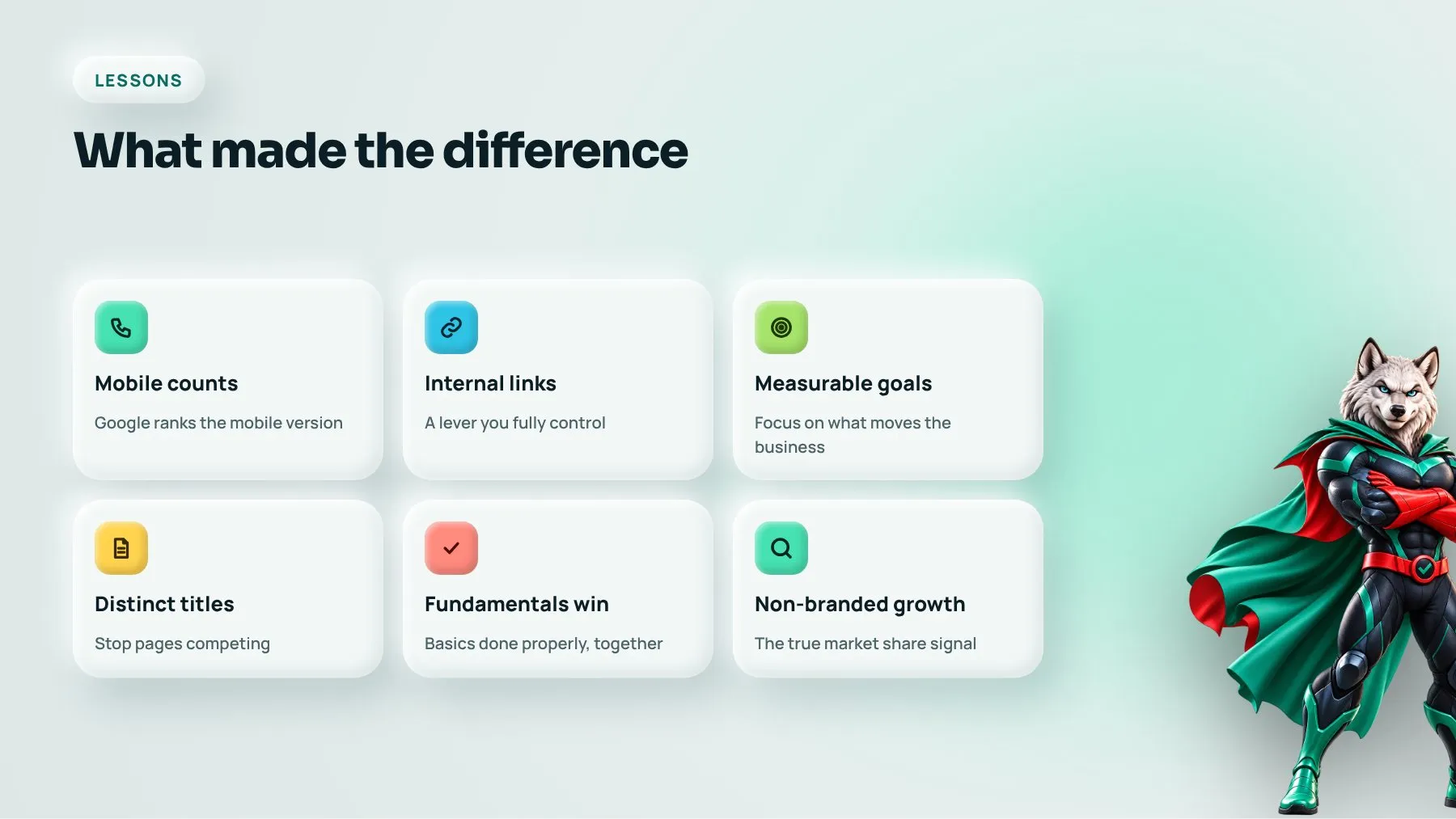
Lessons for travel and booking businesses
- Mobile is the version that counts. If your mobile site is a lighter copy of desktop, Google is ranking the lighter copy.
- Internal links are a ranking lever you fully control. You do not need new backlinks to move authority to your most important pages.
- Set specific, measurable goals. Clear targets for non-branded clicks and sessions kept the work focused on what moves the business.
- Distinct titles and headers prevent self-competition. Sites with many similar pages need each page to say clearly what makes it different.
- Fundamentals still win. None of these fixes were exotic, but done properly together they outperformed the targets.
How to apply this to your business
- Compare a key page on desktop and mobile. Is the content, linking and heading structure the same?
- Map your most valuable pages and count how many clicks they are from the homepage.
- Review internal links on your top content: do they point to the pages you want to rank?
- Check for duplicate or near-duplicate title tags across similar pages.
- Separate branded and non-branded clicks in Google Search Console and track both.
FAQ
How quickly can SEO improve a travel website?
Technical fixes such as mobile parity and internal linking can show results within a few months, as they did here, because they help Google better understand pages that already exist. Building rankings for new, highly competitive terms usually takes longer, often six months or more.
What is the difference between branded and non-branded traffic?
Branded traffic comes from people searching for your company name. Non-branded traffic comes from searches for what you offer, such as a route or fare. Non-branded growth is usually the better indicator that SEO is bringing in new customers.
Does internal linking really affect rankings?
Yes. Internal links help search engines discover pages, understand how they relate to each other and judge which are most important. On large sites, improving internal linking is often one of the fastest ways to lift rankings without new content or backlinks.
Want more non-branded traffic for your travel or booking platform? See our SEO services, browse more case studies or book a strategy call.