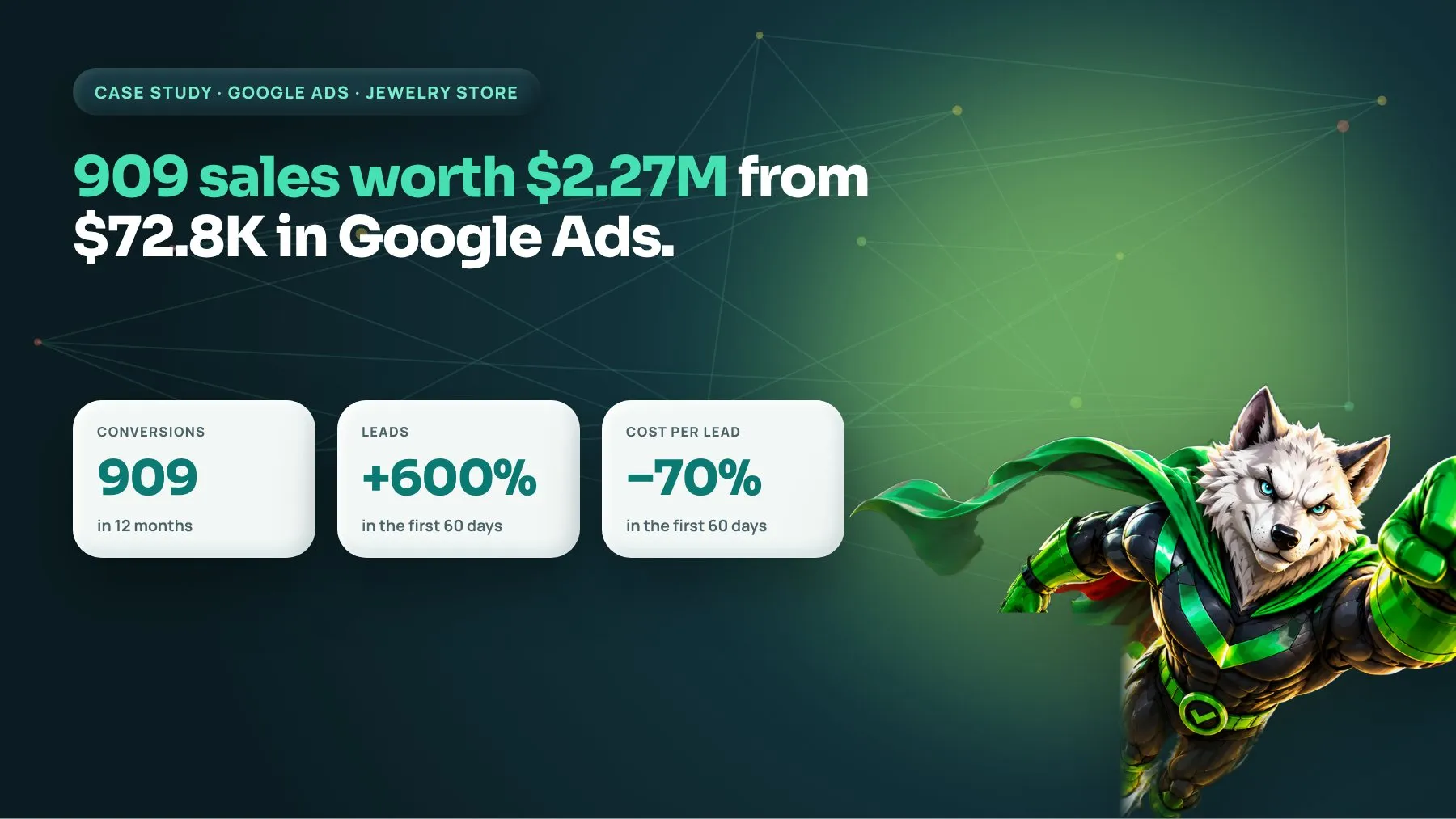
A jewelry store targeting customers within a 50-mile radius was spending heavily on Google Ads with little to show for it. We rebuilt the account around controlled bidding, dedicated landing pages, negative keywords and retargeting. In the first 60 days leads rose 600% and cost per lead fell 70%; over 12 months, $72.8K in ad spend produced 909 sales worth $2,272,500.
At a glance
- Client: Local jewelry store, targeting customers within a 50-mile radius
- Services: Google Ads management, landing page design, display retargeting
- Timeframe: 12 months
- Key results: 600% more leads and 70% lower cost per lead in the first 60 days; about 100 high-quality calls a month at a cost per lead of $80; $72.8K spent, 909 conversions at an average sale value of $2,500, for $2,272,500 in total sales
The challenge: a healthy budget burned in a few clicks
The store had a healthy budget of around $5,000 a month, but the money was not working. A $200 budget allocation could be spent in just a handful of clicks because the cost per click was extremely high. And the clicks it did buy landed on the homepage, which was not built for paid traffic.
That is a costly combination for a jeweler. Jewelry is a high-value, emotional purchase: engagement rings, anniversary gifts, custom pieces. Buyers research carefully and want to trust the seller before they visit or call. Keywords in this space are competitive, so clicks are expensive. When an expensive click lands on a generic homepage with no clear next step, the visitor leaves and the money is gone.
The store needed to pay less for each click, attract better-qualified visitors and turn more of them into calls and store visits.
What we did
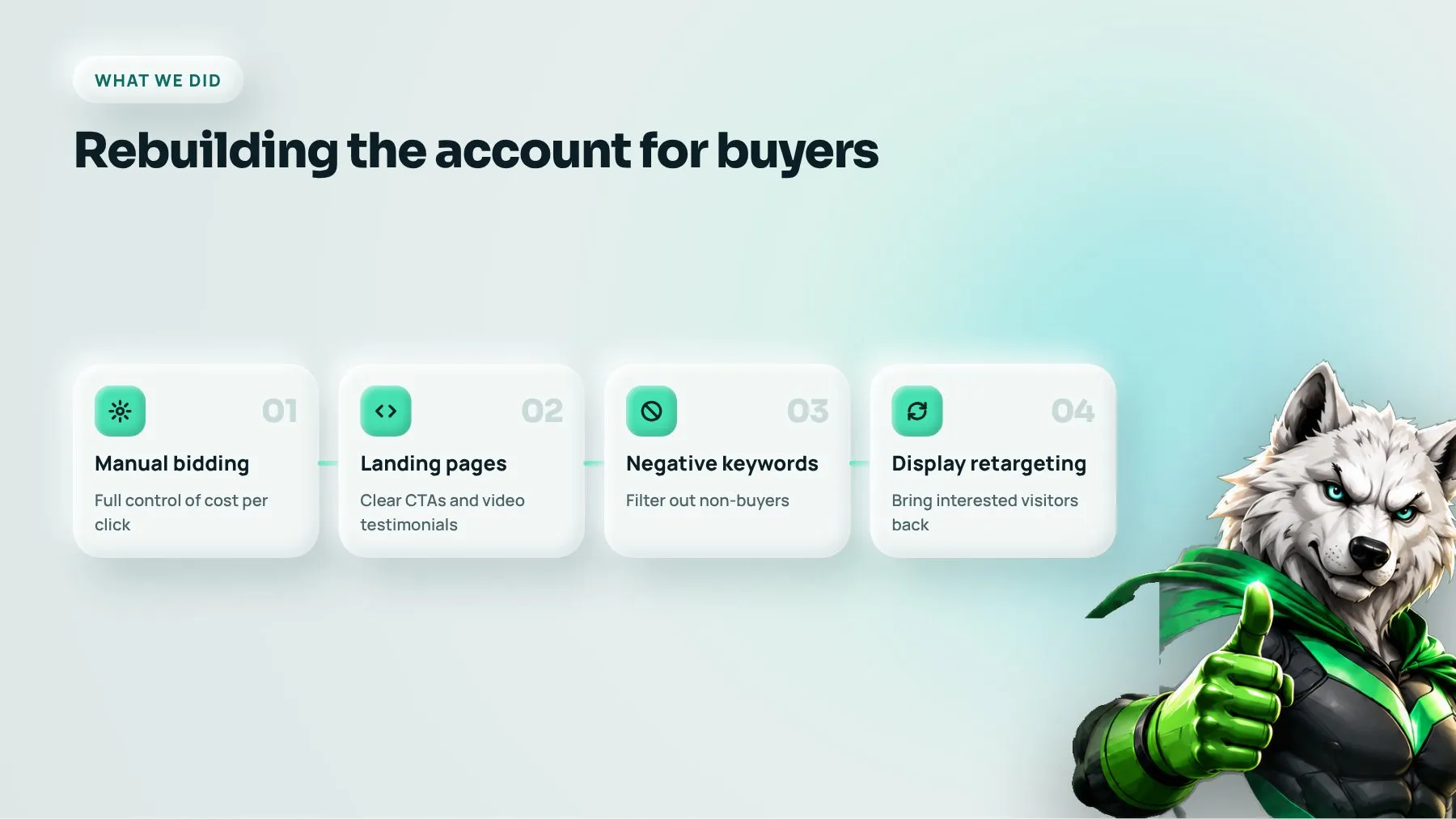
Manual bidding for full control of cost per click
We set up a manual bidding strategy so we had full control over what the store paid per click. Automated bidding can work well once an account has plenty of reliable conversion data, but in an account that was overpaying and not converting, it tends to chase expensive clicks.
Manual control let us set sensible bids by keyword, cut bids on terms that drew clicks but no enquiries, and put more budget behind the searches that brought in buyers. In jewelry, that usually means favoring specific, purchase-ready searches (a type of ring, a metal, a stone, “near me” style searches) over broad, browsing terms.
High-converting landing pages
We replaced the homepage with dedicated landing pages built for paid traffic. Each page had a single focus and a clear call to action, such as calling the store or booking a visit, with buttons placed where visitors could see them without scrolling.
We added video testimonials from happy customers. For a high-value purchase, hearing real buyers talk about their experience is one of the strongest trust builders there is, far more persuasive than claims from the store itself. Good jewelry landing pages also show the pieces clearly with quality photos, explain what makes the store different (craftsmanship, custom design, after-sale service), and make the store’s location easy to find for local buyers.
A negative keyword list to improve traffic quality
We built a negative keyword list so the ads stopped showing for searches that would never turn into sales. In jewelry, typical themes to exclude include jobs and careers, DIY and craft supplies, cheap costume or fashion jewelry if the store sells fine pieces, repairs or services the store does not offer, and informational searches such as how to clean jewelry. Every irrelevant click blocked is budget that can go to a real buyer.
Display retargeting for interested visitors
Most jewelry buyers do not purchase on the first visit. We ran a display retargeting campaign that showed ads to people who had visited the website and shown interest but had not converted. Retargeting keeps the store in mind while the buyer compares options, talks it over with a partner or waits for the right occasion, and it usually converts at a lower cost than reaching new people.
Local targeting within 50 miles
The campaigns targeted people within a 50-mile radius of the store, where customers could realistically visit. That kept spend focused on buyers who could actually come in, rather than paying for clicks from people too far away to buy.
The results
In the first 60 days:
- Leads up 600%. The same kind of budget now produced many more enquiries.
- Cost per lead down 70%. Each lead cost a fraction of what it did before.
Ongoing: the account now brings in an average of about 100 high-quality calls a month at a cost per lead of $80.
Over 12 months:
- Amount spent: $72.8K
- Total conversions: 909
- Average sale value: $2,500
- Total sale value: $2,272,500
Put simply, every dollar of ad spend was matched by many dollars in sales. For a jeweler, an $80 lead that can turn into a $2,500 sale is a very healthy trade.
What made the difference: lessons for jewelry retailers
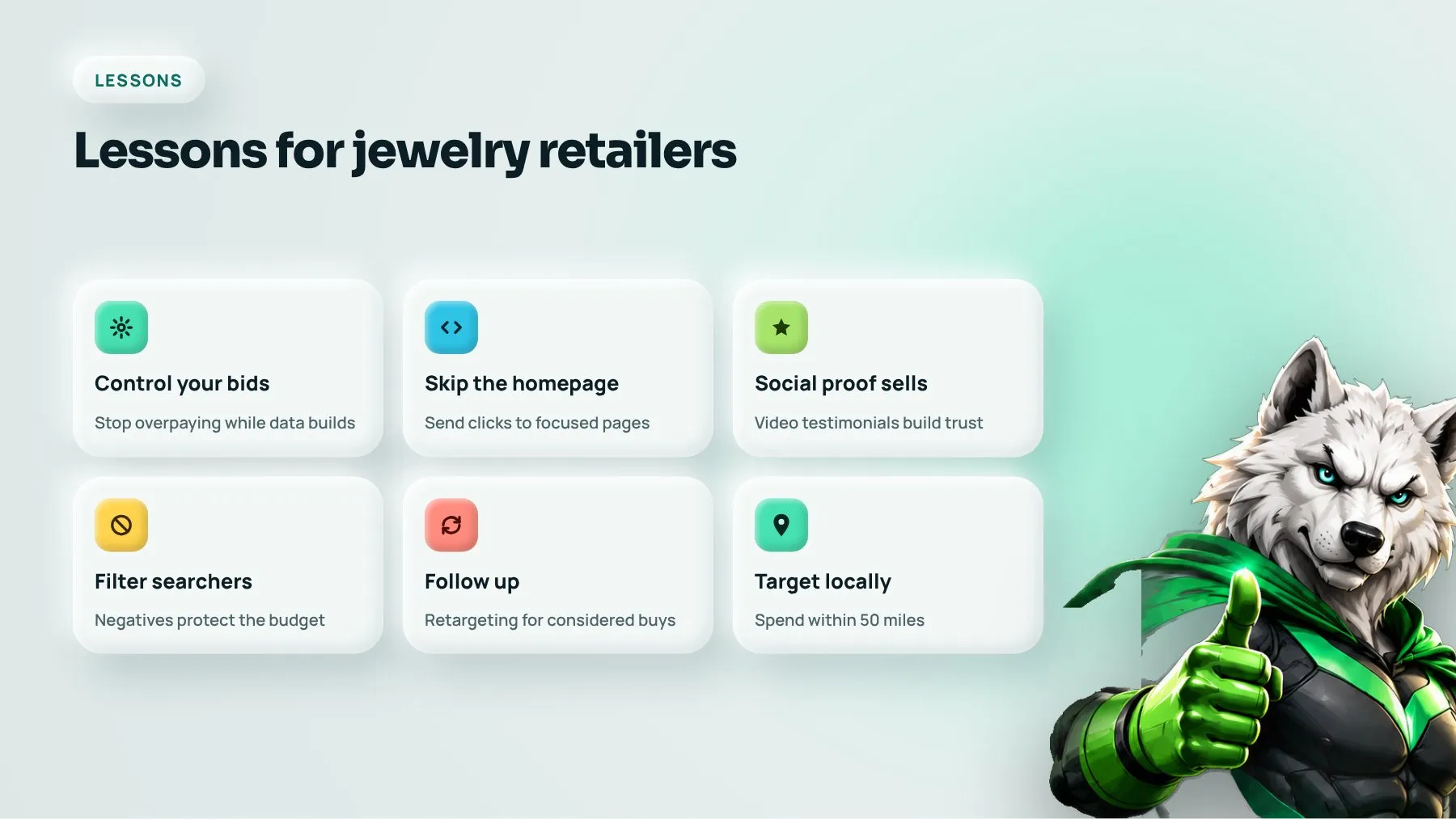
- Control your bids when data is thin. Manual bidding stopped the account overpaying while we learned what worked.
- Never send paid clicks to a generic homepage. A focused landing page with a clear call to action converts far better.
- Social proof sells high-value items. Video testimonials from real customers build trust that copy cannot.
- Filter out the wrong searchers. Negative keywords protect a budget that would otherwise go to people who will never buy.
- Follow up with retargeting. Considered purchases need reminders; retargeting brings interested buyers back.
How to apply this to your jewelry business
- Check where your ads send people; if it is your homepage, build a dedicated page.
- Collect short video testimonials from happy customers.
- Review your search terms report and add negatives for irrelevant themes.
- Set your location targeting to the area your customers actually travel from.
- Set up retargeting for people who viewed products but did not enquire.
- Track calls and form enquiries as conversions so you know your real cost per lead.
See how we manage accounts like this on our Google Ads management page, or explore more case studies.
FAQ
Is Google Ads good for jewelry stores?
Yes, when it is managed tightly. Jewelry searches are competitive and clicks can be expensive, so success depends on good keyword control, strong landing pages and accurate conversion tracking.
Should I use manual or automated bidding?
Automated bidding works best when an account has plenty of reliable conversion data. If your account is new, overpaying or poorly tracked, manual bidding gives you control while you build that data. Many accounts move to automated strategies later.
What makes a good landing page for jewelry?
A clear focus, quality images of the pieces, social proof such as video testimonials, a visible call to action and easy-to-find store details. It should match exactly what the ad promised.
Want your ad budget to bring in buyers, not just clicks? See our Google Ads management or book a strategy call.