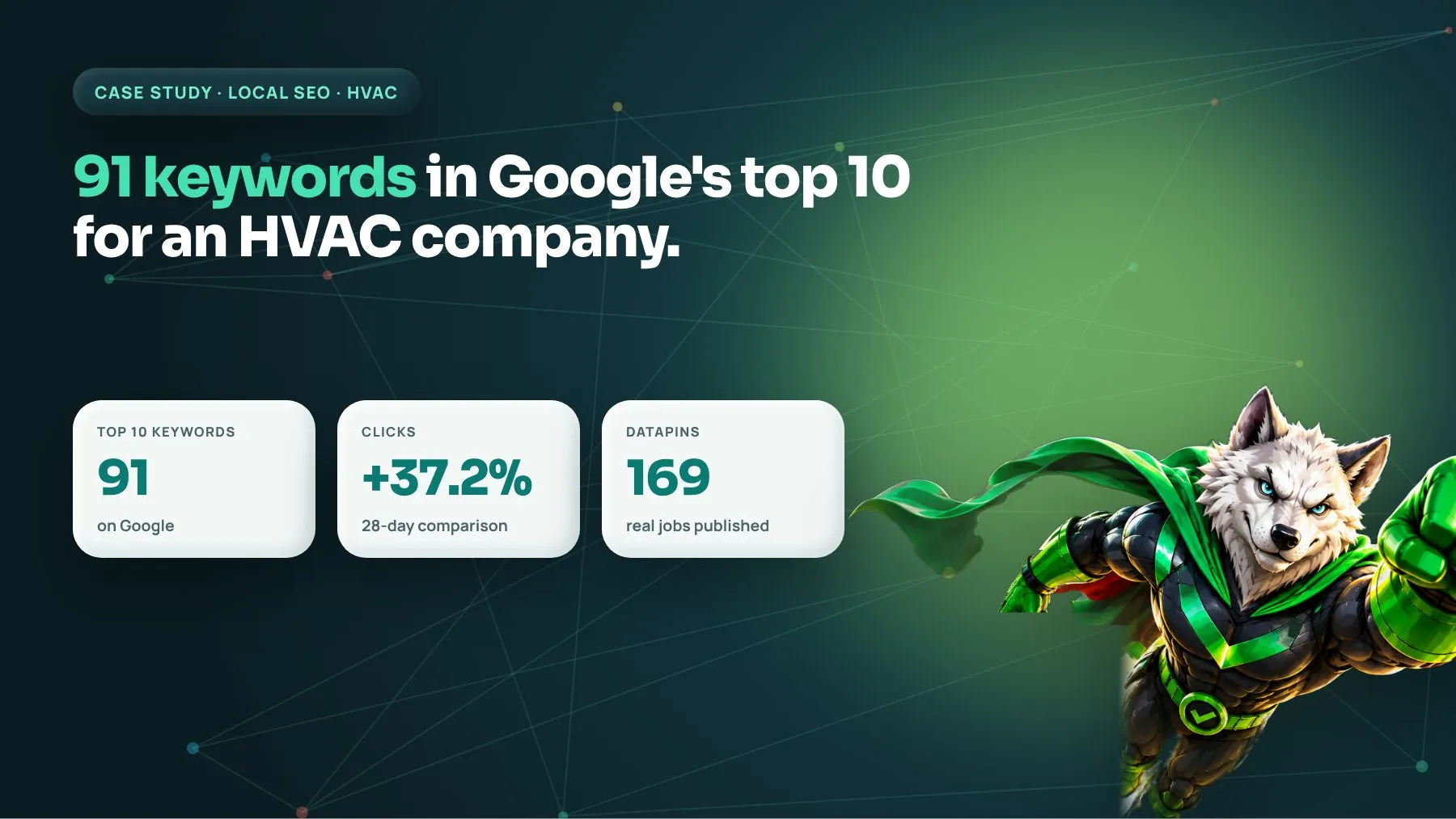
Total Comfort Cooling & Heating, a heating and air conditioning company, has seen steady growth in its organic presence since working with us. In a single month, monthly organic clicks rose from 342 to 426, a 26% increase, and the business now has 91 keywords ranking in Google’s top 10.
At a glance
- Client: Total Comfort Cooling & Heating (HVAC contractor)
- Services: SEO, keyword research, content, Google Business Profile optimization, website design and optimization, user experience, local SEO with DataPins and schema markup
- Key results: monthly organic clicks up from 342 to 426 (+26%); 91 keywords in the Google top 10; over 1,000 keywords indexed in Google Search Console; clicks +37.2% and impressions +14.8% over 28 days; users +24.5% and new users +26.9% over 30 days; 169 DataPins published
The challenge: winning local searches in a crowded, urgent market
HVAC is a classic local service business. When an air conditioner fails in summer or a furnace stops in winter, the homeowner grabs their phone, searches for help nearby and calls one of the first companies they see. Those searches are urgent and valuable, and every HVAC contractor in the area wants them.
That creates two problems for a company like Total Comfort. First, competition is intense, both from other local contractors and from lead-generation directories that sit above them in the results. Second, Google needs strong proof that a business genuinely serves a particular area before it ranks it in the local results and map pack. A contractor’s website that only says “we serve the region” rarely ranks well for the many specific town and service combinations people actually search.
The goal was consistent, compounding growth in organic visibility across the services and areas that bring in paying jobs.
What we did
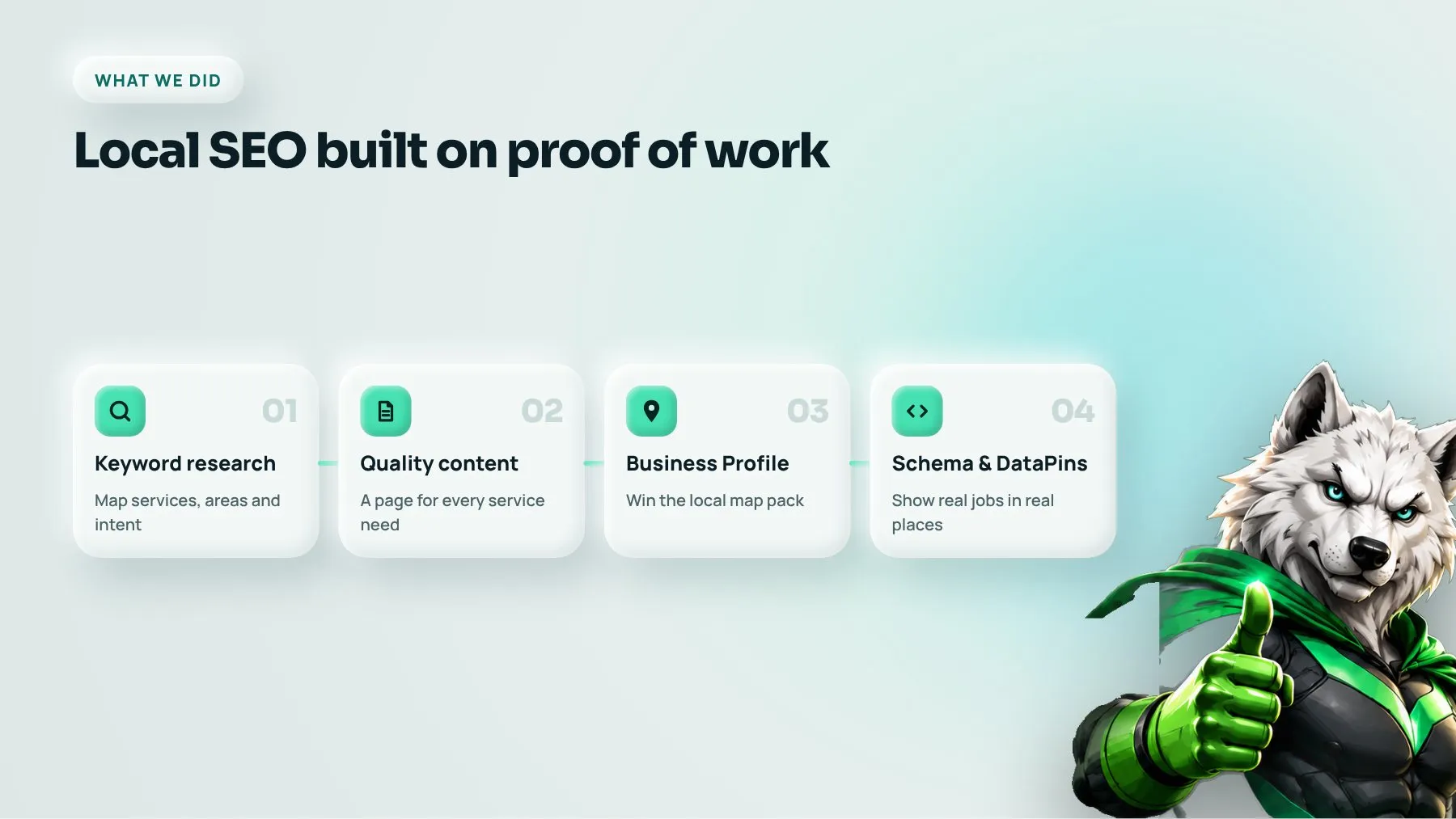
High-level keyword research
We mapped the full range of searches a homeowner might use: emergency repair terms, installation and replacement terms, maintenance plans, specific equipment types and the towns and neighborhoods served. We grouped them by intent, because a person searching “AC not cooling” needs a different page from someone researching a new heat pump. This research shaped every page and piece of content that followed.
High-quality content
With the keyword map in place, we created and improved content to match. That means dedicated service pages for each core service, location-relevant content for the areas served, and helpful articles that answer common homeowner questions. Each page targets a clear topic, links to related services and ends with an obvious way to book or call. Helpful content also earns visibility in AI-generated search answers, where homeowners increasingly start their research.
Google Business Profile optimization
For local searches, the Google Business Profile is often the first thing a customer sees. We set accurate primary and secondary categories for heating and cooling services, listed services in detail, kept name, address and phone consistent everywhere, added photos of real work and kept the profile active with posts and review responses. These are the signals that decide who appears in the map pack.
Website design, optimization and user experience
A ranking only pays if the visitor calls. We optimized the website for speed and mobile use, since most emergency searches happen on a phone. Click-to-call buttons, clear service menus, visible service areas and short contact forms make it easy to act. Better user experience also tends to support rankings, because visitors who find what they need stay and engage.
Search engine optimization
Alongside the content, we handled the technical and on-page fundamentals: title tags and meta descriptions written for the searches that matter, clean heading structure, internal links that guide authority to key service pages, fixed crawl and indexing issues and a tidy sitemap.
DataPins local SEO tool with schema markup
This was a distinctive part of the program. DataPins lets technicians “pin” completed jobs from the field, creating a record of real work in real locations that is published on the website with schema markup. Schema is structured data that tells search engines exactly what something is, in this case a service carried out at a particular place.
For an HVAC company, this is powerful proof of service area. Instead of simply claiming to serve a town, the website shows genuine jobs completed there, which supports both local rankings and customer trust. By the time of this report, the business had published 169 pins.
The results
Rankings
- 91 keywords ranking in Google’s top 10.
- Google Search Console shows over 1,000 keywords indexed for the site.
Google Search Console (28-day comparison)
- Clicks increased by 37.2%.
- Impressions increased by 14.8%.
Google Analytics (last 30 days)
- Users increased by 24.5%.
- New users increased by 26.9%.
DataPins usage
- Total pins: 169.
Month-on-month clicks
- Monthly organic clicks grew from 342 to 426, a 26% increase.
The pattern here matters more than any single figure. Clicks grew faster than impressions, which suggests the site was not just appearing more often but appearing in better positions and with more compelling listings. New users grew strongly too, meaning the business was reaching homeowners who had not found it before. And with over 1,000 keywords indexed, the site has a broad base to keep building on.
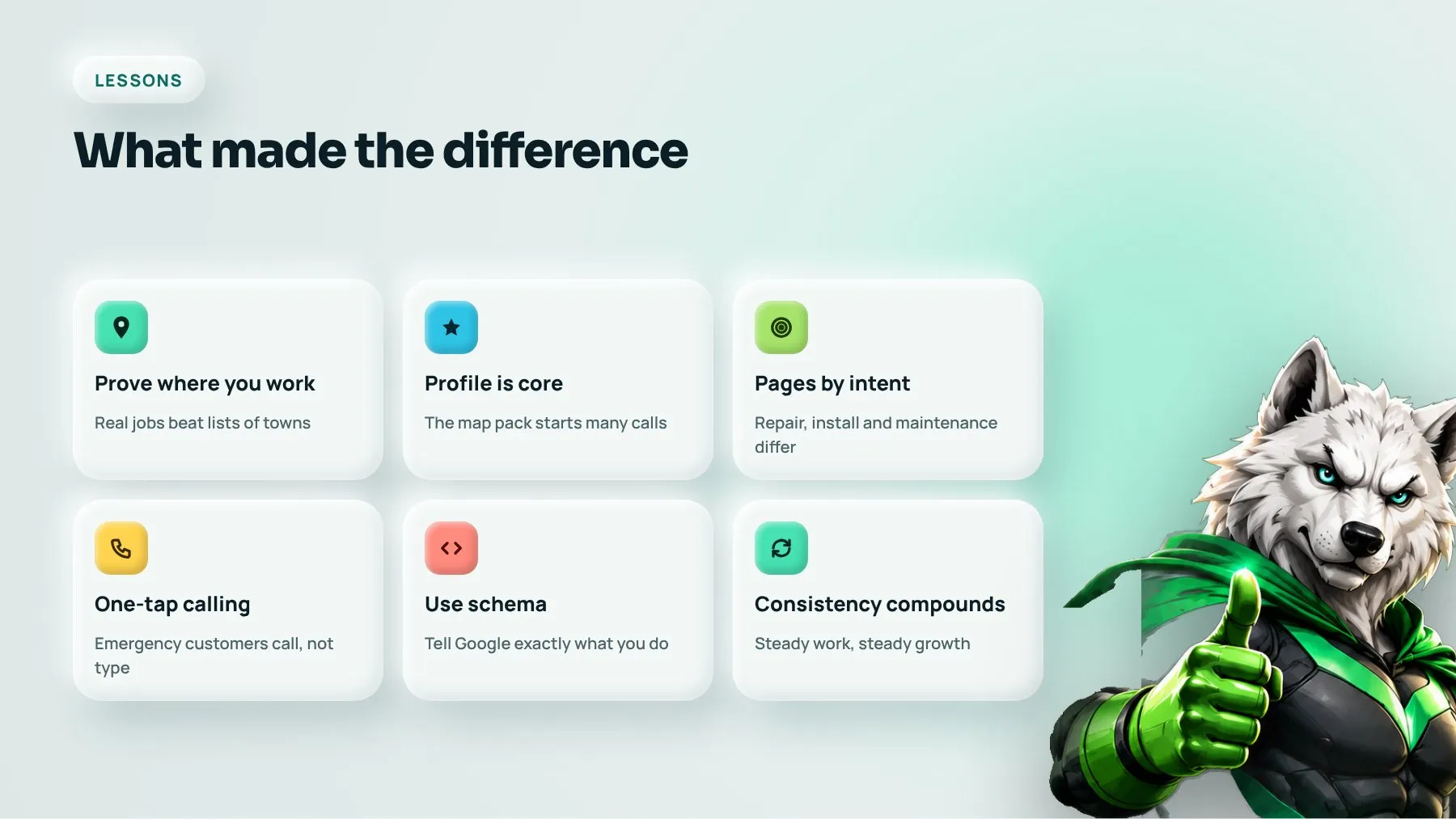
What made the difference: lessons for HVAC and home service businesses
- Prove where you work. Showing real completed jobs with schema markup is far more convincing to Google and customers than a list of town names.
- Treat your Google Business Profile as a core asset. For urgent local searches, the map pack is where many calls begin.
- Build pages around intent. Emergency repair, installation and maintenance searchers want different things; give each a page that answers them.
- Make calling effortless on mobile. Emergency customers do not fill in long forms on a phone.
- Consistency compounds. Steady month-on-month work produced steady month-on-month growth.
How to apply this to your business
- List every service you offer and every area you cover, then check you have a page that matches.
- Complete your Google Business Profile, including categories, services and photos.
- Record and publish completed jobs with location detail, using schema markup where possible.
- Test your website on a phone: can a customer call you in one tap?
- Check Google Search Console monthly for clicks, impressions and new keywords.
FAQ
How long does local SEO take for an HVAC company?
Google Business Profile and on-page improvements can start to show within weeks. Stronger rankings across many services and towns usually build over 3–6 months, and keep compounding with consistent work.
What is schema markup and why does it matter?
Schema markup is structured code that describes your content to search engines, such as your business, services and locations. It helps Google understand and trust what your pages are about, which supports local rankings and richer search listings.
Do I still need SEO if I use lead directories?
Directories can fill gaps, but you pay per lead and often share it with competitors. Ranking your own website and profile builds a channel you own, with leads that come to you alone.
Want the same for your home service business? See our SEO services, explore the industries we work with or book a strategy call.