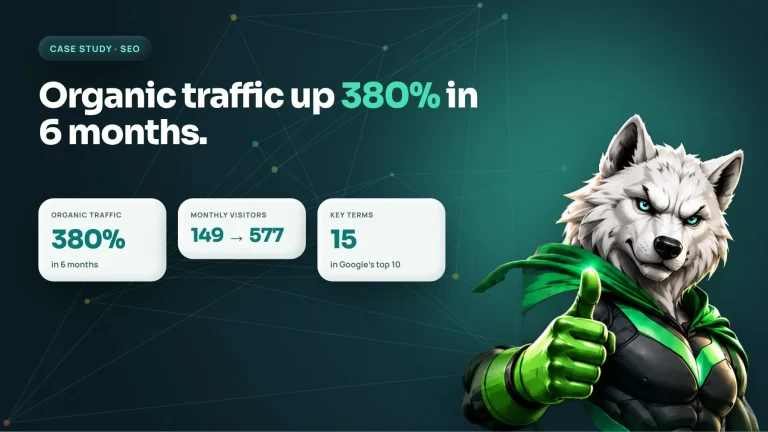
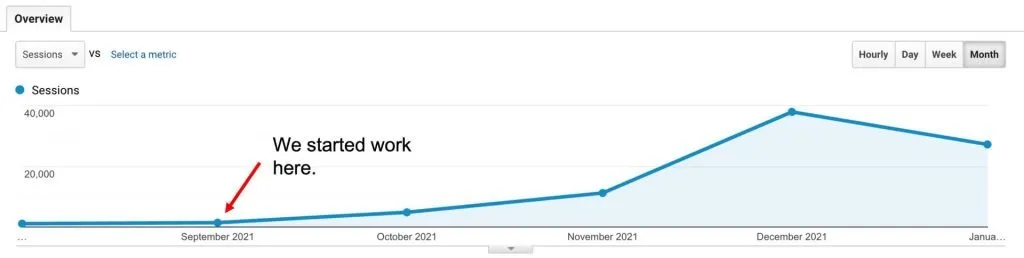
This site started with no organic traffic. Six months later it was receiving 30,000 visits a month from search. There was a lot of work behind that result, and SEO is too complex to reduce to one trick, but three components did most of the heavy lifting: keyword clustering to build topical authority, bulk content creation for publishing velocity, and on-page SEO built around siloed internal linking.

At a glance
- Client: Content website starting from zero organic traffic
- Service: SEO and content marketing
- Timeframe: 6 months
- Scale: 150 prioritized articles across 6 main silos, around 200,000 words in total
- Key result: From 0 to 30,000 visits per month
The challenge: a new site with no authority and no traffic
A new website has no history with Google, no backlinks and no evidence that it knows its subject. Publishing a handful of good articles is rarely enough. Google tends to favor sites that cover a topic thoroughly, so a site with a few scattered posts competes poorly against established sites with deep libraries of related content.
The usual approach, drip-feeding a few articles a month, is slow. At that pace it can take years before a site covers its topic well enough to be treated as an authority, and most businesses cannot wait that long for content to pay off. The challenge was to build that depth quickly, in a way Google would understand and reward.
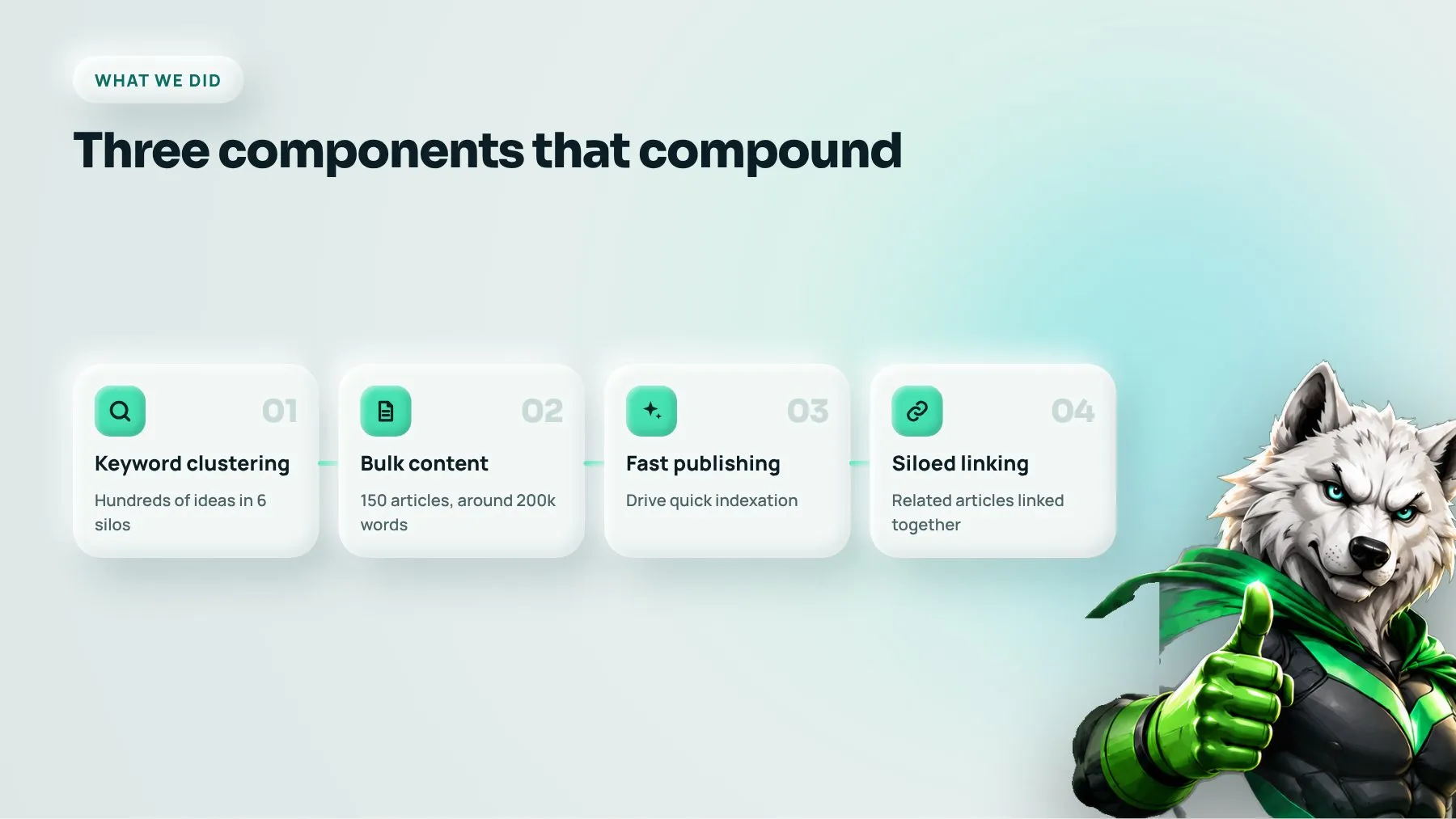
What we did: three components that compound
1. Keyword clustering to build topical authority
Rather than choosing keywords one at a time, we used a keyword clustering process to plan the whole site. Clustering groups keywords that share search intent, often by looking at which searches Google answers with the same results pages. Each cluster becomes one article, and related clusters form a silo: a group of articles covering one theme from every angle.
We used KeyClusters to generate hundreds of article ideas across 6 main silos. From these we prioritized 150 articles based on three factors:
- Keyword volume: how many people search for the topic.
- Difficulty: how hard it is to rank against the current results.
- Relevance: how closely the topic fits the site and its audience.
This gave us a content plan where every article had a clear target and a clear place in the structure, rather than a loose list of blog ideas. Topical authority comes from that completeness: when a site answers the main questions in a subject and connects them sensibly, Google gains confidence that it is a strong source.
2. Bulk content creation for publishing velocity
Next, we ran every planned article through Frase to estimate the word count needed to compete, based on the pages already ranking. Across 150 articles, that added up to about 200,000 words.
That is a lot of content to produce well, but our team produces 1 million words a month, so we have the in-house systems to create content in bulk without letting quality slip. Briefs, writing, editing and optimization run as a production line, with each article checked against its target topic before it goes live.
We then used our publishing system to push content out quickly and drive fast indexation. Speed matters. Drip-feeding a few articles a month means waiting years for a site to reach critical mass; publishing the core library in a short period lets Google see the full depth of coverage much sooner. The faster you publish, the quicker you rank, provided the content is genuinely useful.
3. On-page SEO built around siloed internal linking
Our on-page process focused on the 20% of factors that deliver 80% of the results:
- URL slug targeting the primary keyword.
- Header title and meta title targeting the primary keyword.
- Headers (H2, H3) structured hierarchically and targeting keyword variations.
- Images every 250 to 350 words, with alt text using keyword variations.
- External links to authoritative, non-competing sources.
- Internal links to other articles in the same silo, using exact or close-match anchor text.
Internal linking within a silo deserves special attention. Linking related articles to each other with descriptive anchor text signals to Google what each article is about and how the topics fit together. It also helps with indexation, because crawlers follow those links to discover new pages. And once the site starts earning backlinks, that authority flows through the internal links to help every article in the silo rank, not just the one that received the link.
The results: 0 to 30,000 visits a month in 6 months
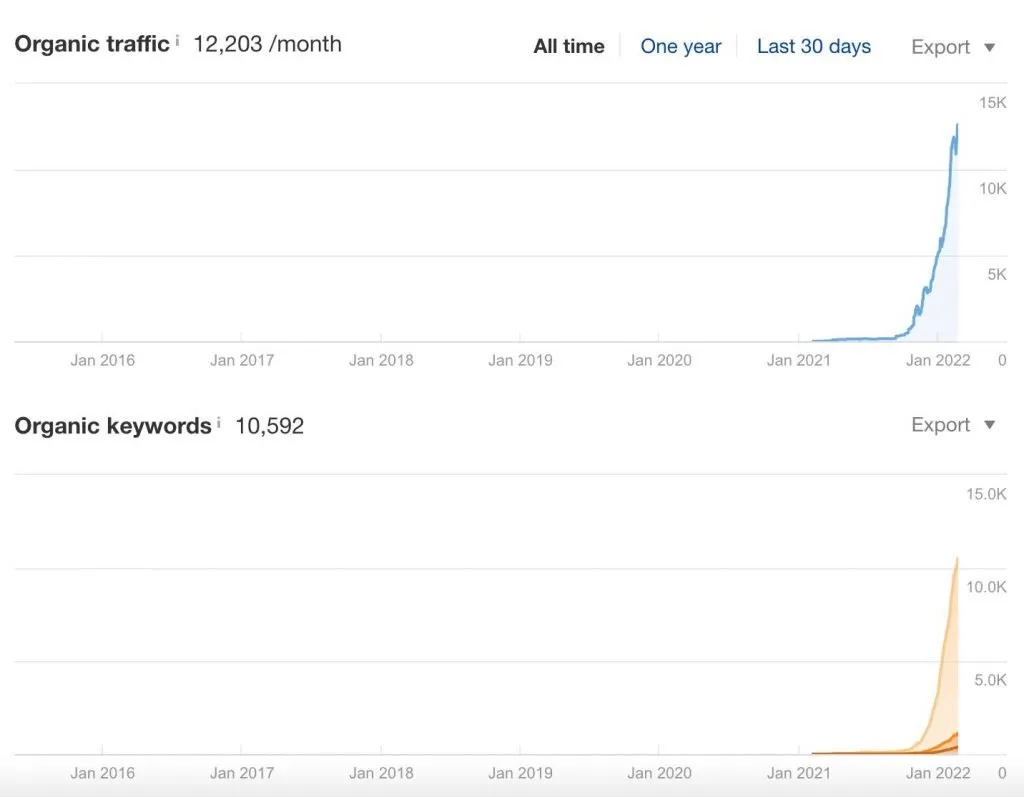
- Organic traffic grew from 0 to 30,000 visits per month in 6 months
- 150 articles published across 6 silos, about 200,000 words
The analytics and keyword data show a steady upward curve rather than a single spike, which is what you want from content SEO. Each new article added more searches the site could appear for, and the internal links helped new articles benefit from the authority of existing ones. Traffic built on this kind of foundation tends to be durable, because it rests on broad coverage of a topic rather than one or two lucky rankings.
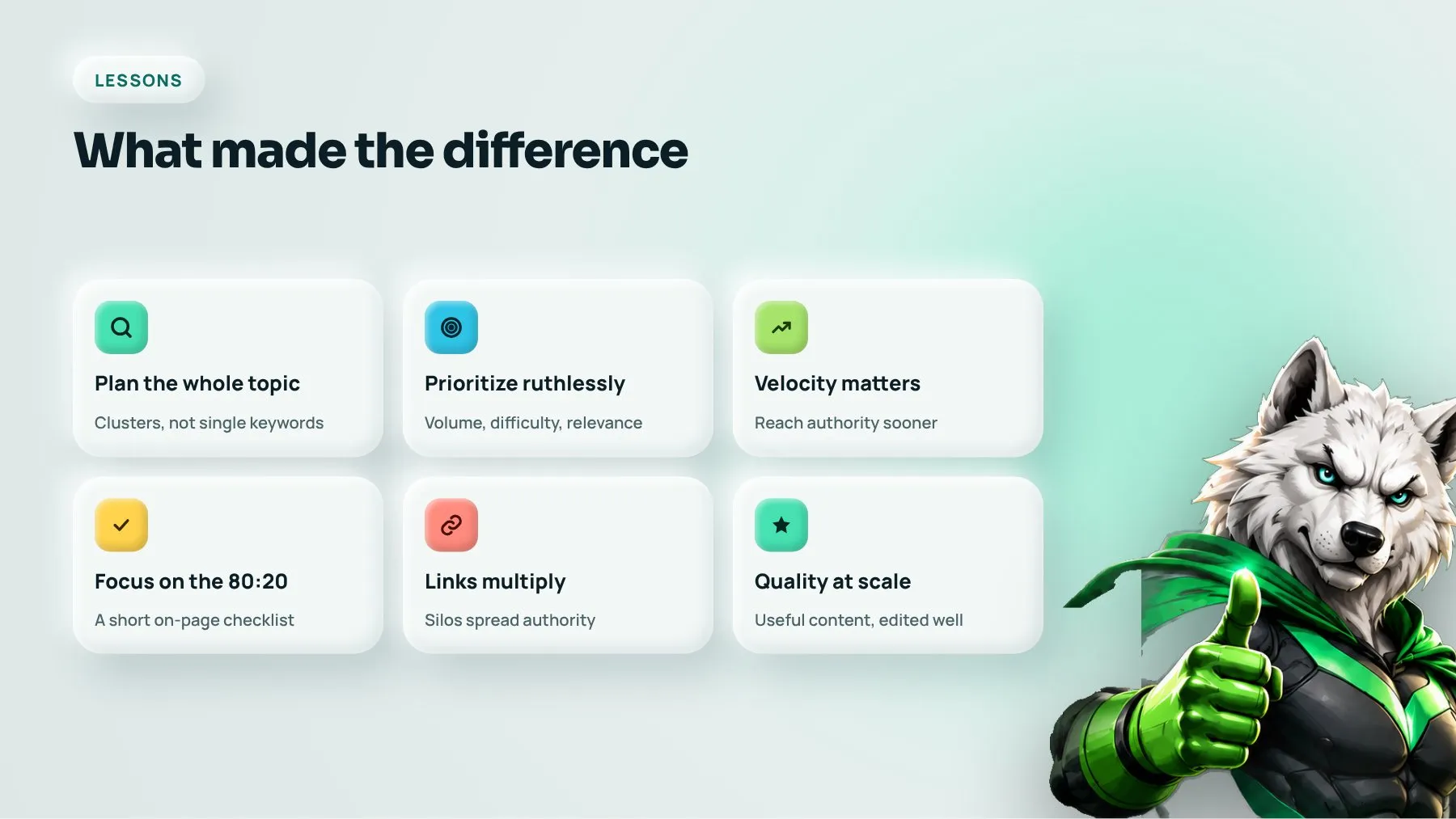
What made the difference: lessons for content-led growth
- Plan the whole topic, not single keywords. Clustering turns a list of keywords into a structure Google can understand.
- Prioritize ruthlessly. Volume, difficulty and relevance decide what gets written first.
- Velocity matters. Publishing a full library quickly gets you to authority far sooner than drip-feeding.
- Focus on the on-page factors that matter most. A short, consistent checklist beats chasing every minor signal.
- Internal links are the multiplier. Silos linked with clear anchors spread authority across the site.
How to apply this to your business
- Group your keywords into clusters by search intent.
- Organize clusters into a small number of themed silos.
- Prioritize articles by volume, difficulty and relevance.
- Set a realistic but fast publishing schedule for the core library.
- Use a consistent on-page checklist for every article.
- Link every new article to related articles in the same silo.

FAQ
Does publishing lots of content quickly risk a Google penalty?
Volume itself is not the problem; low-quality or unhelpful content is. Publishing quickly works when every article is genuinely useful and edited properly.
What is topical authority?
It is the confidence search engines have that your site covers a subject thoroughly. You build it by answering the main questions in a topic and linking related content clearly. It also helps your content get cited in AI answers, which is the focus of generative engine optimization.
How long does content SEO take to produce traffic?
New sites usually need several months before content gains traction. A well-planned, fast publishing schedule shortens that wait, as this six-month result shows.
Ready to grow traffic with content that ranks? See our SEO services, browse more case studies, or book a strategy call.