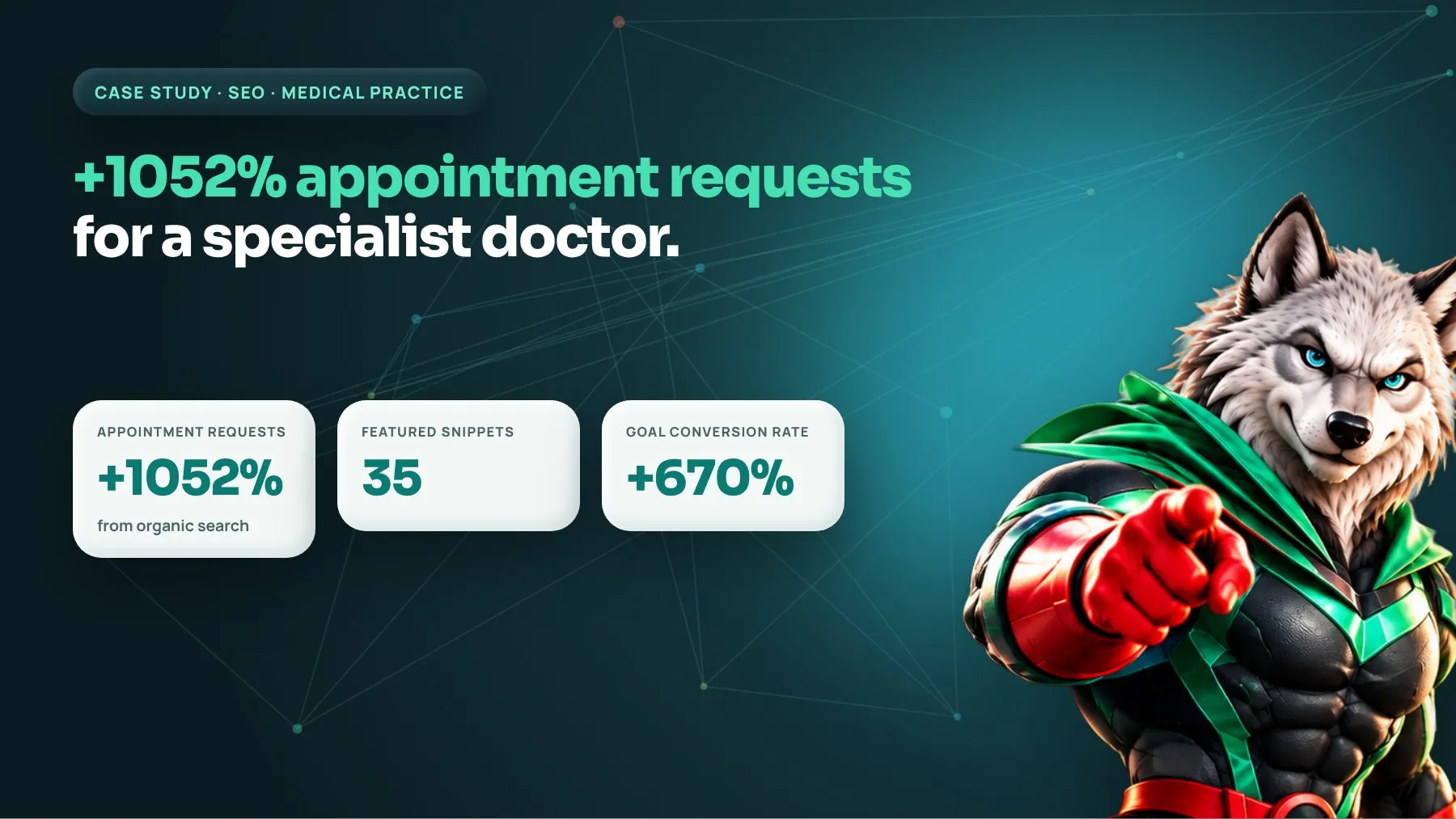
A doctor wanted to build brand awareness, share useful medical information about their specialty, and turn more of their website visitors into patients. We built a content-led SEO strategy around the questions patients actually ask. Appointment requests rose by 1052%, alongside 35 featured snippets, 120 People Also Ask placements and large gains in first-page rankings.
At a glance
- Client: Medical doctor (specialist practice)
- Services: SEO, content strategy, content refresh
- Key results: +1052% appointment requests; +670% goal conversion rate; +834% goal completions; +102% keywords in position #1; +129% front-page keywords; 35 featured snippets; 120 People Also Ask links
The challenge: being the trusted answer, not just another clinic
The doctor’s goals were broader than “rank higher”. They wanted three things at once:
- Brand awareness, so local patients recognized the practice.
- Useful medical information, so the website genuinely helped people understand their symptoms and options.
- More conversions and better rankings, so that awareness turned into booked appointments.
These goals fit together well, but only with the right approach. Health searches are some of the most closely judged by Google. Medical content falls under what Google calls “Your Money or Your Life” topics, where accuracy, expertise and trustworthiness are weighed heavily. Thin, generic articles do not rank, and they do not persuade patients either. Meanwhile, large health publishers and hospital systems dominate many informational searches.
A specialist practice wins by being more specific, more timely and more useful for the people in its area and field.
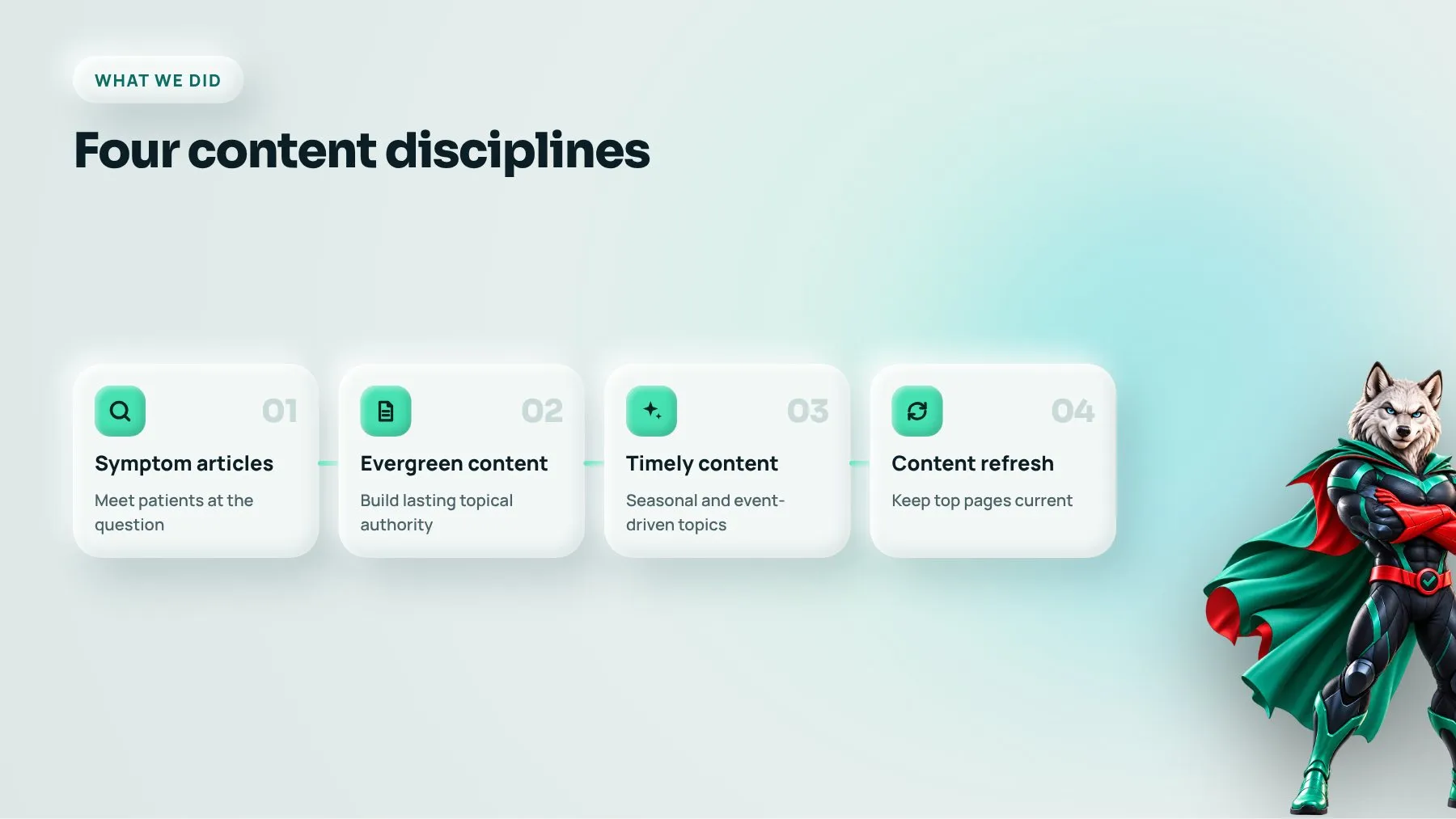
Our strategy: four content disciplines
1. Articles that meet patients at the symptom
Most patients do not search for a doctor first. They search for what they are experiencing. We created relevant articles designed to quickly capture the interest of people experiencing various symptoms: clear titles, a direct answer near the top, then the detail, and finally a sensible next step, which is often booking an appointment.
This structure matters for two reasons. It serves the reader, who wants an answer quickly. And it is exactly the format Google pulls into featured snippets and People Also Ask boxes, where a concise, well-structured answer to a specific question can appear above every other result.
2. Evergreen content that keeps working
We enriched the website with timeless articles relevant to the doctor’s field: explanations of common conditions, treatments and what to expect from care. Evergreen content builds topical authority over time. Each piece supports the others through internal links, and together they show search engines that the practice covers its specialty thoroughly. They also keep attracting visitors long after they are published.
3. Timely content that matches what people are worried about now
Patient concerns shift through the year. We stayed on top of trends and published quickly when demand appeared, covering topics such as allergy seasons, temperature changes, back-to-school, and smoke inhalation from fires.
Seasonal and event-driven content has a short window of very high interest. A practice that publishes a clear, trustworthy answer at the right moment can rank quickly, reach people who have never heard of it, and earn lasting brand recognition. Planning a seasonal calendar in advance, and being ready to react when something unexpected happens, is what makes this work.
4. Refreshing high performers
The final discipline is the one most practices neglect. We continuously refreshed high-performing content to protect rankings and keep the information current. That means updating guidance, improving clarity, adding answers to new questions that searchers are asking, and tightening the structure so the page stays the best result. In medicine especially, out-of-date content is both an SEO risk and a trust risk.
The results
- Appointment requests up 1052%. This is the number that matters most to a practice: many more people asking to be seen.
- Goal conversion rate up 670% and goal completions up 834%. More of the visitors arriving on the site took the action the practice wanted, not just more visitors overall.
- Keywords in position #1 up 102%, front-page keywords up 129%. The practice became far more visible for the searches that matter.
- 35 featured snippets and 120 People Also Ask links. The doctor’s content was repeatedly chosen as the answer Google shows at the top of the page, which builds the brand recognition the doctor wanted in the first place.
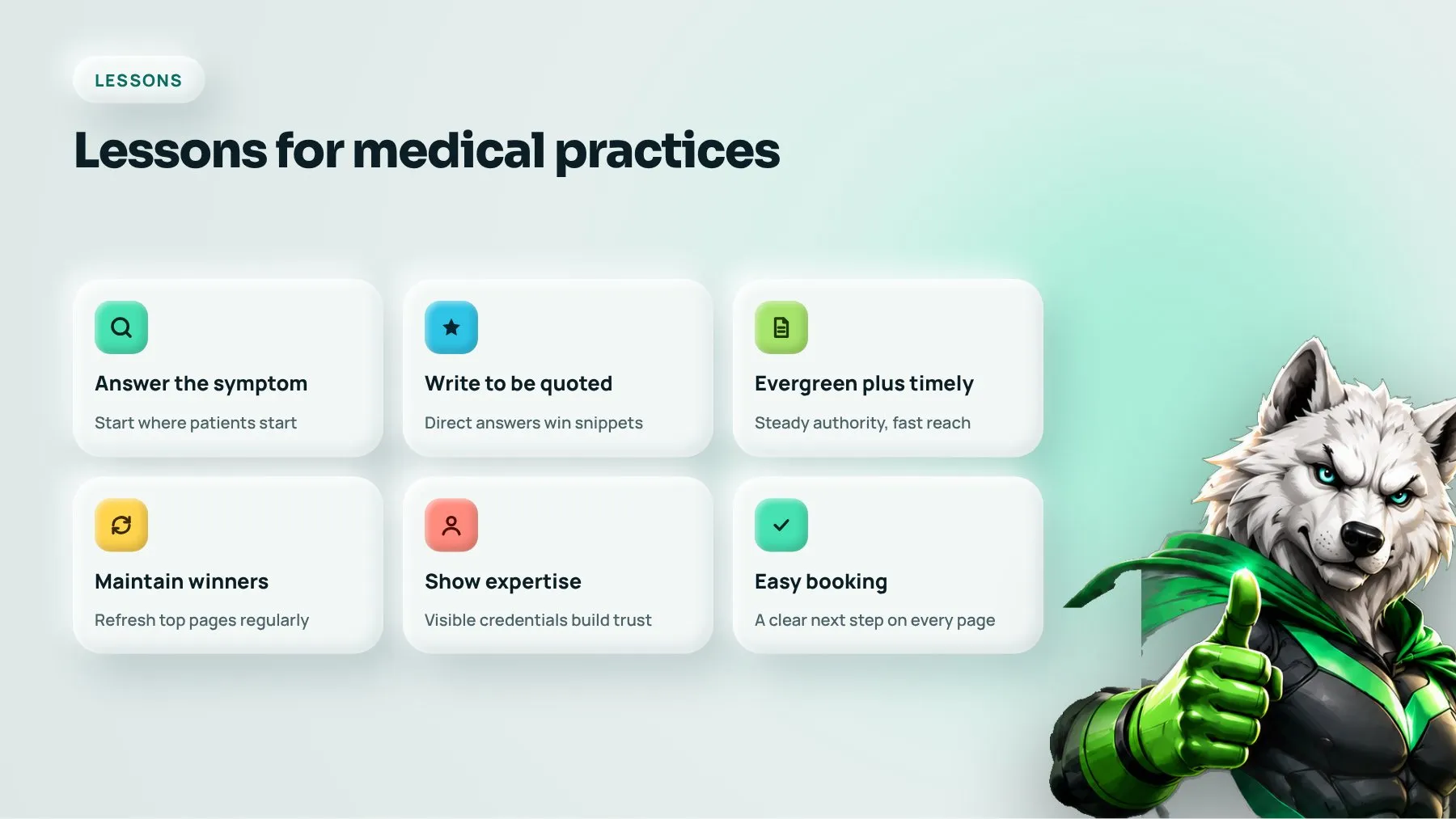
Lessons for medical practices
Answer the symptom, not just the service
Patients start with what they feel. Content that meets them there earns their attention and trust.
Structure content to be quoted
Direct answers, clear headings and concise explanations win featured snippets and People Also Ask placements. Increasingly, the same qualities help content get cited in AI-generated answers too, which is the focus of our AI Overviews optimization work.
Mix evergreen and timely
Evergreen content builds steady authority; timely content reaches new audiences fast. You need both.
Maintain what already works
Refreshing top pages is often the fastest way to protect and grow results.
Expertise must be visible
Show who wrote or reviewed the content and their qualifications. In health search, trust signals are not optional.
How to apply this to your practice
- List the symptoms and questions patients ask before they book with you.
- Write one clear, accurate article per question, with a direct answer near the top.
- Build a seasonal content calendar for your specialty.
- Link related articles to each other and to your service and booking pages.
- Review your top-performing pages every few months and update them.
- Make booking easy from every article.
FAQ
Is content marketing safe for doctors, given medical accuracy concerns?
Yes, if it is done properly. Content should be accurate, reviewed by a qualified clinician, clearly sourced where appropriate, and should encourage people to seek professional care rather than self-diagnose.
How long does medical SEO take to show results?
Timely content can rank within weeks; evergreen content and authority usually build over 3 to 6 months and beyond. The strongest results come from consistent publishing and maintenance.
What are featured snippets and People Also Ask?
They are answer boxes Google shows at or near the top of results. Winning them puts your practice’s answer in front of searchers before the standard listings, which is valuable for both visibility and trust.
Want more appointments for your practice? See our SEO services or book a strategy call.