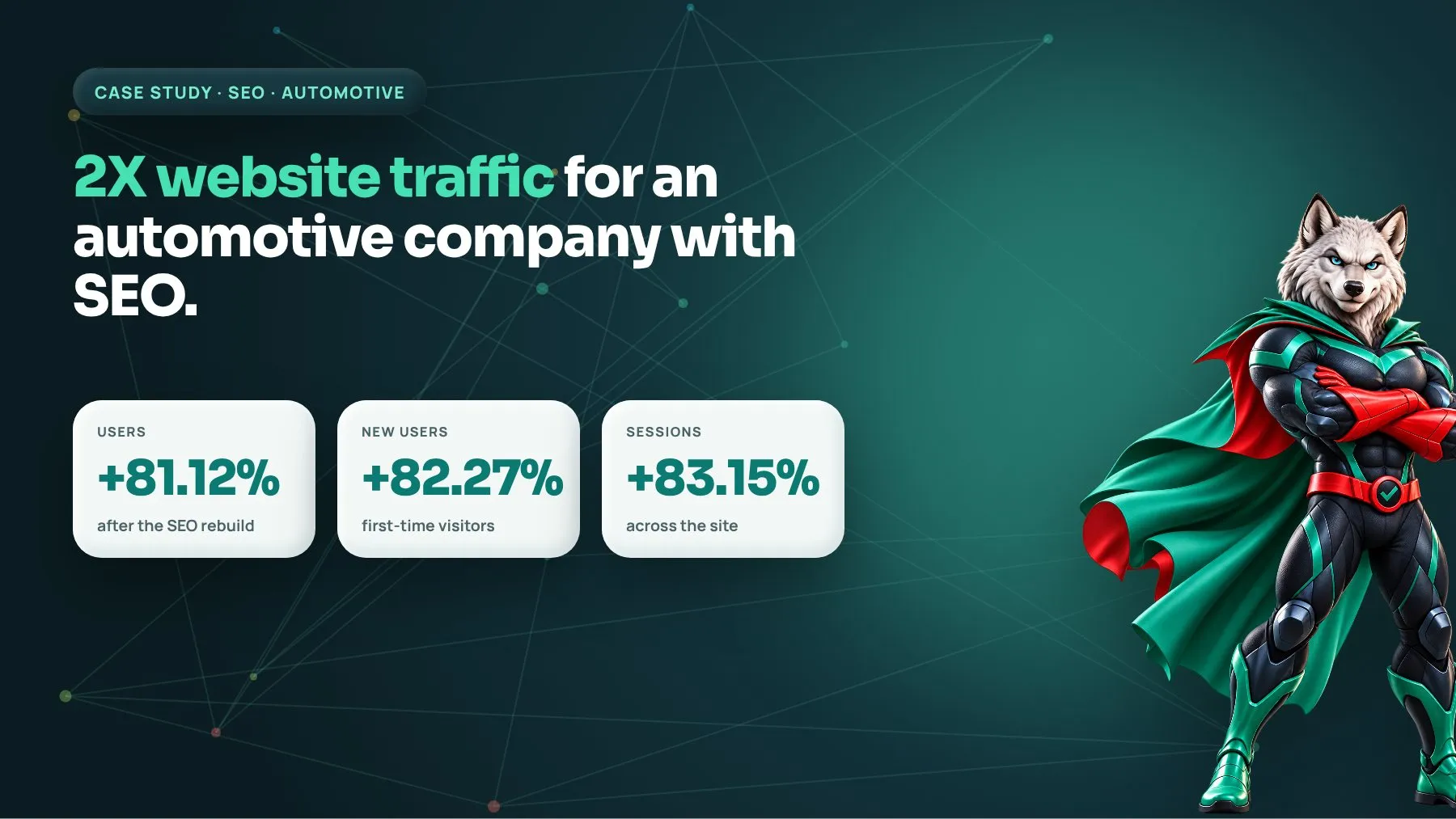
An automotive company came to us with a website that was in poor shape and was not producing the phone calls and leads the business needed. We rebuilt its SEO from the ground up, starting with speed, then content, then authority. The result was close to double the traffic: users up 81.12%, new users up 82.27% and sessions up 83.15%.
At a glance
- Client: Automotive company
- Service: Search engine optimization (technical, content and off-page)
- Key results: +81.12% users, +82.27% new users, +83.15% sessions
The challenge: a website that could not earn calls
The brief was simple to state and hard to deliver. The site needed “top to bottom” optimization so that it could rank for the searches that produce phone calls and enquiries. It was not a case of tweaking a few title tags. The foundations were weak.
That matters more in automotive than in many sectors. People searching for vehicles, parts, servicing or repairs usually have a near-term need. They compare a handful of options, often on a phone, and they call whoever looks credible and loads quickly. A slow, poorly structured site loses those people in the first few seconds, and it also signals to Google that the page is a poor answer. Every week the site underperformed, those calls were going to competitors.
There were three connected problems:
- Technical drag. Slow pages hurt both rankings and the share of visitors who stay long enough to call.
- Thin content. Without useful pages and articles, the site had little to rank for beyond its own brand name.
- Weak authority. Few signals from other sites meant Google had little reason to trust it over established competitors.
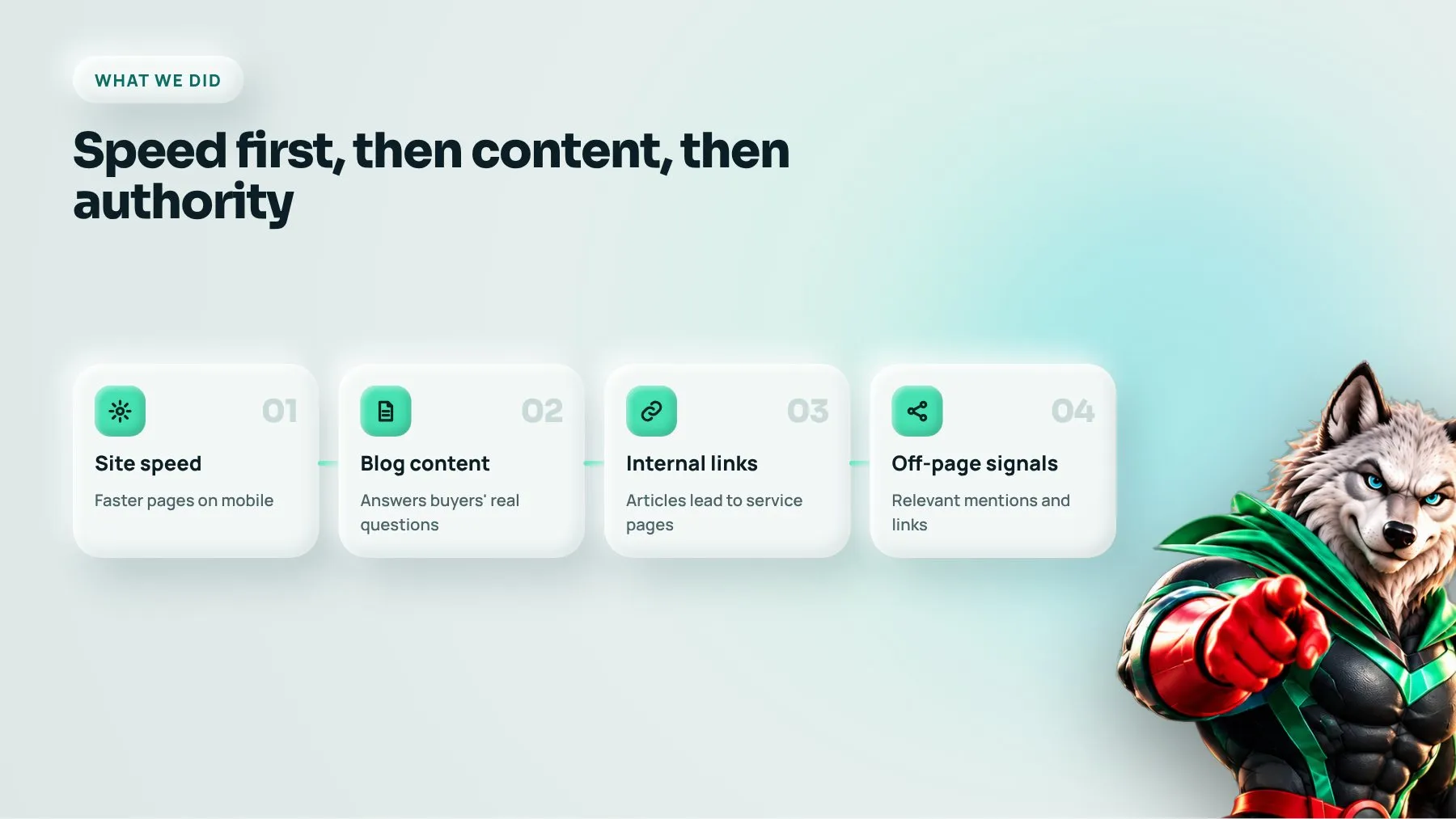
What we did: speed first, then content, then authority
We sequenced the work deliberately. There is no point sending more visitors to a page that takes too long to load, and no point building links to content that does not deserve to rank.
Site speed improvements
Speed was the first fix because it improves every visit that follows. On automotive sites the usual culprits are large vehicle and product images, heavy sliders, third-party scripts (chat widgets, inventory feeds, tracking tags) and themes that load far more code than the page needs.
Doing this properly means:
- Compressing and resizing images, serving modern formats and lazy-loading anything below the fold.
- Removing or deferring scripts that block the page from rendering, and auditing tags that nobody uses any more.
- Enabling caching and a content delivery network so pages are served quickly wherever the visitor is.
- Measuring against Google’s Core Web Vitals on mobile, not only on a fast office connection.
The goal is not a perfect lab score. It is a page that shows its main content and phone number fast enough that a person on a phone does not give up.
Blog writing and optimization
With the site fast, we turned to content. Automotive buyers ask a lot of questions before they pick up the phone: what a service involves, how often something should be replaced, what a fault might mean, how two options compare. Each of those questions is a search, and each is a chance to be the business that answered it.
We planned articles around those real questions, wrote them to be genuinely useful, and optimized each one with a clear target topic, a descriptive title and meta description, logical headings and internal links back to the relevant service pages. That last step is what turns informational traffic into customer acquisition: a reader who finds a helpful answer is one click away from the page that lets them book or call.
We also reviewed the existing pages so the blog and the service pages were not competing for the same searches.
Off-page signals to grow visibility
Finally, we worked on the signals Google reads from outside the site. For a local, trust-driven business like this, that means relevant mentions and links from sources that make sense for an automotive company, consistent business information across directories, and content good enough that other sites are willing to reference it.
We focused on relevance over volume. A handful of links from credible, related sites does more than a large number of low-quality ones, and it carries none of the risk.
The results: nearly twice the audience
After the work bedded in, the numbers moved together:
- 81.12% increase in users
- 82.27% increase in new users
- 83.15% increase in sessions
The detail worth noticing is that new users grew slightly faster than total users. That tells us the growth came from people discovering the business for the first time through search, not existing customers returning. For customer acquisition, that is the number that matters most.
Sessions growing at a similar rate to users also suggests the extra traffic was not a one-off spike from a single article. More people were arriving, and they were arriving through many different pages. That broader footprint is what makes organic growth durable.
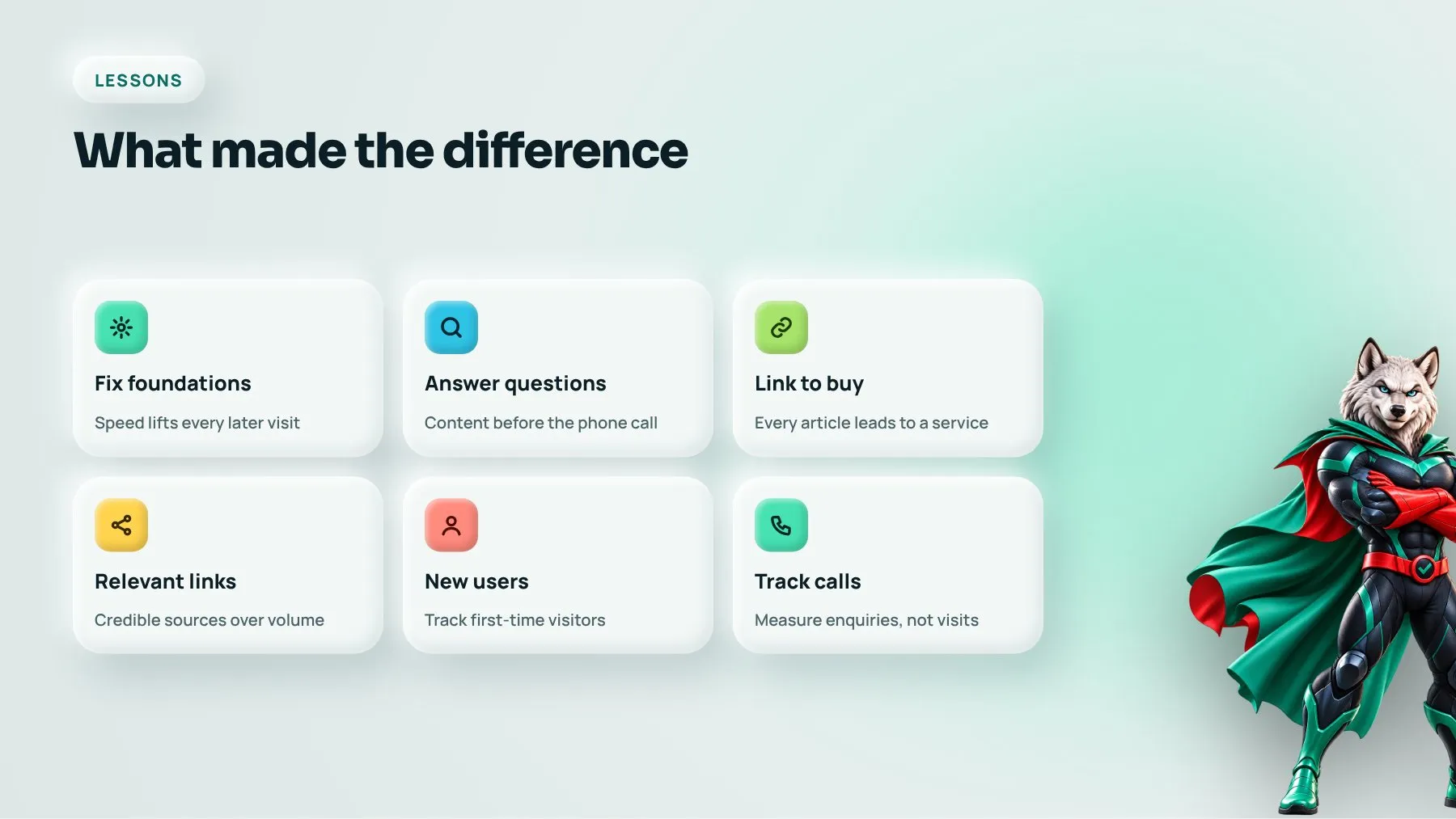
What made the difference: lessons for automotive businesses
1. Fix the foundations before you buy more traffic
Speed work is unglamorous, but it raises the return on everything else. Any traffic you win from content or ads converts better on a fast site.
2. Answer the questions customers ask before they call
Automotive customers research before they commit. Content that answers those questions clearly earns traffic that a service page alone never will.
3. Link every article to a way to buy
Informational content only acquires customers if it leads somewhere. Internal links from articles to service pages, and a visible phone number, close that gap.
4. Choose relevance over volume in link building
Authority comes from credible, related sources. Chasing large numbers of weak links is slower and riskier.
5. Watch new users, not just total traffic
If acquisition is the goal, track how many first-time visitors search is bringing in, and how many of them call or enquire.
How to apply this to your business
- Test your key pages on a phone using Google’s PageSpeed Insights and fix the biggest issues first.
- List the twenty questions customers ask most often before buying, and check whether your site answers each one.
- Make sure every article links to the most relevant service page and shows a clear way to get in touch.
- Check that your business name, address and phone number are identical across your site and directories.
- Track calls and form submissions, not only visits, so you can see which pages acquire customers.
FAQ
How long does SEO take to work for an automotive business?
Technical fixes like speed can help within weeks, but content and authority take longer. Most businesses start to see meaningful movement in three to six months, with growth compounding after that if the work continues.
Is site speed really a ranking factor?
Speed is one of many signals Google uses, and on its own it will not push a weak page to the top. Its bigger effect is on people: a faster site keeps more visitors long enough to call, which is the point of ranking in the first place.
Do we need a blog if we already have service pages?
Service pages capture people who already know what they want. A blog captures people earlier, while they are still researching, and gives you far more pages that can rank. Used together, with links between them, they bring in more customers than either alone.
Want the same kind of growth for your automotive business? See our SEO services, browse more case studies or book a strategy call.