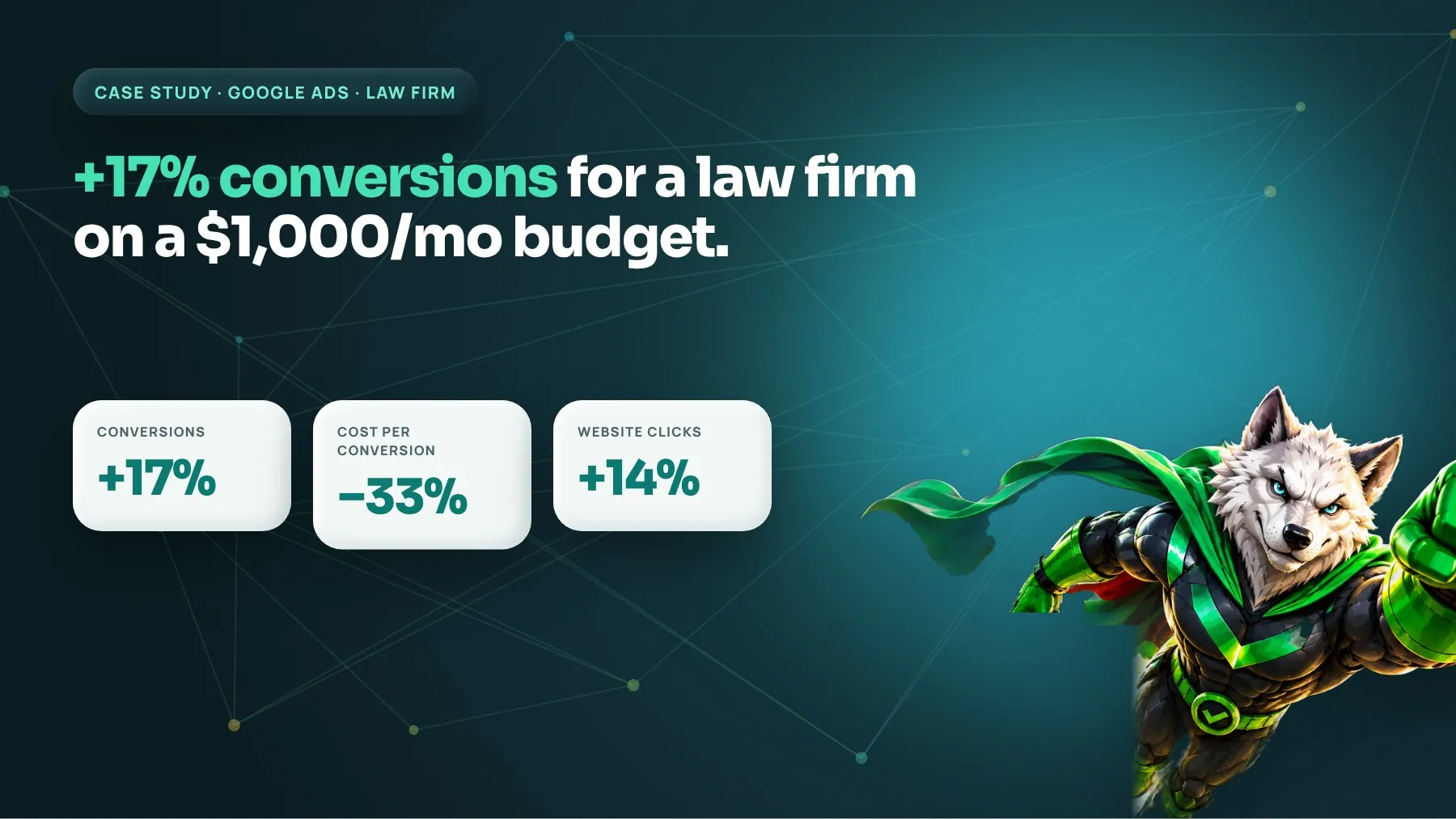
A law firm came to us with Google Ads campaigns that had stalled. Spend was steady, results were flat, and the firm wanted more enquiries without simply paying more for them. We rebuilt the account on the same $1,000 monthly budget, and conversions rose 17% while cost per conversion fell 33%.
At a glance
- Client: Law firm
- Service: Google Ads (pay-per-click) management
- Budget: $1,000 per month
- Key results: +17% conversions, −33% cost per conversion, +14% website clicks
The challenge: a decent budget stuck below benchmark
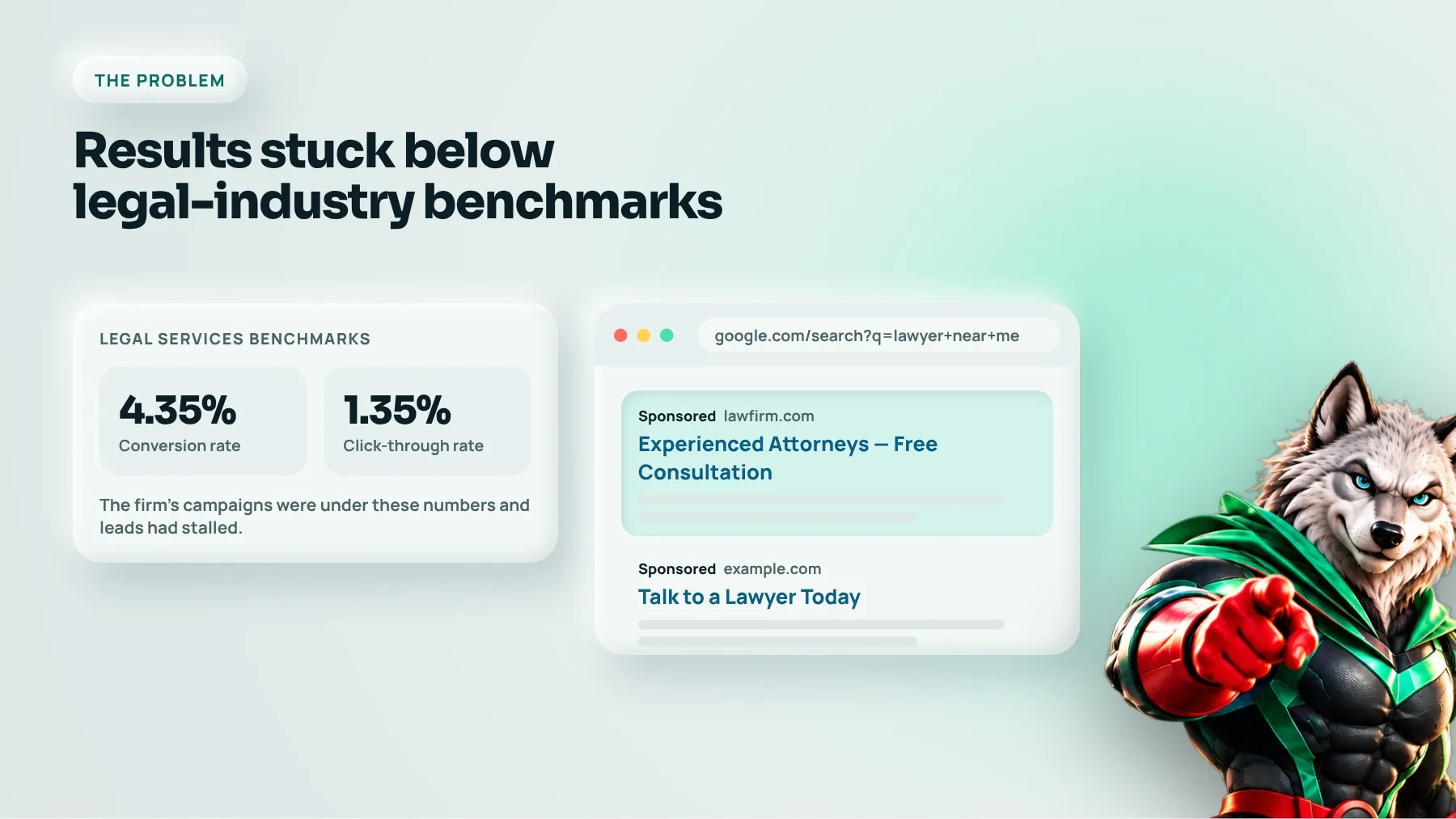
The firm was not underspending. A $1,000 monthly budget is a workable amount for a focused legal campaign. The problem was that the money was not working hard enough. The campaigns were falling short of the benchmarks the firm was measuring itself against for legal services: a conversion rate of 4.35% and a click-through rate of 1.35%.
Why this matters so much for a law firm: legal keywords are among the most expensive in Google Ads. Every wasted click costs real money, and with a fixed budget, every wasted click is also a lost chance to reach someone who needs a lawyer. A legal client can be worth a great deal to a firm over the life of a matter, so a small improvement in conversion rate or cost per enquiry has an outsized effect on revenue.
Stalled legal accounts usually share the same symptoms:
- Broad targeting that pays for searches from people looking for free advice, jobs at law firms or information only.
- Generic ads that look like every other firm on the page, so the click-through rate stays low.
- Weak landing pages, often the homepage, that make the visitor hunt for the right practice area and a way to get in touch.
- No clear structure, so budget drifts to whatever Google decides rather than to the cases the firm wants.
Our approach: rebuild around intent
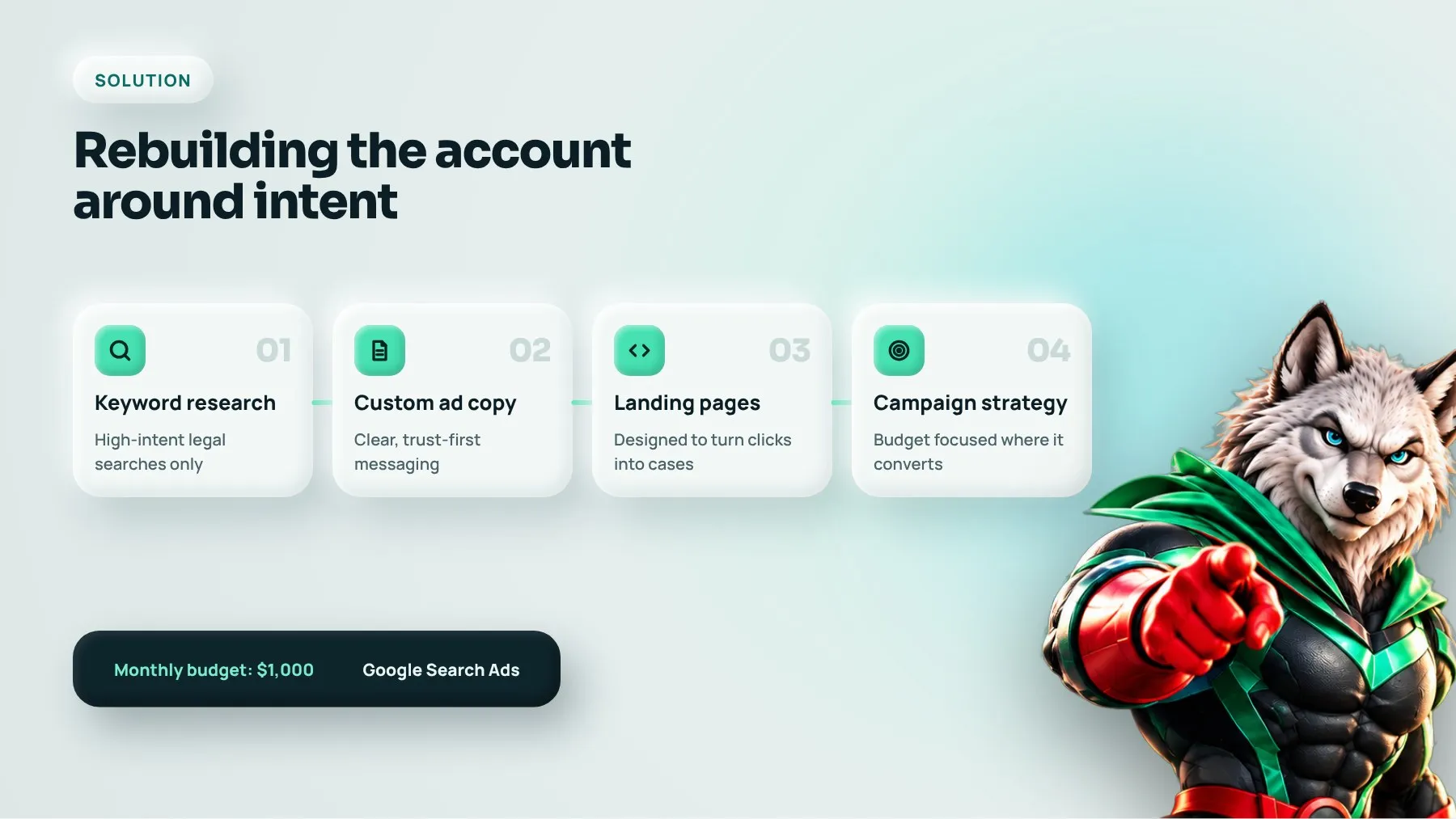
We kept the budget the same and changed how it was spent. The work fell into four parts.
Keyword research focused on hiring intent
We started by separating searches from people ready to hire a lawyer from searches that only look similar. Terms that signal a need for representation, a consultation or a specific legal problem were prioritized. We used phrase and exact match for the core terms so the firm controlled which searches triggered its ads.
Just as important was what we excluded. We built negative keyword lists around themes that rarely convert for a firm: “free”, “jobs”, “salary”, “course”, “template”, “definition” and similar informational searches. On a $1,000 budget, cutting this waste is often the single fastest win.
Custom ad copy that earns the click
Legal search results are crowded with near-identical ads. We wrote copy specific to each practice area and each ad group, matched closely to the searches it would appear for. The messaging led with what a prospective client cares about: relevant experience, how quickly they can speak to someone and what the first step looks like.
We used the available ad assets, such as sitelinks to key practice areas, callouts for reassurance points and call assets so mobile searchers could ring directly from the ad. Better relevance and a more useful ad lift click-through rate, which also tends to improve Quality Score and lower the cost of each click.
Landing pages designed to convert
Sending paid traffic to a general homepage wastes the work done in the ad. We designed landing pages that picked up exactly where the ad left off: the same practice area, the same promise and one clear action. Each page had a short enquiry form, a visible phone number, signals of credibility and no distracting navigation.
We also made sure conversions were tracked properly, including form submissions and calls, so every decision after launch was based on enquiries, not just clicks.
Campaign strategy and budget control
Finally, we restructured the account so budget followed results. Campaigns were split by practice area so the firm could see which types of case were winning enquiries at an acceptable cost. We reviewed search terms regularly, adjusted bids and schedules to the times enquiries actually came in, and shifted spend away from ad groups that consumed budget without converting.
The results: more enquiries for less
On the same $1,000 per month, the rebuilt account delivered:
- 17% increase in conversions
- 33% decrease in cost per conversion
- 14% increase in website clicks
- More ad clicks and conversions overall, at a lower cost per conversion
The combination is what matters. More clicks alone could mean more waste. Here, clicks rose and the cost of each enquiry fell by a third, which means the extra traffic was the right traffic. For a firm with a fixed budget, a 33% cut in cost per conversion is the same as getting significantly more enquiries for every dollar it already spends.
Lessons for law firms running Google Ads
1. Budget is rarely the first problem
Before spending more, make sure the current budget is not leaking into irrelevant searches. Structure and targeting usually unlock more than a bigger budget.
2. Negative keywords are a revenue tool
In legal, excluding the wrong searches is as valuable as finding the right ones. Review the search terms report every week.
3. Match the ad to the page
A visitor who clicks an ad about a specific legal problem should land on a page about that problem, with one obvious next step.
4. Track calls, not just forms
Many legal clients prefer to call. If phone enquiries are not tracked, the account is being optimized on half the picture.
How to apply this to your firm
- Check your search terms report and add negatives for any irrelevant themes.
- Split campaigns by practice area so you can see where enquiries actually come from.
- Write ads specific to each practice area, with call assets on mobile.
- Send each ad group to a matching landing page with a short form and phone number.
- Make sure calls and forms are both tracked as conversions.
FAQ
Is $1,000 a month enough for Google Ads as a law firm?
It can be, if the campaigns are tightly focused. A smaller budget works best concentrated on one or two practice areas and a defined location, rather than spread thinly across everything the firm does.
How quickly will we see results from a rebuilt account?
Changes to targeting and negatives often show within weeks. Google’s bidding needs time and conversion data to settle, so most accounts need a couple of months before performance is reliably stable.
Should we use our homepage as the landing page?
Usually not. A dedicated landing page for each practice area converts better because it speaks directly to the visitor’s problem and removes distractions.
Want the same for your firm? See our Google Ads management, explore our lead generation services or book a strategy call.