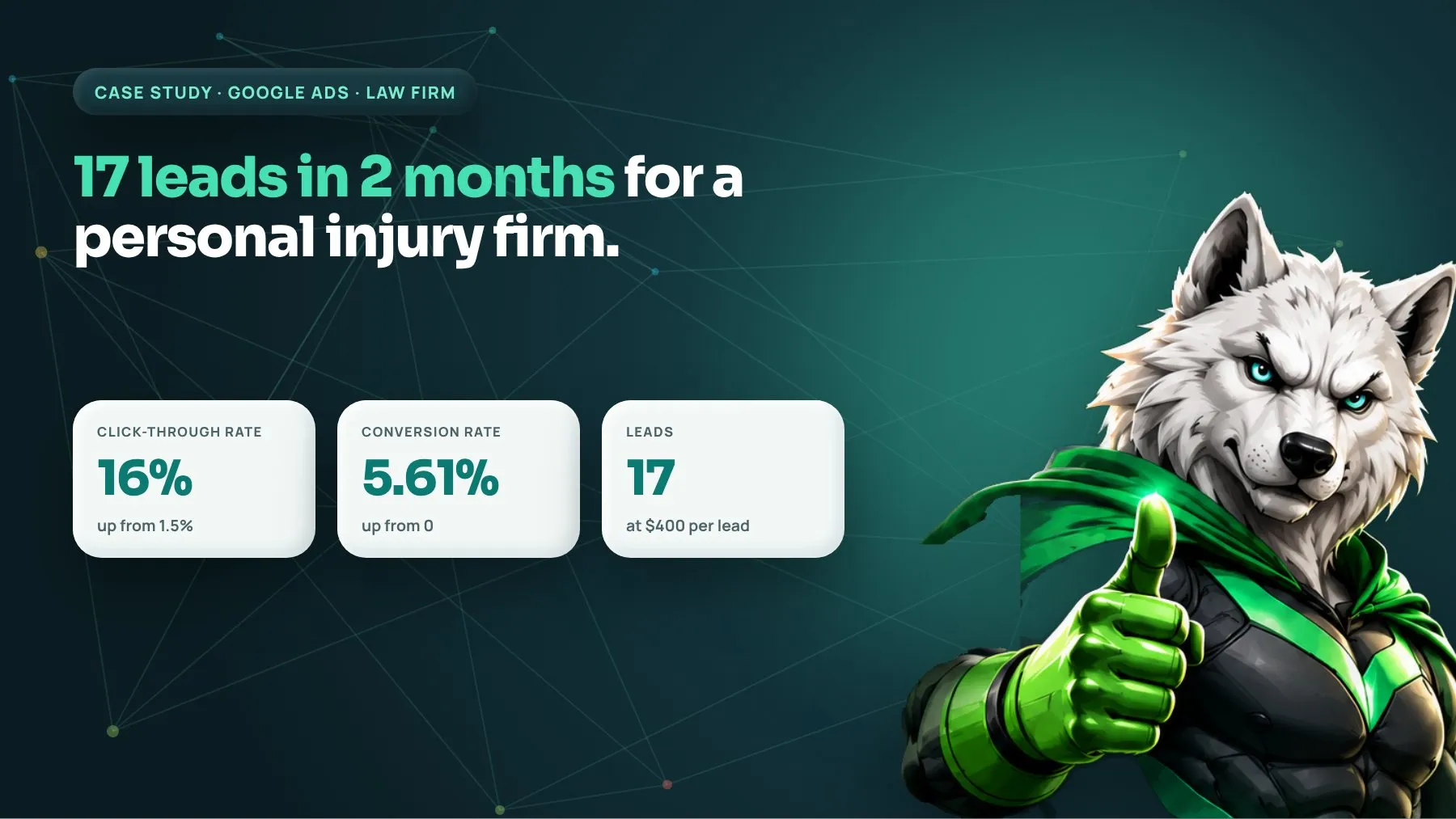
A personal injury law firm handling car, truck, motorcycle and bicycle accident cases came to us for a keyword strategy and landing page development. Its Google Ads were attracting low-quality traffic and producing no conversions. Within two months, click-through rate rose from 1.5% to 16%, conversion rate went from 0 to 5.61%, and the campaigns generated 17 leads at a cost per lead of $400.
At a glance
- Client: Personal injury law firm (car, truck, motorcycle and bicycle accidents)
- Service: Google Ads management, keyword strategy, landing page development
- Timeframe: 2 months
- Key results: CTR from 1.5% to 16% (+1053.33%); conversion rate from 0 to 5.61%; 17 leads; $400 cost per lead
The challenge: paying for clicks that never became cases
Personal injury is one of the most expensive categories in Google Ads. Firms compete hard for every search because a single signed case can be worth a great deal. That makes waste especially painful: every irrelevant click costs real money, and a campaign that does not convert can burn through a budget quickly.
The firm’s account had four problems:
- Low-quality traffic. Ads were showing to people who were not looking for an accident lawyer.
- The wrong keyword focus. Budget was going to terms that did not reflect someone ready to hire a firm.
- No dedicated landing page. Paid visitors were sent to general pages that were not built to turn a click into a call or form.
- Questionable search volume. Some targeted terms had too little volume, or volume of the wrong kind, to support the campaign.
The result was a conversion rate of zero. The firm was paying for attention and getting nothing it could take forward.
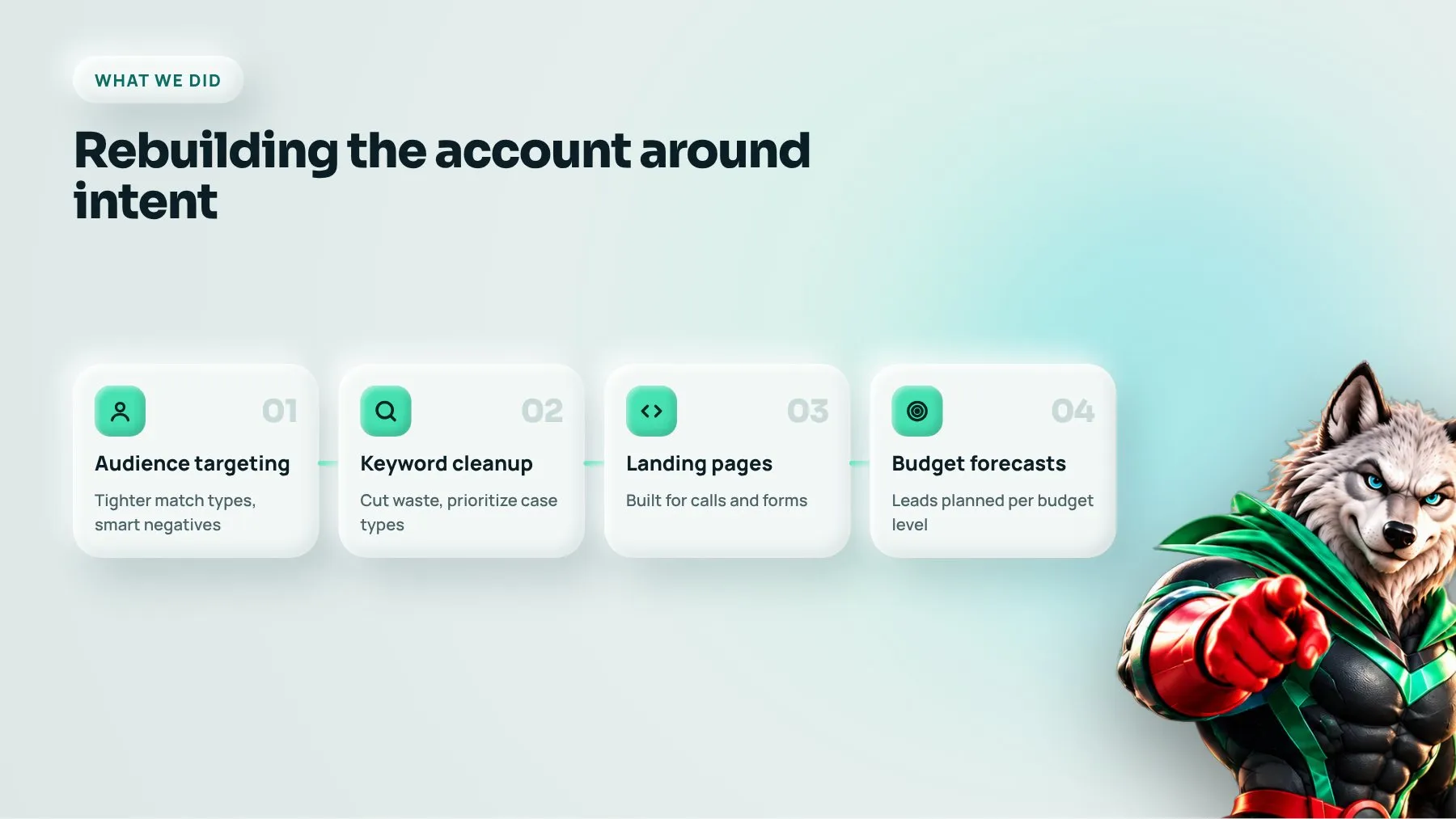
What we did: rebuilding around intent
Audience targeting with tighter match types
We moved the account toward phrase-style matching that kept ads closely aligned with the keywords that mattered. Loose matching in legal attracts searches like general legal information, jobs at law firms, or unrelated accident queries. Tighter matching kept ads in front of people describing an accident situation and looking for help. We paired this with negative keyword themes to exclude research, employment and free-advice searches that rarely turn into cases.
Keyword optimization: cut, then prioritize
We removed keywords that were spending without performing. The remaining terms were sorted by priority and efficiency: high-intent, case-type terms for car, truck, motorcycle and bicycle accidents at the top, with budget weighted toward them. Separating case types also lets ad copy speak directly to each situation, which is one reason click-through rate rose so sharply. Someone searching for help after a truck accident sees an ad about truck accidents, not a generic one.
Dedicated landing pages for paid traffic
We built landing pages specifically for paid search visitors. A good personal injury landing page has a single job: getting the visitor to call or submit a short form. That means a headline that matches the search, a clear explanation of how the firm helps, trust signals, a short form, a prominent phone number that works well on mobile, and no distracting navigation. Many accident searches happen on phones, sometimes shortly after an incident, so speed and click-to-call matter.
A keyword strategy built around budget
We created keyword lists for different monthly budget levels and forecast the conversions each could produce. This gave the firm a clear view of what different levels of spend could realistically deliver, rather than a vague promise. It also addressed the search volume question directly: we could show where volume existed and where it did not, so the budget was planned around reality.
The results: from zero conversions to 17 leads
- CTR jumped from 1.5% to 16%, an increase of 1053.33%.
- Conversion rate went from 0 to 5.61%.
- 17 leads generated in two months.
- Cost per lead of $400.
The CTR change shows the ads finally matched what people were searching for. The move from zero to a 5.61% conversion rate shows the landing pages were doing their job. And 17 leads in two months means the firm had real prospects to speak with, where before it had none.
On cost per lead: $400 can sound high outside legal, but personal injury is a category where a single case can be worth many times that. What matters to the firm is the cost of a signed case compared with the value of the case, and a predictable lead flow at a known cost is something it can plan around.
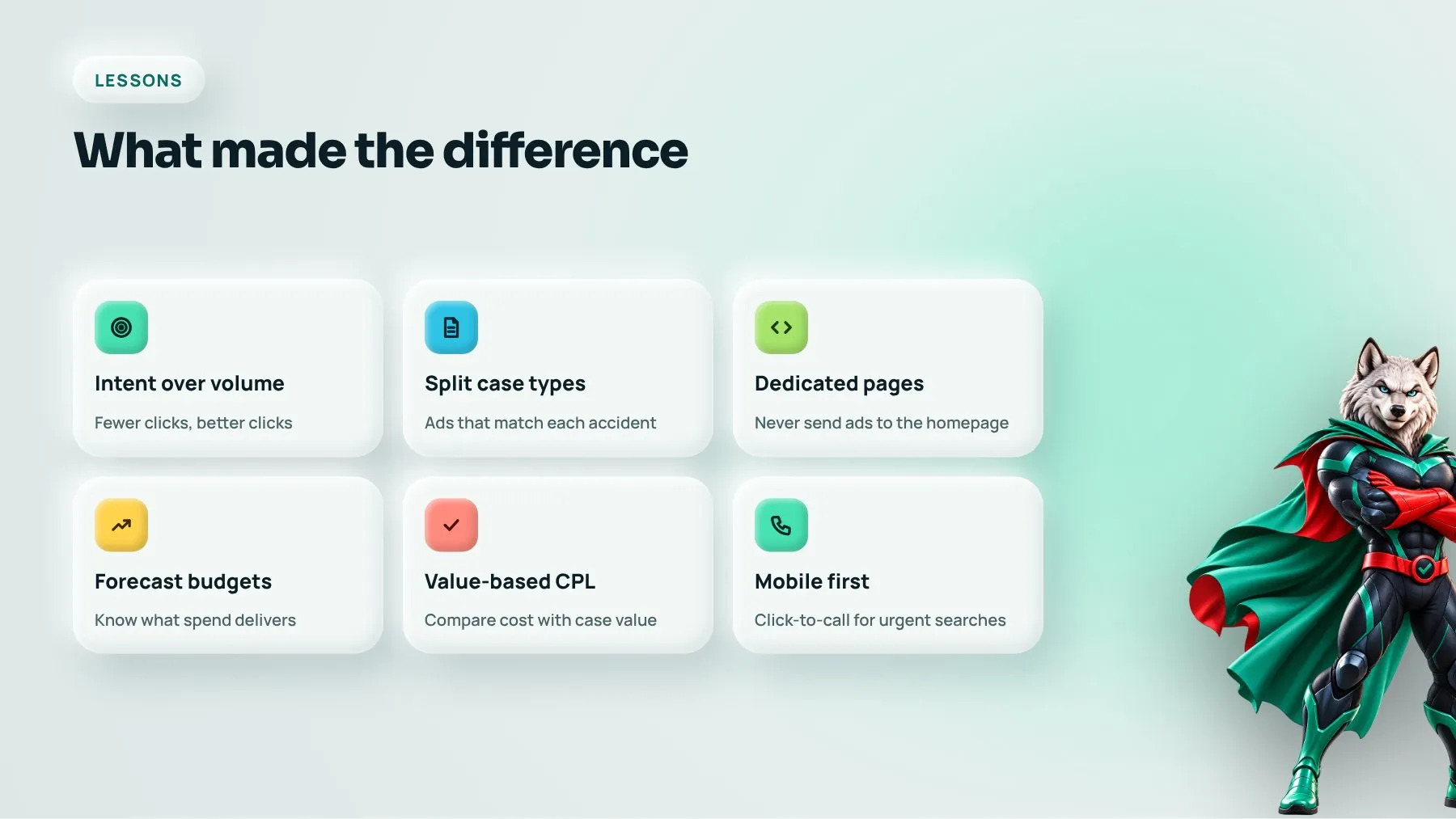
What made the difference: lessons for personal injury firms
1. Intent beats volume
In legal PPC, a smaller set of high-intent keywords outperforms a large, loose list. Fewer clicks, better clicks.
2. Separate your case types
Grouping car, truck, motorcycle and bicycle accidents separately lets ads and pages speak directly to each situation.
3. Never send paid traffic to a general page
A dedicated landing page is often the single biggest lever on conversion rate.
4. Plan budget around forecasts
Knowing what each budget level can deliver turns ad spend into a business decision rather than a gamble.
5. Judge cost per lead against case value
A lead cost is only high or low compared with what a signed case is worth.
How to apply this to your firm
- Review your search terms report and add negatives for research, job and free-advice searches.
- Split campaigns or ad groups by case type.
- Write ad copy that mirrors each case type’s searches.
- Build a dedicated, mobile-first landing page with a short form and click-to-call.
- Track calls and form submissions as conversions so you can see what works.
- Forecast leads for your budget before you increase spend.
FAQ
How quickly can Google Ads produce leads for a law firm?
Google Ads can start producing enquiries within weeks once the account is set up properly, because ads show as soon as they are live. The first month or two is usually spent refining keywords, negatives and landing pages, with results improving as data builds.
Why is PPC so expensive for personal injury lawyers?
Many firms compete for the same searches, and each signed case can be valuable, so advertisers are willing to bid high. That makes tight targeting and strong landing pages essential, because wasted clicks cost more here than in most industries.
Do I need a separate landing page if my website is good?
Usually, yes. Website pages are built to inform and serve many audiences. A landing page is built for one search and one action, which typically converts paid visitors far better.
Want more qualified leads for your firm? See our Google Ads management, read about our lead generation services or book a strategy call.