
An Amazon seller came to us wanting more profitable sales from the advertising budget they were already spending. By rebuilding their sponsored ads around better keyword research, tighter keyword selection, disciplined bid optimization and aggressive negative keywords, product sales reached $30.01k, up 21% in the last 30 days and 312% compared with the same period the year before.
At a glance
- Client: Amazon seller account (ecommerce brand)
- Service: Amazon marketing and Amazon PPC management
- Tactics: Keyword research, keyword selection, bid optimization, negative keywords
- Key results: $30.01k in product sales; +21% in the last 30 days; +312% year on year
The challenge: ad spend that was not turning into profitable sales
Most Amazon sellers do not have a traffic problem so much as a relevance problem. Sponsored Products campaigns will happily spend money on any search that loosely matches a product, and Amazon’s automatic targeting is designed to explore broadly. Left alone, an account drifts toward clicks from shoppers who were never going to buy that item: people looking for a cheaper alternative, a different size, a competitor’s brand, or a completely unrelated product that shares a word with the listing.
That matters commercially for three reasons. First, every wasted click raises your advertising cost of sale (ACoS), which eats directly into margin on a platform where fees already take a large share of each sale. Second, poor conversion on ads weakens a product’s organic momentum, because Amazon rewards listings that sell. Third, a seller who cannot see which keywords make money tends to cut budget across the board, which starves the terms that were actually working.
The goal here was simple: grow product sales without simply throwing more money at the platform. That meant knowing exactly which searches produced orders, paying the right price for them, and refusing to pay for the rest.
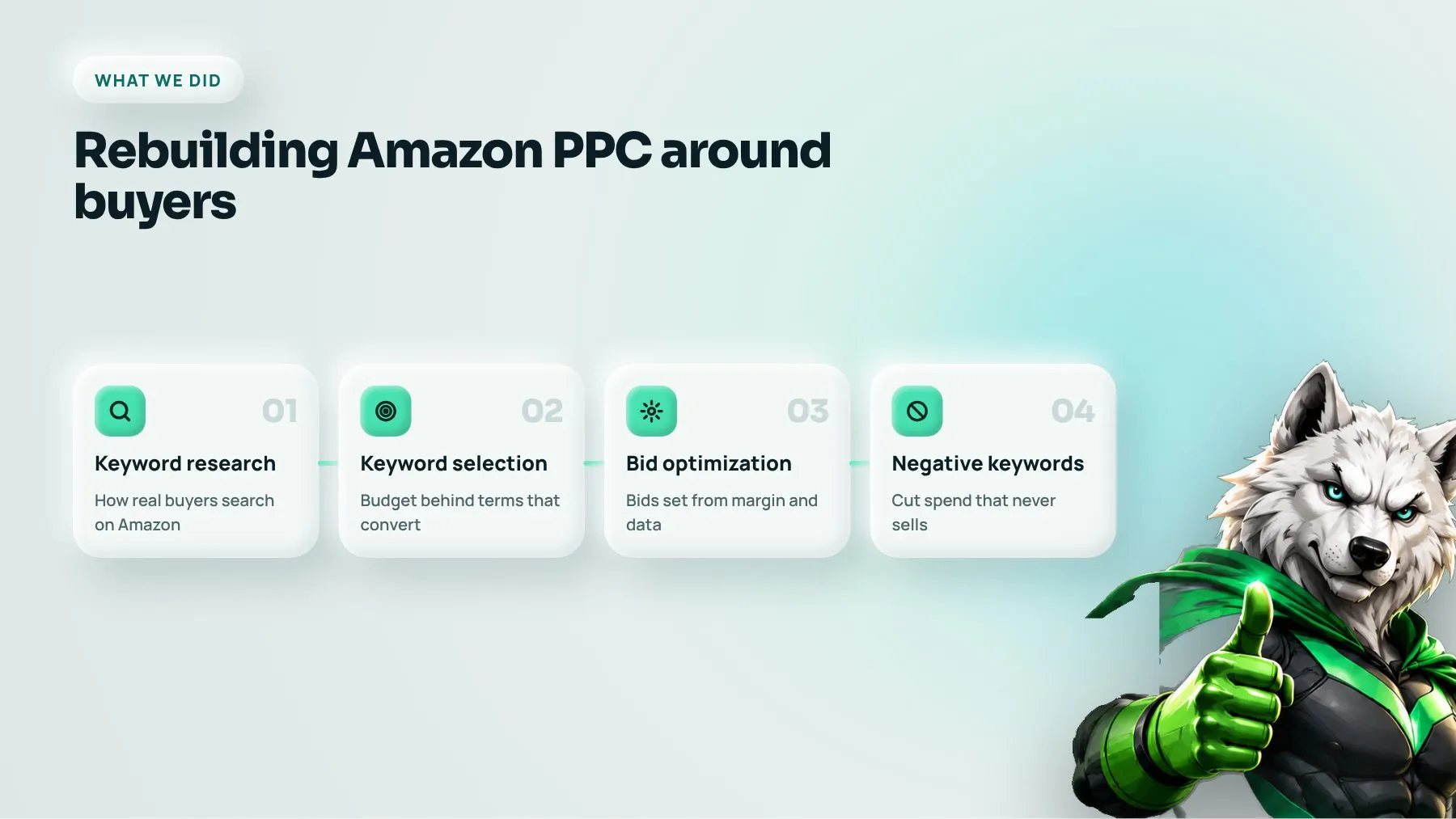
What we did: a four-part Amazon PPC rebuild
The account was restructured around four disciplines. None of them is exotic. The difference is in doing each one carefully and repeatedly, rather than once at launch.
Keyword research: finding how real buyers search
We started by building a full picture of the language shoppers use to find this type of product. On Amazon, that comes from several sources: the search term reports from existing automatic and broad campaigns (the most valuable data, because it shows real searches that led to real orders), Amazon’s own search bar suggestions, competitor listings and their titles, and keyword tools built on Amazon search data.
The aim is not the longest possible list. It is a map of intent: which phrases signal a shopper who is ready to buy this exact product, which ones signal a comparison shopper, and which ones are only loosely related. Feature-specific and use-case phrases (size, material, compatibility, who the product is for) usually convert far better than one-word category terms, even though they have less volume.
Keyword selection: putting budget behind the terms that convert
Research produces candidates. Selection decides where the money goes. We grouped keywords into tightly themed campaigns and ad groups so that each one could be measured and bid on separately, rather than mixing a high-converting phrase with a dozen weak ones in the same bucket.
In practice that means a typical structure of:
- Exact match campaigns for proven converting search terms, where we want maximum control over price and placement.
- Phrase and broad match campaigns for controlled discovery, feeding new converting terms back into exact match.
- Product targeting against relevant competitor ASINs and categories where the product compares well on price, reviews or features.
- Branded defense so that shoppers searching for the seller’s own brand see the seller’s products, not a competitor’s ad.
Harvesting winning search terms from discovery campaigns into exact match is one of the most important ongoing habits in Amazon PPC. It is how an account gets more efficient over time instead of less.
Bid optimization: paying the right price for each click
Once keywords are separated, each one can be bid according to what it is actually worth. We set bids from the data: conversion rate, average order value and the target ACoS the seller’s margins could support. Keywords that converted well and sat comfortably under target got more room to win top-of-search placement. Keywords that spent without selling were reduced or paused.
We also reviewed placement performance (top of search, product pages, rest of search) and adjusted placement modifiers where one placement clearly converted better. Bid changes were made on a regular cadence with enough data behind them, rather than daily reactions to a single good or bad day, which is a common way sellers end up chasing noise.
Negative keywords: cutting the spend that never sells
Negative keywords were probably the fastest lever in this account. Every search term report was reviewed for queries that spent money with no orders, or that were plainly irrelevant. Typical negative themes on Amazon include:
- Other brands’ names where the seller had no chance of winning the sale
- Wrong sizes, models or compatibility terms
- “Cheap”, “free”, “used” and similar signals when they did not fit the product
- Unrelated products that happened to share a word with the listing
We also used negative exact matches inside discovery campaigns to stop them competing with the exact match campaigns for the same term. That keeps data clean and stops the account bidding against itself.
The results: $30.01k in sales and 312% growth year on year
After the rebuild, the seller account reported:
- $30.01k in product sales
- An increase of 21% in the last 30 days
- An increase of 312% compared with the previous year
The 21% month-on-month figure shows that growth was still accelerating, not leveling off. The 312% year-on-year figure is the more meaningful one for a business owner: it compares the same season, so it strips out holiday spikes and quiet months, and shows that the account is fundamentally selling far more than it was a year earlier.
Just as importantly, this growth came from making the existing advertising work harder. When ad spend is focused on terms that convert, sales from ads also feed organic ranking, which is why well-managed PPC on Amazon tends to lift total sales, not only ad-attributed sales.
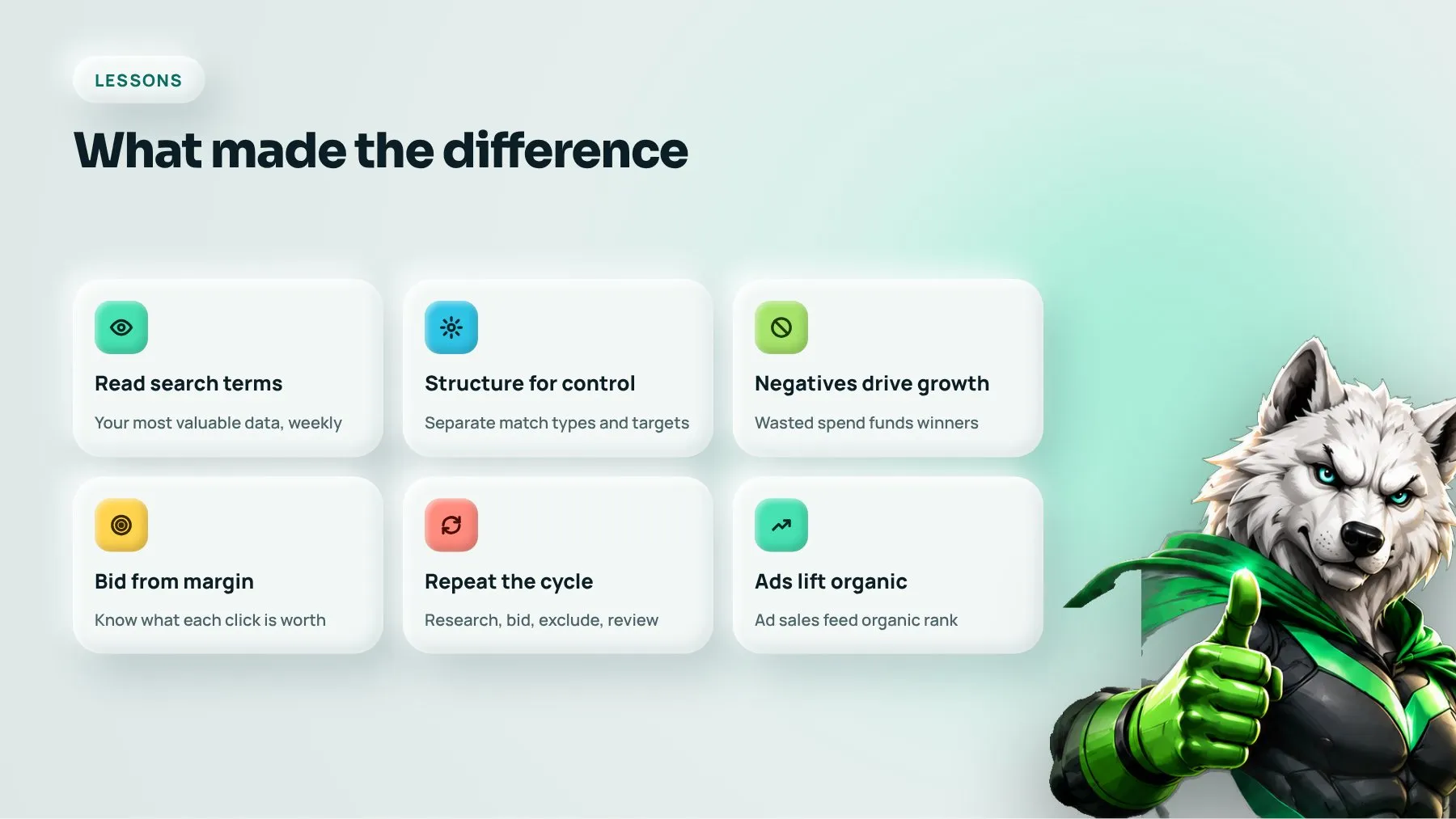
What made the difference: lessons for Amazon sellers
- Search term reports are the most valuable data you own. They show exactly what shoppers typed before buying. If nobody is reading them weekly, money is leaking.
- Structure creates control. Separating exact, phrase, broad and product targeting lets you bid each one on its own merits instead of averaging winners and losers together.
- Negative keywords are a growth tactic, not just a cost tactic. The money you stop wasting is money you can put behind keywords that sell.
- Bid from margin, not from instinct. A target ACoS based on real product margins tells you how much each click is worth.
- Consistency beats one-off fixes. The gains came from repeating the same disciplined cycle: research, select, bid, exclude, review.
How to apply this to your Amazon business
- Download your search term report for the last 60 days and sort by spend with zero orders.
- Add clearly irrelevant and non-converting terms as negatives.
- Move your best converting search terms into their own exact match campaign.
- Work out your break-even ACoS for each product from its real margin.
- Adjust bids up on profitable terms and down on terms above target.
- Repeat the review on a fixed weekly or fortnightly schedule.
FAQ
How long does it take to see results from Amazon PPC changes?
Negative keywords and bid changes can affect spend within days. Meaningful sales trends usually need several weeks of data, and the knock-on lift in organic ranking tends to build over one to three months.
Should I use automatic or manual campaigns on Amazon?
Both. Automatic and broad campaigns are useful for discovering new search terms, while manual exact match campaigns give you control over the terms you know convert. The skill is in moving winners from one to the other and keeping them from competing.
Is it better to increase my Amazon ad budget or fix the account first?
Fix the account first. Raising budget on a poorly structured account usually scales the waste along with the sales. Once spend is focused on converting terms, extra budget goes much further.
Selling on Amazon and want your ad spend to do more? See our Amazon marketing services, browse more case studies, or book a strategy call.