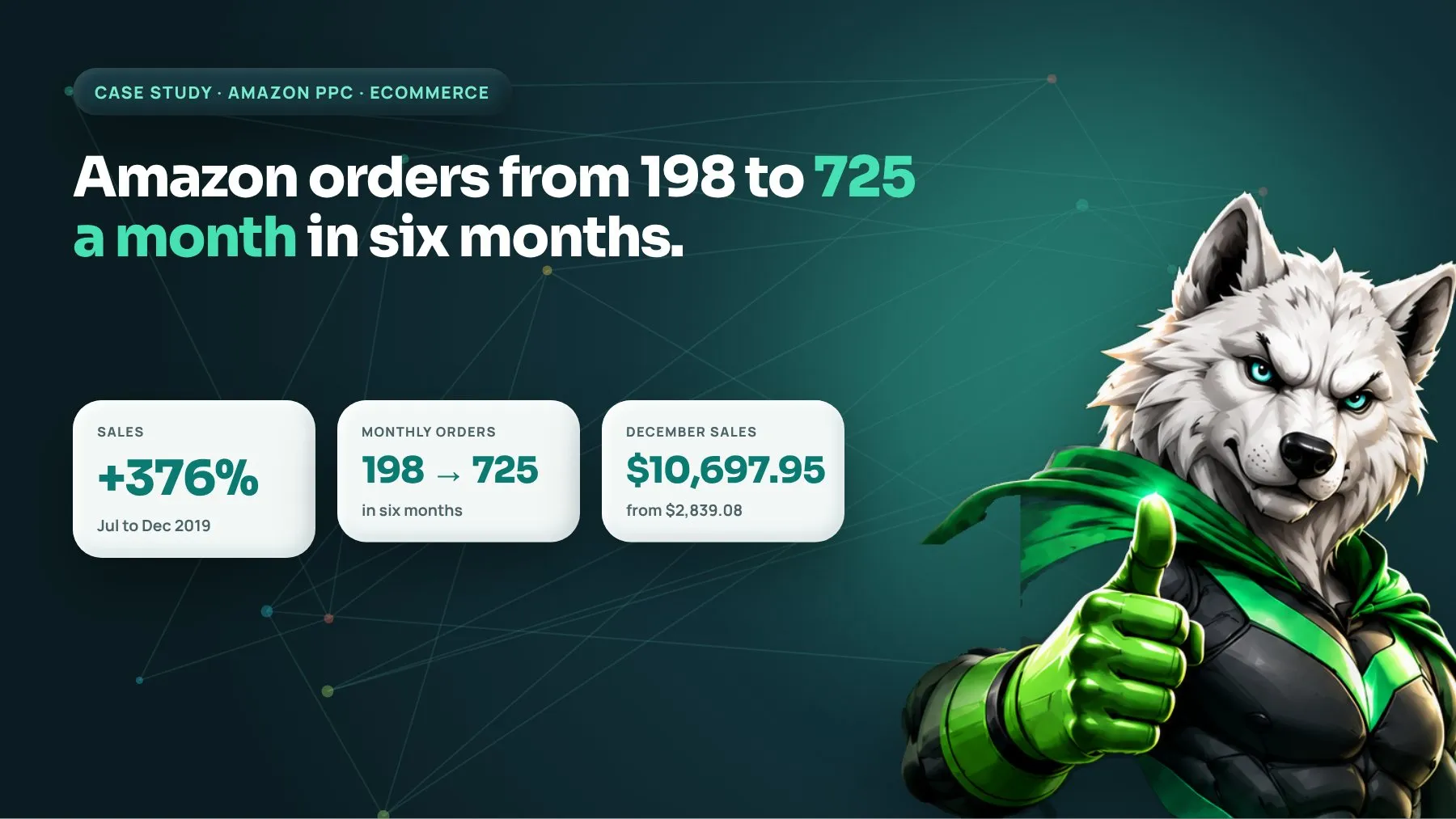
An Amazon seller came to us with a steady but stalled business: around 198 orders a month and sales that were not moving. Over six months we rebuilt how they found, chose and paid for keywords. Sales rose 376%, from $2,839.08 in July 2019 to $10,697.95 in December 2019, and monthly orders climbed from 198 to 725.
At a glance
- Client: Amazon seller (third-party marketplace business)
- Services: Amazon PPC and marketplace keyword strategy
- Timeframe: July 2019 to December 2019 (six months)
- Key results: 376% increase in sales ($2,839.08 to $10,697.95 per month); orders up from 198 to 725 per month
The challenge: a seller stuck at 198 orders a month
On Amazon, visibility is everything. A shopper types a search, scans the first screen of results and buys from one of the listings they see. If your product does not appear for the searches that matter, it does not matter how good the product is.
This seller had two linked problems. First, they were not showing up for enough of the searches their buyers actually used. Second, the advertising they did run was not disciplined: spend was spread across terms that did not convert, and bids were not tied to what each keyword was worth to the business.
That combination is common, and it is expensive. Wasted ad spend hurts margin directly. Less obviously, weak sales velocity also holds back organic ranking, because Amazon’s algorithm rewards listings that convert and sell. A seller who cannot generate sales through ads struggles to earn organic rank, and a seller without organic rank becomes ever more dependent on ads. Breaking that loop was the real job.
What we did: four levers, pulled in order
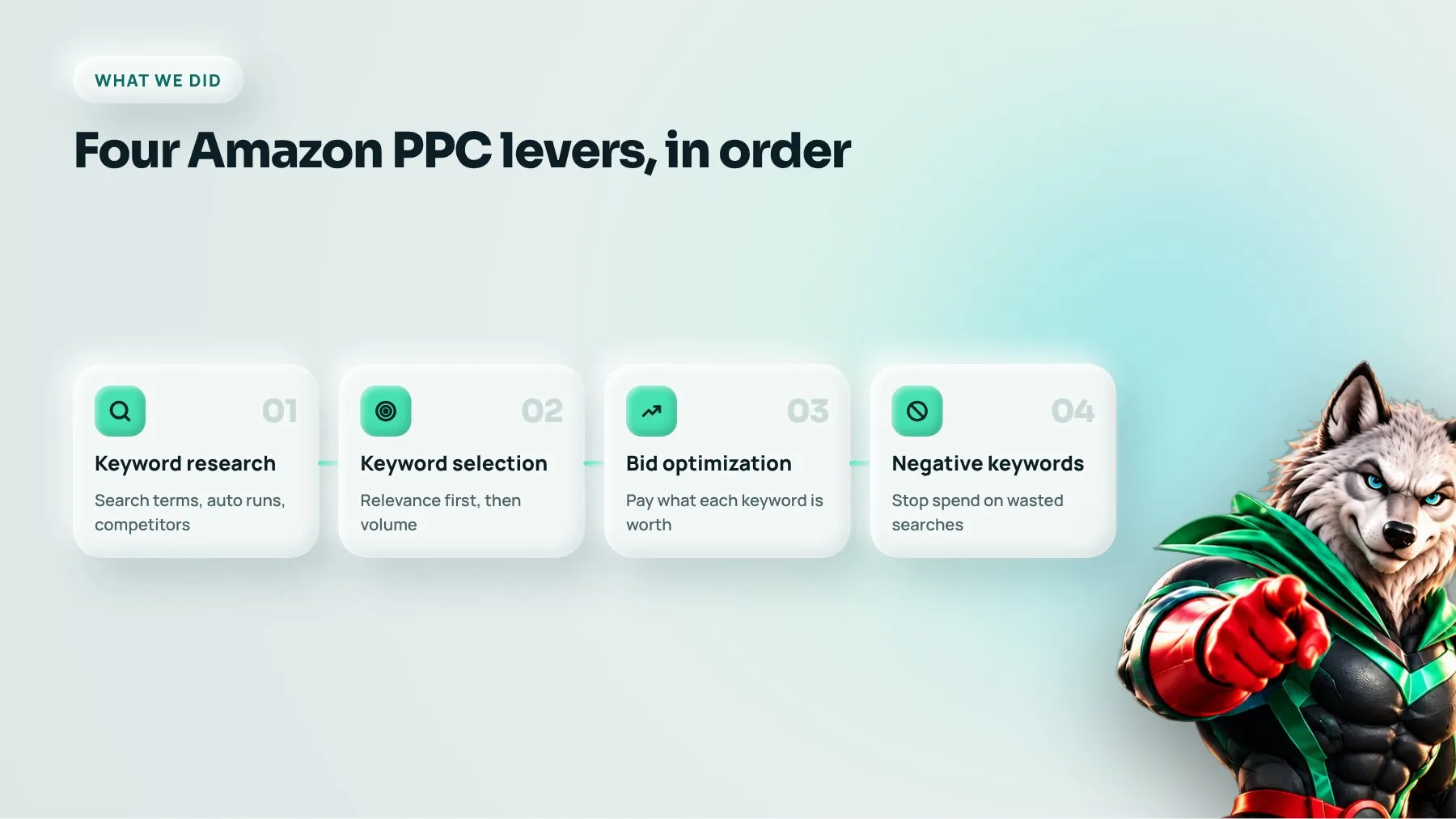
The strategy was deliberately simple. We did not chase new channels or gimmicks. We worked four core levers of Amazon advertising properly and in the right sequence: keyword research, keyword selection, bid optimization and negative keywords.
1. Keyword research: finding how buyers actually search
Amazon search behavior is different from Google. People on Amazon are already in a buying mood, and their queries tend to be shorter and more product-focused: product type, size, material, use case, sometimes a competitor’s brand.
We built the keyword universe from several sources:
- Search term reports from the seller’s existing campaigns, which show the real queries that triggered ads and which of those led to orders.
- Automatic campaigns used as a discovery tool, letting Amazon match the product to queries we might not have predicted.
- Competitor listings, to see the language rivals use in titles and bullet points and the attributes buyers care about.
- Amazon’s own search suggestions, which reflect common queries in the category.
The output was not one long list. It was a grouped map of themes: core product terms, attribute terms, use-case terms and long-tail phrases.
2. Keyword selection: choosing what deserves budget
Research produces far more keywords than any budget can support. Selection is where most of the money is made or lost.
We prioritized keywords by relevance first and volume second. A high-volume keyword that only loosely describes the product will attract clicks from people who do not buy. A tighter, lower-volume phrase that exactly matches the product usually converts better and costs less per order.
Selected keywords were organized into campaigns by match type:
- Exact match for proven, high-converting terms, where we wanted tight control of bids.
- Phrase match for promising terms that needed room to find close variations.
- Broad match and auto campaigns kept as a smaller discovery layer, feeding new winners into the exact-match campaigns.
This “harvest and graduate” structure means the account keeps learning without letting discovery spend run unchecked.
3. Bid optimization: paying what each keyword is worth
Most underperforming Amazon accounts have one thing in common: the same bid logic applied to every keyword. That ignores the fact that some terms produce orders cheaply and others never do.
We reviewed bids keyword by keyword against their actual performance. Terms that produced orders at an acceptable advertising cost of sale (ACoS) had bids raised to win more impressions and better placements. Terms that spent without converting had bids reduced or were paused. We also watched placement performance, because top-of-search placement often converts differently from product-page placement.
Bid optimization is not a one-off task. We revisited bids on a regular cycle as data built up, so budget kept flowing toward what worked.
4. Negative keywords: stopping the leaks
Negative keywords tell Amazon which searches you do not want to appear for. They are the cheapest efficiency gain in any account, and they are often neglected.
We mined the search term reports for queries that were irrelevant, too broad, or attracted the wrong buyer. Typical negative themes include:
- Searches for a different product type that shares a word with yours.
- Queries for sizes, materials or variations the seller does not offer.
- Searches that clicked repeatedly without ever converting.
We also used negatives to stop campaigns competing against each other. Once a keyword graduated to an exact-match campaign, we added it as a negative in the discovery campaigns, so each search was handled by the campaign best placed to bid on it.
The results: 376% more sales and 725 monthly orders
Over six months the numbers moved decisively:
- Sales up 376%: from $2,839.08 in July 2019 to $10,697.95 in December 2019.
- Orders up from 198 to 725 per month.
What these numbers mean is more important than the numbers themselves. The seller did not simply buy more traffic. The growth came from spending on the right searches, paying sensible prices for them and cutting the waste. That is why sales could grow this fast without the business losing control of its advertising costs.
The gains also showed up in both paid and organic sales. As ad-driven orders increased, sales velocity improved, and Amazon’s algorithm rewards that with better organic placement. Data-driven advertising did not just add paid orders; it strengthened the listing’s overall position.
What made the difference: lessons for Amazon sellers
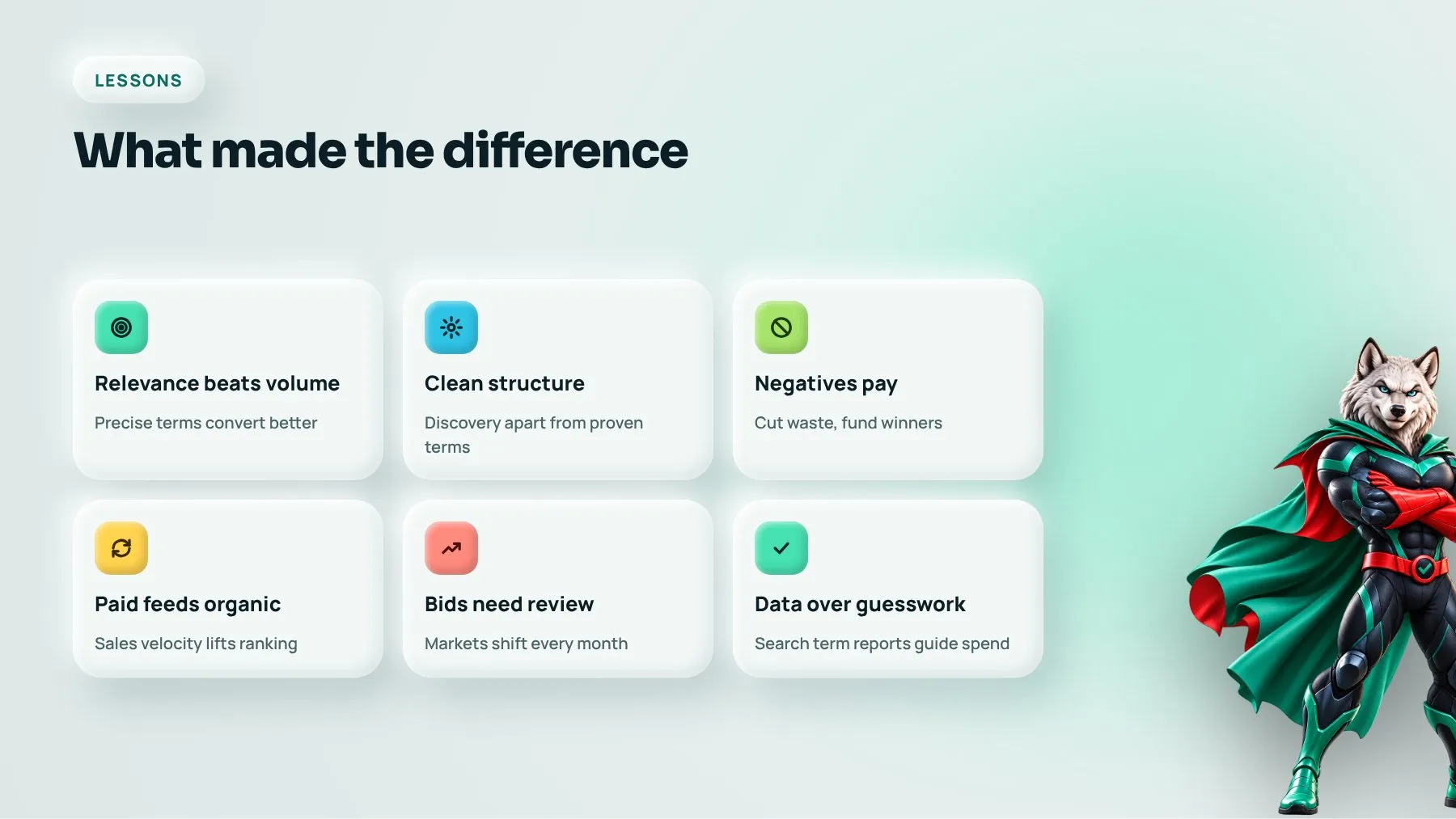
Relevance beats volume
The biggest wins rarely come from the biggest keywords. They come from the terms that most precisely describe your product and match a buyer who is ready to purchase.
Structure makes optimization possible
Separating discovery from proven performers, and organizing campaigns by match type, gives you clean data. Without clean structure you cannot tell which keyword deserves more budget.
Negatives are a profit tool, not housekeeping
Every irrelevant click is money that could have gone to a converting term. Regular negative keyword work is one of the highest-return tasks in Amazon advertising.
Paid and organic are connected on Amazon
Ads drive sales, sales drive ranking, and ranking drives organic sales. Treating PPC and organic visibility as one system is how sellers break out of a plateau.
Bids need ongoing attention
Markets, competitors and seasons shift. A bid that was right last month may be wrong today. Regular, data-led bid reviews keep spend aligned with results.
How to apply this to your Amazon business
- Download your last 60 days of search term reports and highlight every query that spent without an order.
- Add the irrelevant ones as negative keywords, starting with the biggest spenders.
- Move your proven, converting search terms into exact-match campaigns with their own bids.
- Keep a smaller auto or broad campaign running purely for discovery.
- Set a target ACoS that reflects your margin, and review bids against it on a fixed schedule.
- Check your listing titles and bullets use the same language your best-converting search terms use.
FAQ
How long does it take to see results from Amazon PPC optimization?
Waste reduction from negative keywords and bid changes can show within weeks. Bigger shifts, like the move from 198 to 725 orders here, typically build over several months as the account gathers data and organic ranking improves alongside paid sales.
What is a good ACoS for my products?
It depends on your margin and goals. A product with healthy margins can sustain a higher ACoS, especially when you are building rank. The right target is the one that keeps each order profitable, or deliberately invests in ranking for a defined period.
Should I run auto campaigns or manual campaigns?
Both, with different jobs. Auto campaigns are good for discovering new search terms; manual exact-match campaigns are where you control bids on proven winners. The skill is in moving terms from one to the other and blocking overlap with negatives.
Want the same disciplined growth for your products? See our Amazon marketing services, browse more case studies, or book a strategy call.