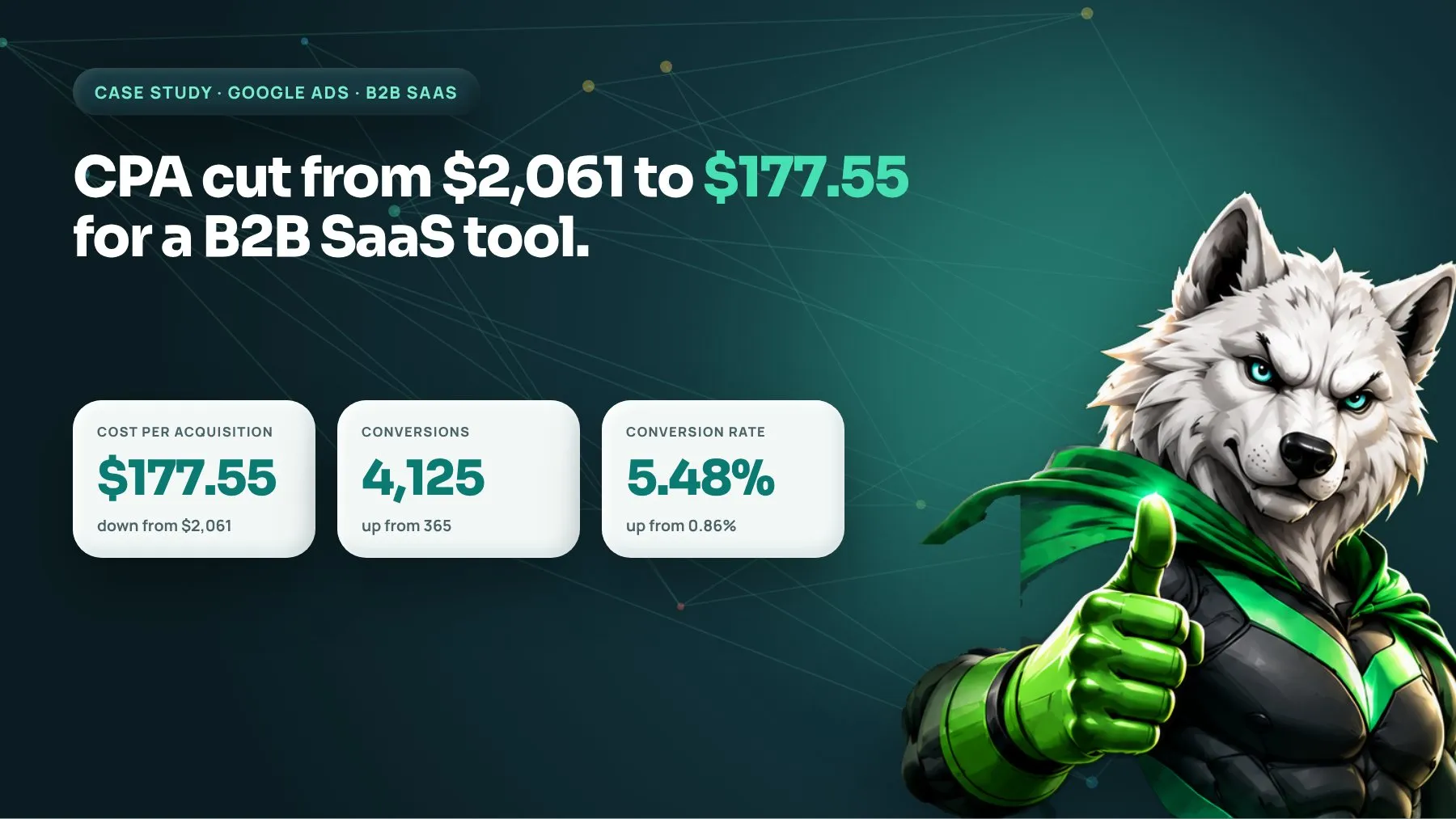
This case study covers a B2B SaaS product: a mass notification tool used to reach people in specific regions of the United States. On almost exactly the same ad spend, we cut the cost per acquisition from $2,061 to $177.55 and grew conversions from 365 to 4,125, by rebuilding the Google Ads account, the landing pages and the tracking behind them.
At a glance
- Client: B2B SaaS company, mass notification tool for US regions
- Services: PPC (primary), SEO (secondary), landing pages, conversion tracking
- Timeframe: Before: 1 Dec 2019 to 28 Feb 2021 (15 months). After: 1 April 2021 to 31 Dec 2021 (9 months)
- Key results: CPA from $2,061 to $177.55; conversions from 365 to 4,125; CTR from 1.03% to 6.39%; conversion rate from 0.86% to 5.48%; CPC from $17.73 to $9.73
How we were selected
Our first meeting was with the company’s HR team on an online call, and they were impressed by our track record. The process took almost 20 days. We then had several calls with the Marketing Director in February 2021. The company was talking to 8 PPC agencies, and we were selected as its marketing agency, with PPC as the main focus and SEO as a secondary priority.
The challenge: a big budget producing very expensive leads
Over 15 months the company had spent $731,235 on paid search and generated 365 conversions. That is a cost per acquisition of $2,061. For a SaaS business, a CPA like that makes growth through paid search almost impossible to justify, however valuable each customer may be.
Our analysis of the paid campaigns and website found ten problems:
- Targeting the whole USA, when the product served specific regions.
- Broad match keywords, which matched the ads to far too many irrelevant searches.
- The wrong keywords selected in the first place.
- Wrong location settings.
- The wrong age groups targeted.
- The wrong landing pages used.
- No conversion tag optimization, so the data was unreliable.
- Unrealistic ad copy.
- No proper call-to-action optimization.
- Nobody monitoring the campaigns once they were live.
We also faced five structural challenges:
- B2B and B2C searchers used the same keywords. Removing consumer queries was essential to stop paying for clicks that could never become customers.
- Landing pages sat on a separate website and could not record leads properly.
- Lead capture ran through Pardot, part of Salesforce.
- The Pardot landing pages were very basic, with no proper tracking because of poor linking and setup.
- No UTM mapping, so nobody could tell which campaign produced which lead.
The commercial impact is clear. Without reliable tracking, Google’s bidding had no good signal to optimize toward, and the marketing team could not see which spend was working. Every dollar was effectively spent blind.
What we did
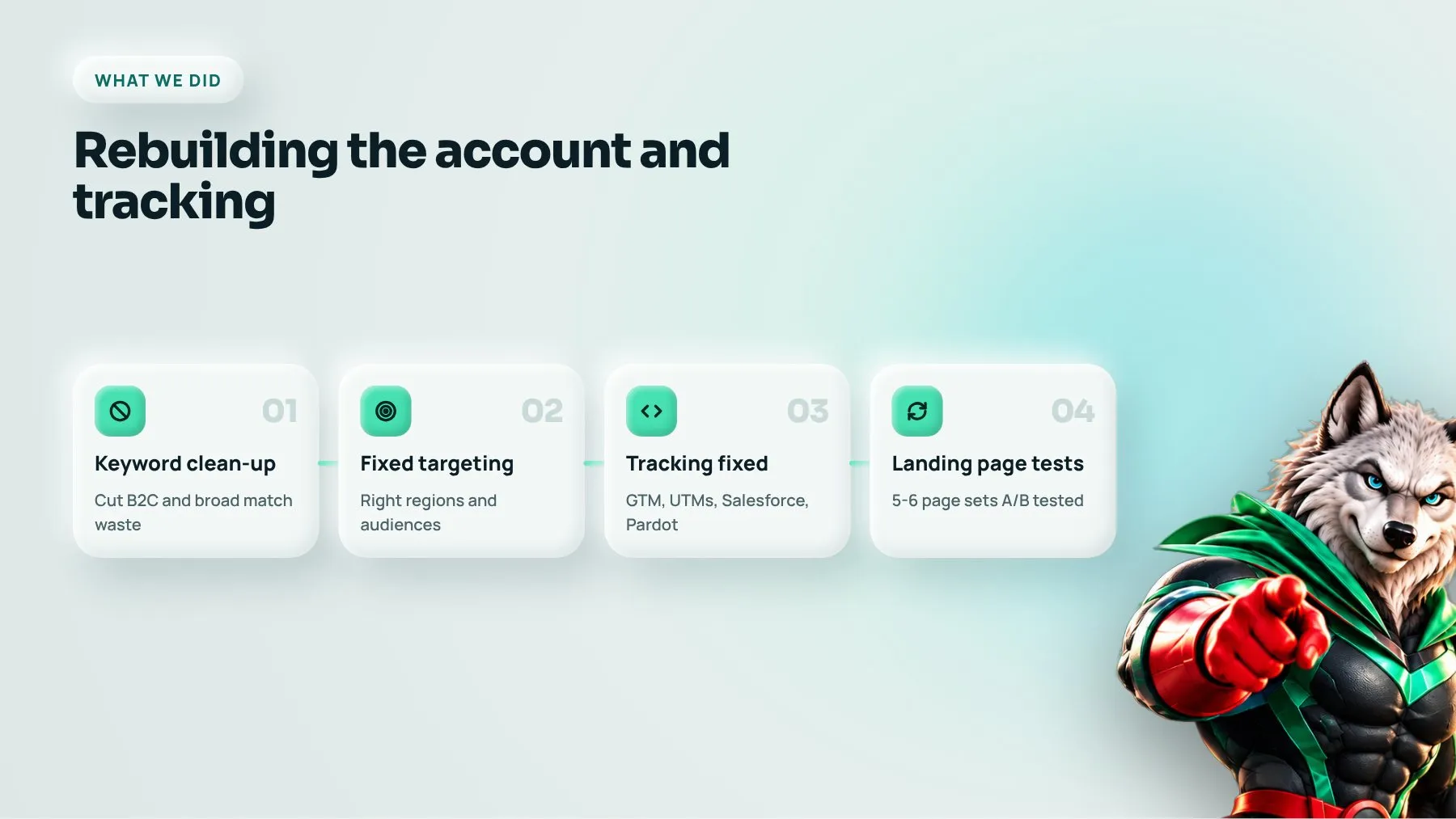
Cleaned out useless keywords
Keywords are the foundation of a search account. We removed every keyword that was not bringing in relevant business buyers and built extensive negative keyword lists. In a market where consumers and businesses search with the same words, negatives are the main defense. Typical themes to exclude include personal and household use, free tools, consumer app searches and job-seeker queries.
We also moved away from broad match, which had let the ads appear for loosely related searches. Tighter match types give much more control over which searches trigger the ads.
Found new, high-intent keywords
We discovered new keywords using market research, real user behavior and our paid research tools. The aim was to find the phrases decision-makers use when they are actively looking for a solution, rather than browsing.
Fixed targeting
We corrected the location settings to focus on the regions the product actually serves, rather than the whole country, and fixed the age targeting. Every click outside the real market is money that cannot produce a customer.
Rebuilt campaigns around themes
We created proper campaigns and ad groups organized by theme and requirement. Tight groups mean the keyword, the ad copy and the landing page all match closely. That relevance lifts Quality Score, which lowers cost per click and improves ad position. It is a large part of why CPC fell from $17.73 to $9.73.
Rewrote the ad copy
We replaced unrealistic claims with clear, credible copy that speaks to business buyers and includes strong calls to action. Honest, specific ads attract the right clicks and discourage the wrong ones.
New landing pages, then A/B testing
We created new landing pages in Pardot with better design and better copy, then ran A/B tests across 5–6 different sets of landing pages. Testing takes opinion out of the process: the version that converts best wins, and the next test tries to beat it.
Fixed tracking end to end
- Conversion code fixed using Google Tag Manager, so Google Ads recorded real conversions accurately.
- UTM parameters fixed and campaigns mapped to Salesforce and Pardot, so every lead could be traced back to its campaign and keyword.
Accurate tracking does two jobs. It shows the team where to invest, and it gives Google’s automated bidding the right signal to find more of the same.
Better tools for meetings and calls
We upgraded the basic meeting scheduler to Chili Piper, making it easier for qualified leads to book a meeting straight away. We also added RingDNA to track calls and appointments. Calls were recorded so the quality of leads could be checked, which closed the loop between ad spend and real sales conversations.
Retargeting and ongoing management
We created retargeting campaigns to bring back visitors who showed interest but did not convert, which is common in B2B where decisions involve several people and take time. And unlike before, the campaigns were actively monitored and managed after launch.
The results
| Metric | Before (15 months) | After (9 months) |
|---|---|---|
| Clicks | 41,235 | 75,235 |
| Impressions | 3,985,211 | 1,085,325 |
| Conversions | 365 | 4,125 |
| CPC | $17.73 | $9.73 |
| Budget spend | $731,235 | $732,255 |
| CTR | 1.03% | 6.39% |
| Conversion rate | 0.86% | 5.48% |
| Cost per acquisition | $2,061 | $177.55 |
The spend was almost identical, but the outcome was transformed. Impressions fell while clicks rose, because the ads were now shown to far fewer, far more relevant people. That is why CTR rose from 1.03% to 6.39%. Those better visitors then landed on tested pages and converted at 5.48% instead of 0.86%. Lower CPC, higher CTR and higher conversion rate combined to cut CPA from $2,061 to $177.55, in 9 months rather than 15.
What made the difference: lessons for B2B SaaS companies
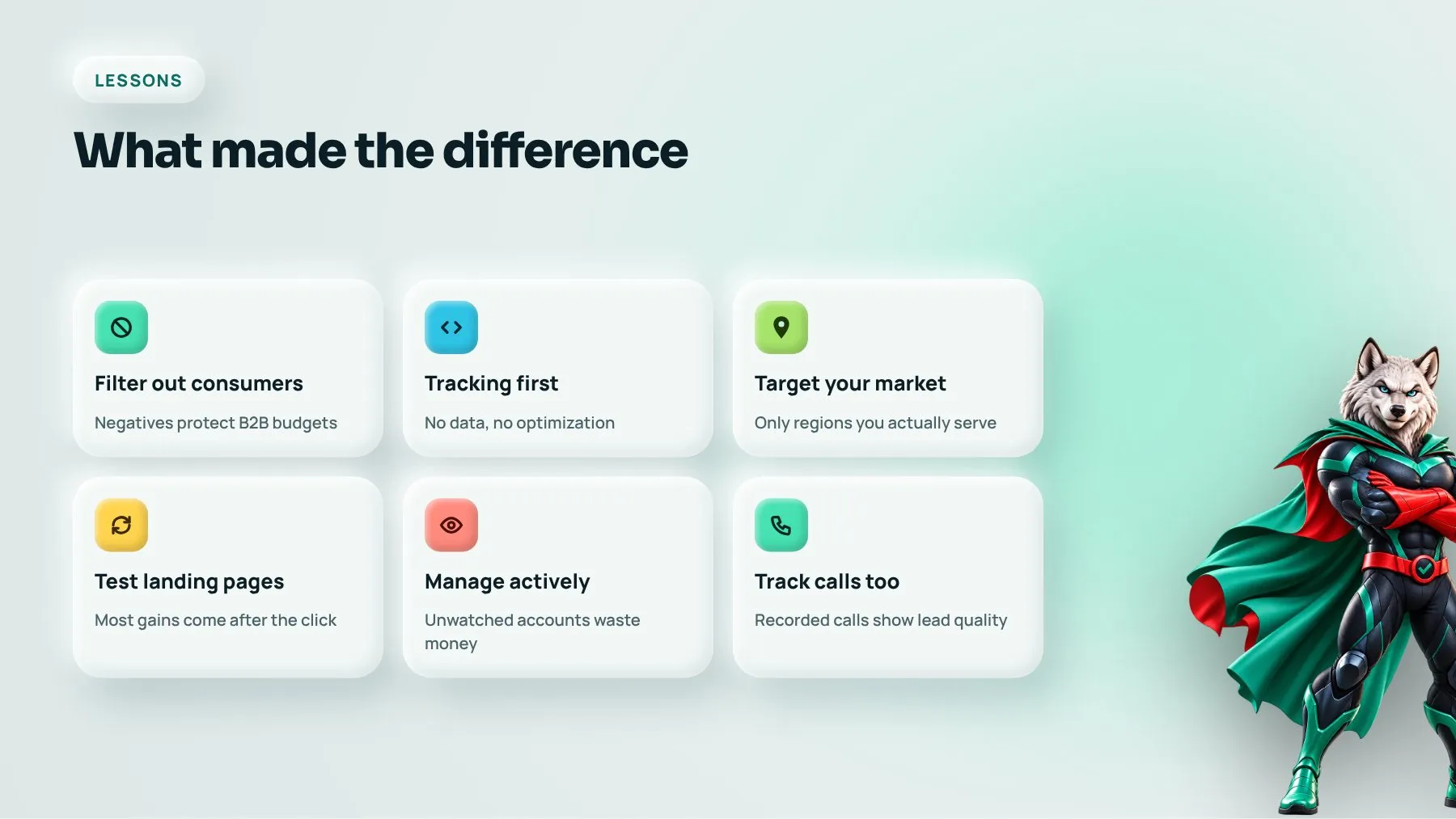
- Filter out consumers aggressively. When B2B and B2C share keywords, negative keywords and tight match types protect your budget.
- Tracking comes first. If conversions are not recorded and mapped to your CRM, neither you nor Google can optimize.
- Target only the market you serve. Location and audience settings are simple to fix and expensive to get wrong.
- Test landing pages continuously. The page is often where most of the conversion gain is found.
- Someone must manage the account. Campaigns left alone after launch drift and waste money.
How to apply this to your business
- Check your search terms report for consumer and irrelevant queries, and add negatives.
- Confirm conversion tracking works and flows into your CRM with UTM parameters.
- Make sure location and audience targeting match your real customers.
- Group keywords tightly by theme, with matching ads and landing pages.
- Run at least one landing page A/B test at a time.
- Review the account weekly.
FAQ
Why is Google Ads so expensive for B2B SaaS?
B2B software keywords are competitive, and many searchers are not real buyers. Without careful keyword selection, negatives and tracking, a large share of spend goes on clicks that never convert, which drives CPA up.
How long does it take to fix an underperforming Google Ads account?
Structural fixes such as keywords, targeting and tracking can improve results within weeks. Landing page testing and bidding optimization usually need a few months of data to reach their full effect.
Do we need a CRM integration for PPC?
For B2B, yes. Connecting ads to a CRM such as Salesforce shows which campaigns produce real pipeline, not just form fills, so budget can move toward what actually generates revenue.
Want the same for your SaaS business? See our Google Ads management, explore our lead generation services or book a strategy call.