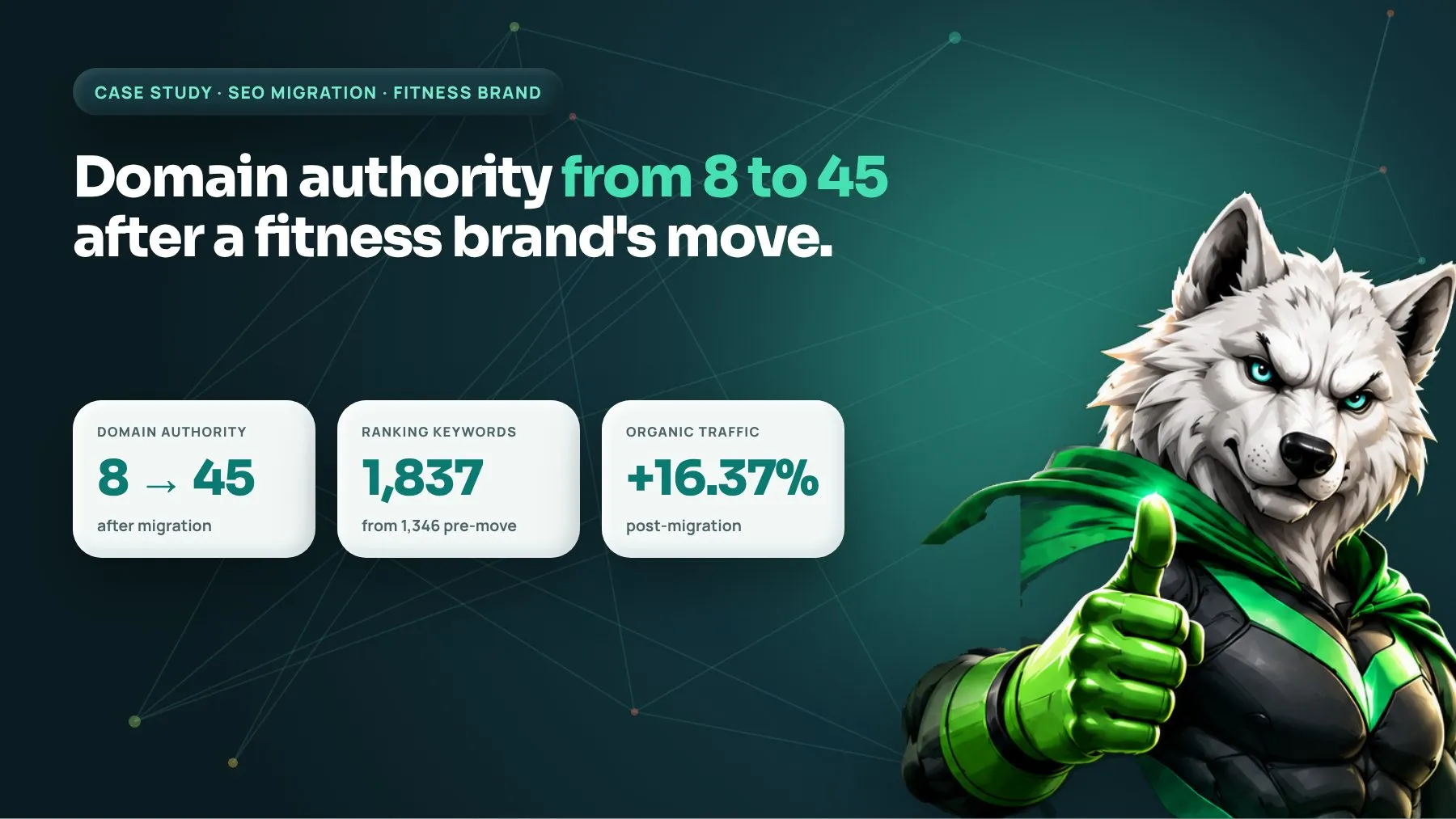
A fitness brand offering workouts, mental wellness, healthcare, nutrition and medical care, online and offline, wanted to bring all its products under one brand name and one domain. We planned and ran the migration. After the move, domain authority recovered from 8 to 45, ranking keywords rose from 1,346 to 1,837, and organic search traffic grew by 16.37%.
At a glance
- Client: Fitness brand serving customers online and offline
- Service: SEO, website domain migration
- Key results:
- Domain authority restored from 8 to 45
- Ranking keywords up from 1,346 pre-migration to 1,837
- Organic search traffic up 16.37%
The challenge: consolidating a brand without losing search visibility
The brand had grown into several areas: workouts, mental wellness, healthcare, nutrition and medical care. Its objective was to bring all of its fitness products under a single brand name and reach more users. Commercially, that makes sense. One brand is easier to market, easier for customers to trust, and builds recognition faster than several separate names.
But moving a website to a new domain is one of the riskiest things a business can do in SEO. Every page Google has indexed, every ranking and every backlink points at the old addresses. Handled badly, a migration can wipe out years of search visibility overnight. The brand faced three specific concerns:
- Domain authority recovery: a new domain starts with little authority of its own. The brand needed a realistic estimate of how long recovery would take and what to expect.
- Reduced visibility on the SERPs: during and after a move, rankings commonly dip while Google recrawls and reassesses the site.
- Loss of traffic: fewer rankings means fewer visitors, and for a brand selling memberships, programs and services, fewer visitors means fewer customers.
The job was to make the move while protecting what the brand had already earned, and then grow beyond it.
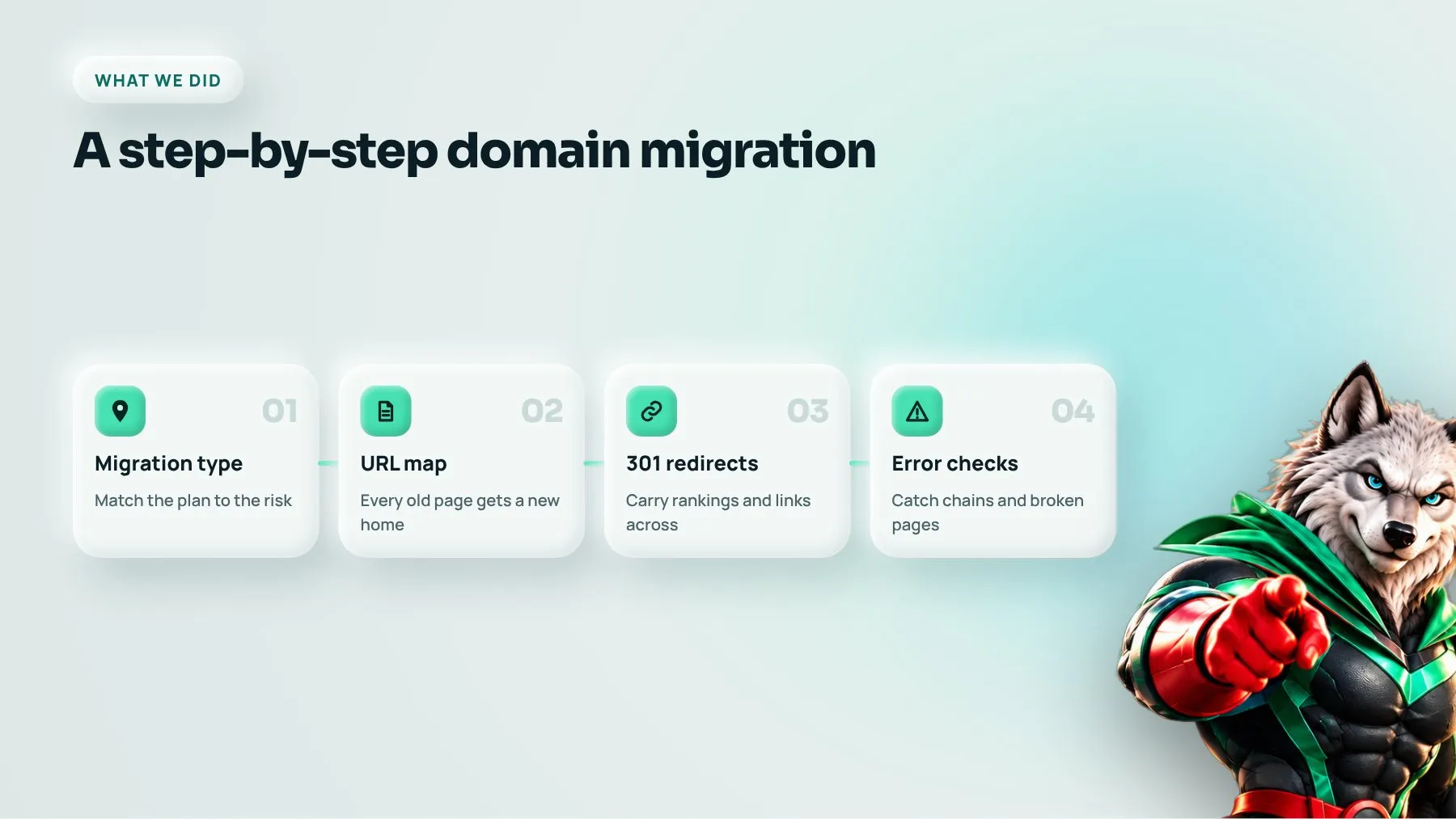
What we did: a structured, step-by-step domain migration
Good migrations are won in planning. We ran the project in clear stages, so that nothing important was left to chance on launch day.
Moving to the new domain
We started by agreeing exactly what was moving: which domains and sections would be consolidated, which content would carry over, and which pages would be merged or retired. For a brand covering several service areas, this meant deciding how workouts, wellness, nutrition and medical content would sit together in one clear structure.
Planning for the type of website migration
Not all migrations are the same. A domain change alone is different from a domain change combined with a new design, new platform or new URL structure. The more that changes at once, the higher the risk. We identified the type of migration involved so the plan, testing and monitoring matched the real level of risk.
Building the migration plan
The core of the plan was a complete URL map. We crawled the existing sites and exported every indexed URL, then matched each old URL to its most relevant new equivalent. The plan also covered:
- Benchmarks: recording rankings, traffic and indexed pages before the move, so recovery could be measured accurately.
- Priority pages: identifying the pages carrying the most traffic, rankings and backlinks, which needed the closest attention.
- Backlink preservation: making sure pages with valuable links redirected to the right destination so that authority would pass to the new domain.
Initiating the move with a site migration plan
At launch we followed the plan step by step: one-to-one 301 (permanent) redirects from old URLs to new ones, updated internal links and canonical tags pointing to the new domain, a new XML sitemap, and the new domain verified in Google Search Console. Where available, the change-of-address tool was used to tell Google about the move.
Avoiding pitfalls and identifying errors
Most migration losses come from a handful of avoidable mistakes: redirect chains, redirects pointing everything at the homepage, broken pages, staging-site settings that block search engines, and internal links still pointing at old addresses. We crawled the new site and tested the redirects against the URL map to catch these before they could cost rankings.
Validating the migration progress
After launch, we checked that Google was crawling the new domain, that the new pages were being indexed and the old ones dropped, and that errors in Search Console were being resolved quickly.
Monitoring performance
Finally, we tracked rankings, traffic and authority against the pre-migration benchmarks, so that any drop could be traced to its cause and fixed rather than guessed at.
The results: stronger authority and more traffic than before the move
The migration didn’t just recover what the brand had. It grew it.
- Domain authority restored from 8 to 45. Domain authority is a third-party score that estimates how strong a site’s backlink profile is. A new domain starting at 8 has very little standing; reaching 45 shows that the authority built up across the old sites was successfully passed to the new one and then built upon.
- Ranking keywords up from 1,346 to 1,837. The consolidated site ranks for more searches than the brand did before the migration, which means the brand now appears for a wider range of fitness, wellness and nutrition queries.
- Organic search traffic up 16.37%. More of those rankings turned into real visits.
For a business consolidating under one name, this is the outcome that matters: a single, stronger brand that reaches more people in search, without the traffic collapse that so often follows a poorly run migration.
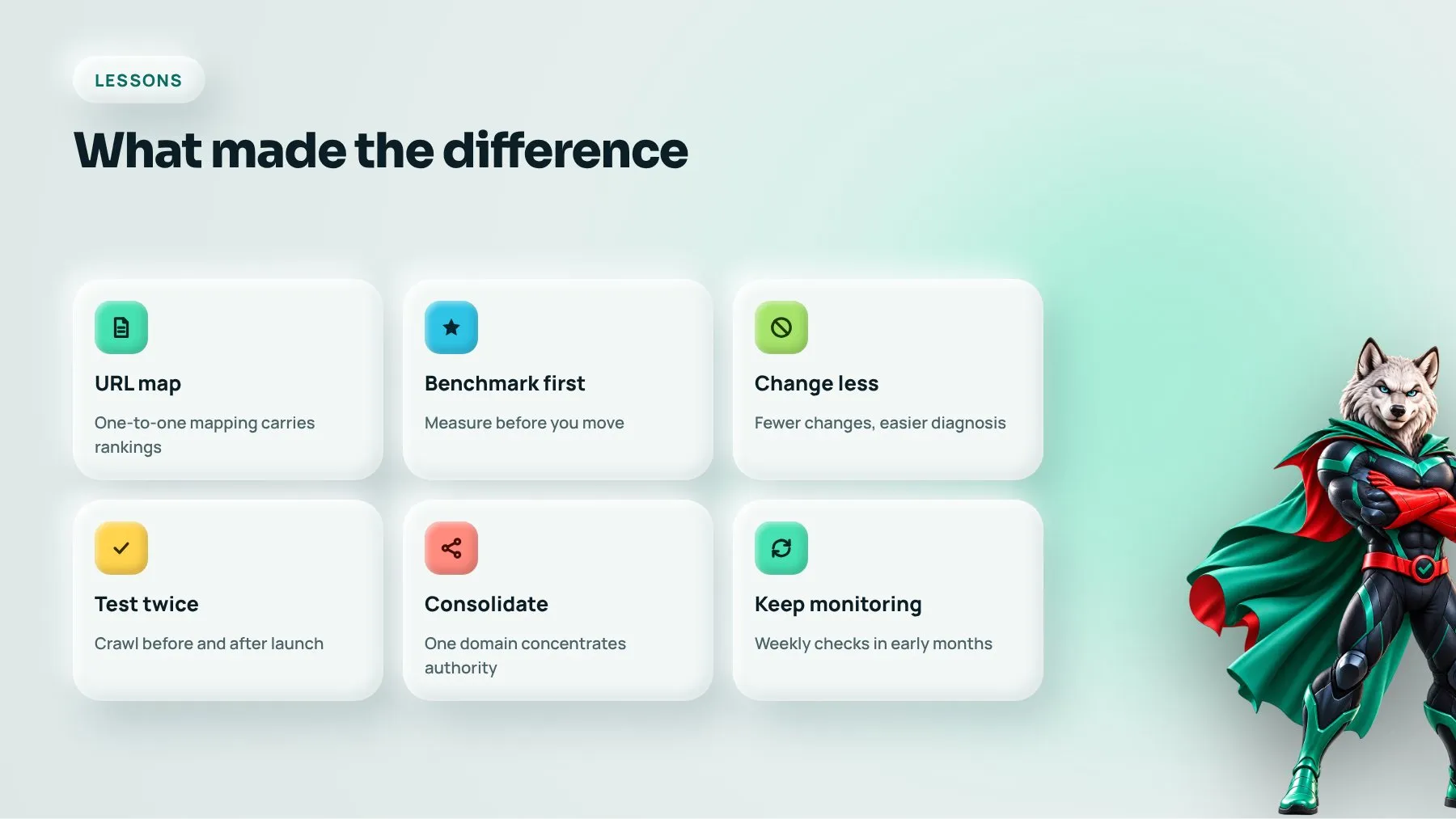
What made the difference: lessons for brands planning a migration
The URL map is everything
Every old page needs a clear new home. Mapping URLs one to one is what carries rankings and links across.
Benchmark before you move
Without pre-migration data, there is no way to know whether recovery is on track or what went wrong.
Change as little as possible at once
The more you change in a single launch, the harder it is to diagnose problems. Match the plan to the type of migration.
Test before and after launch
Crawling and redirect testing catch the small errors that cause big losses.
Consolidation can strengthen SEO
Bringing several sites under one domain concentrates authority, which can lift the whole brand when done carefully.
How to apply this to your business
- Crawl your current site and export every indexed URL before you plan anything.
- Map each old URL to its closest new equivalent and implement 301 redirects.
- Record rankings, traffic and indexed pages as a benchmark.
- Update internal links, canonicals and sitemaps to the new domain.
- Verify the new domain in Search Console and monitor it weekly for the first few months.
FAQ
Will I lose traffic if I change my domain?
A short-term dip is common while Google processes the move, but a well-planned migration should recover and can end up stronger, as this case shows. Most serious, lasting losses come from missing or incorrect redirects.
How long does it take to recover after a domain migration?
It varies with the size of the site and the complexity of the move. Many sites recover within a few weeks to a few months. Monitoring against benchmarks shows whether you are on track.
Should I combine several websites into one?
Often, yes, if they serve the same brand and audience. One domain is easier to grow and concentrates authority. It needs careful planning so that each old site’s rankings and links are carried over.
Planning a website move or rebrand? See our SEO services and website development, or book a strategy call.