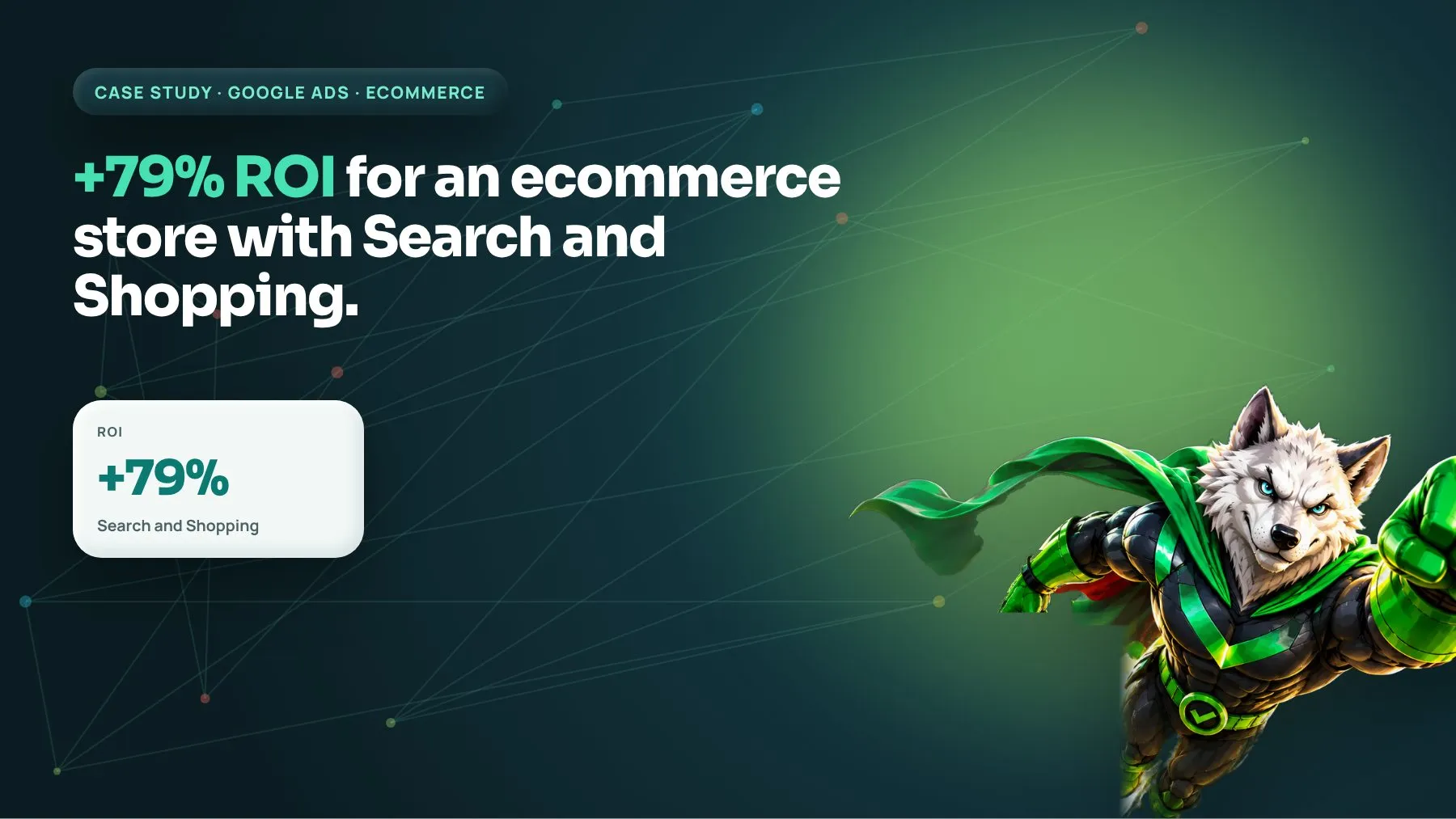
An ecommerce store asked us to turn its paid search into a dependable source of sales. It wanted more leads, more regular orders and a lower cost per conversion. By rebuilding keyword targeting around commercial intent, rewriting ad copy and running dedicated Search and Shopping campaigns, we delivered a 79% increase in ROI and a broader customer base.
At a glance
- Client: Ecommerce retailer
- Services: Google Ads management (Search and Shopping campaigns), keyword research, ad copywriting
- Key result: 79% increase in ROI
The challenge: traffic that did not pay its way
The client came to us with three clear goals:
- Choose relevant keywords with commercial intent
- Bring suitable traffic to the website
- Increase sales and reduce the cost of conversions
These goals describe a familiar problem in ecommerce advertising. It is easy to buy clicks. It is much harder to buy clicks from people who are ready to purchase at a price that leaves a profit. When an account targets broad, informational searches, the store pays for browsers and researchers who never check out, and the cost of each sale climbs until advertising stops making sense.
For an online store, that matters more than for most businesses. Margins on individual products are finite, and every wasted click comes straight out of them. Regular, predictable sales also matter for stock planning and cash flow, so the client needed a campaign structure it could rely on month after month, not occasional spikes.
What we did: intent-led keywords, better ads and Shopping campaigns
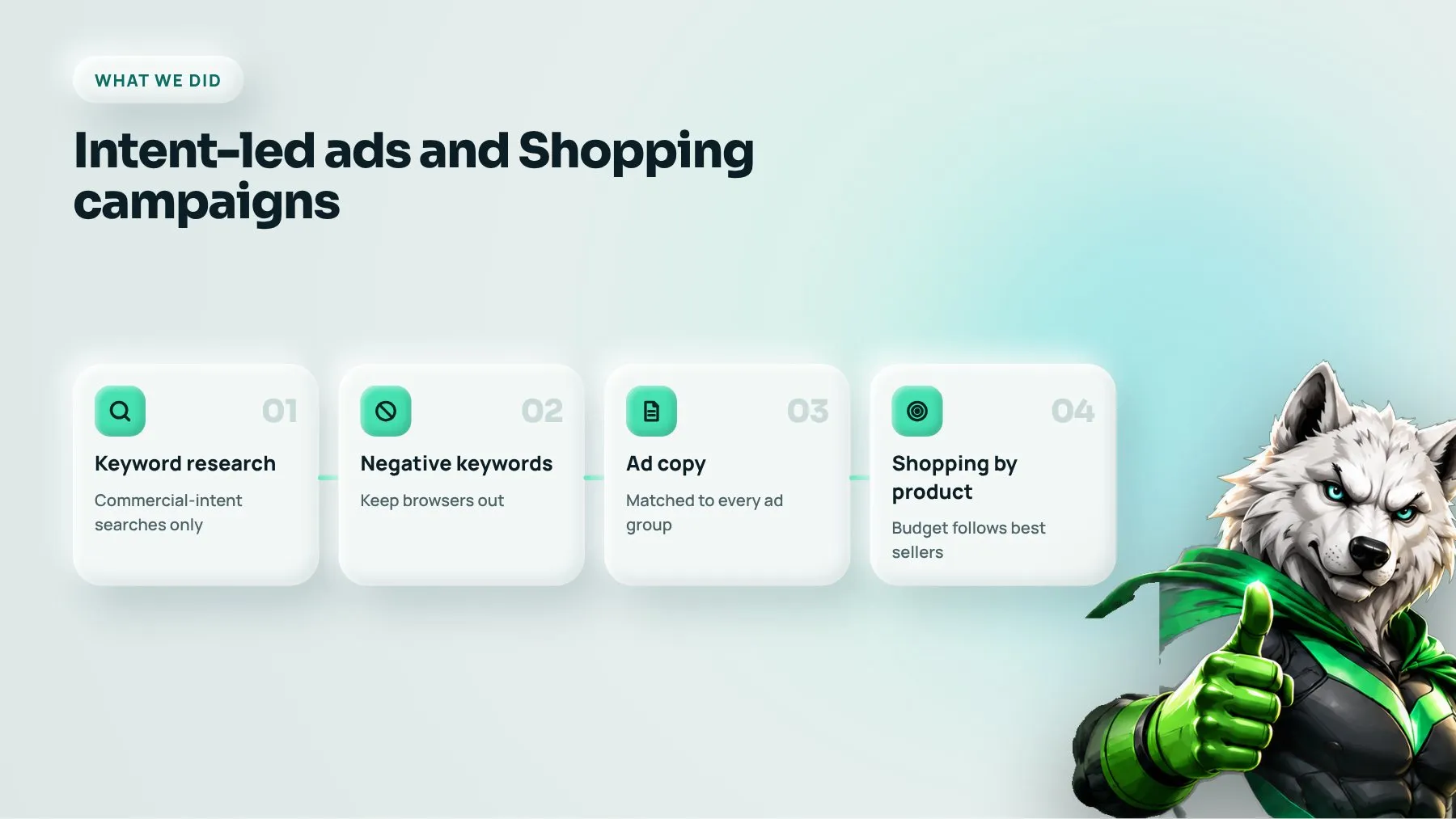
Keyword research focused on commercial intent
We started with fresh keyword research. The aim was not simply more keywords, but the right ones: searches that show someone is close to buying. Product names, product types with modifiers such as “buy” or “price”, and specific model or variant searches all signal purchase intent far more than generic, top-of-funnel topics.
We then retargeted the keywords with higher traffic and search volumes, concentrating budget on terms that combined real demand with buying intent. In a well-run account this also means:
- Using match types deliberately, so broad matching does not drag in irrelevant searches
- Building negative keyword lists for themes that attract browsers rather than buyers, such as free, DIY, jobs or how-to searches
- Grouping keywords tightly so each ad group speaks to one clear need
Rewriting ad copy around relevant keywords
Next, we edited the ad copy so each ad reflected the keywords in its group. When the words someone searched appear in the ad, the ad is more relevant to them, they are more likely to click, and Google tends to reward that relevance with better ad quality and more efficient costs.
Good ecommerce ad copy also does some selling before the click. It highlights what makes the store worth buying from, such as range, delivery or returns, and it sets expectations so the people who click are the people likely to convert. The goal was ads that brought in more traffic and more leads, but specifically more of the right traffic.
Search and Shopping campaigns built for conversions
Finally, we created and ran Search and Shopping campaigns designed to drive conversions.
Search campaigns capture people typing specific product and category queries. Shopping campaigns show the product itself, with image, title and price, directly in search results. For an online store, Shopping is often the most efficient channel in Google Ads, because shoppers see exactly what they will get and what it costs before they click.
With the challenge of increasing revenue and sales, we carved out Shopping campaigns by product to enhance sales and the customer base. These campaigns specifically targeted product-based keywords. Splitting Shopping campaigns this way gives much finer control: budget and bids can follow the products that sell well and earn a good return, rather than being spread evenly across a catalog where some items rarely convert. It also makes it far easier to see which products are driving the result and which need attention, whether that is a better product title, a better image or a price review.
The results: a 79% increase in ROI
The headline result was a 79% increase in ROI.
ROI is the number that matters most in ecommerce advertising, because it measures what the business keeps, not just what it sells. A 79% improvement means each unit of ad spend was producing substantially more return than before. That is the combined effect of all three changes: better keyword targeting cut wasted spend, better ads attracted more qualified shoppers, and product-level Shopping campaigns put budget behind the items most likely to sell.
The work also met the client’s broader goals. Traffic became more suitable because it came from people searching with commercial intent, and the Shopping campaigns brought in new customers who discovered the store through its products, broadening the customer base the client wanted to grow.
What made the difference: lessons for ecommerce brands
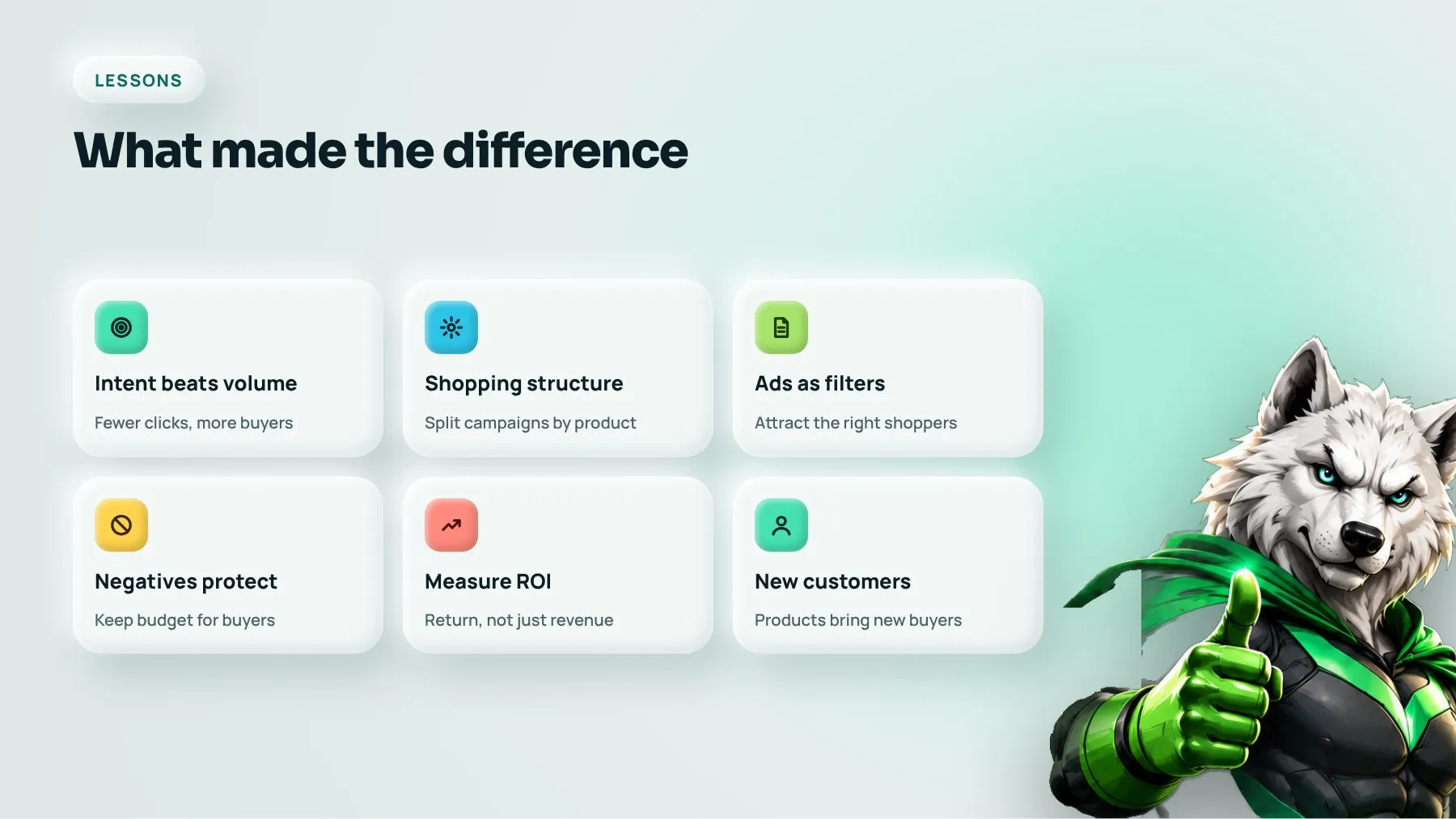
- Intent beats volume. A smaller number of clicks from people ready to buy is worth more than a flood of browsers.
- Shopping campaigns deserve their own structure. Splitting campaigns by product lets you put money where the returns are.
- Ad copy is a filter as well as a hook. Clear, relevant ads attract the right shoppers and discourage the wrong ones.
- Negative keywords protect margin. Every irrelevant search you block is budget you keep for buyers.
- Measure return, not just revenue. ROI shows whether advertising is truly growing the business.
How to apply this to your business
- Review your search terms report and list every search that clearly is not a buyer. Add them as negatives.
- Check whether your Shopping campaigns treat all products the same. Separate best sellers from the rest.
- Make sure product titles in your feed include the words customers actually search for.
- Rewrite ads so they match the keywords in each ad group and mention a genuine reason to buy from you.
- Track conversion value and ROI inside Google Ads, not just clicks and conversions.
FAQ
Should my online store use Search or Shopping campaigns?
Most ecommerce stores benefit from both. Shopping campaigns are usually strongest for product searches because shoppers see the item and price first, while Search campaigns capture category, brand and specific queries. The right balance depends on your catalog and margins.
How long does it take to improve Google Ads ROI?
Some improvements, such as adding negative keywords and fixing ad relevance, can show within weeks. Restructuring Shopping campaigns and letting bidding learn from new data usually needs one to three months before results stabilize.
What budget do I need for Google Shopping?
There is no fixed minimum, but the budget needs to be large enough to gather meaningful data on your key products. It is usually better to focus a modest budget on your best products than to spread it thinly across the whole catalog.
Want stronger returns from your ecommerce advertising? See our Google Ads management, explore our Amazon marketing service, or book a strategy call.