An online golf store was spending around $100 a day on paid ads and getting only a couple of sales for it. Each sale cost about $450 to win, while the average order was worth $150, so every sale lost money. We rebuilt the campaigns and improved the website experience without raising the budget. Cost per sale fell to $48, the average sale value rose to $270, and the account delivered a 462% ROI.
At a glance
- Client: Online golf store (ecommerce)
- Services: Google Ads management, landing page and offer optimization
- Budget: Unchanged at $100 per day
- Key results: Cost per sale $450 → $48; average sale value $150 → $270; 61 conversions; $16,470 total sale value from $2.93K spend; 462% ROI
The challenge: paying $450 to make a $150 sale
The numbers before we started told the whole story. A $450 cost per sale against a $150 average sale value means the store lost about $300 on every order it won through ads, before even counting the cost of the product. No amount of extra budget fixes that. It only makes the losses bigger.
This is a common trap in ecommerce advertising, and golf is a particularly tough category for it. Golf shoppers often research heavily, compare prices across big retailers and brand sites, and search for very specific products and models. Broad campaigns pick up a lot of browsing, comparison and curiosity traffic that rarely buys. Meanwhile, a small store competes against retailers with far bigger budgets.
The store did not need more spend. It needed every dollar to go to searches that buy, and a site that turned those visitors into larger orders.
What we did
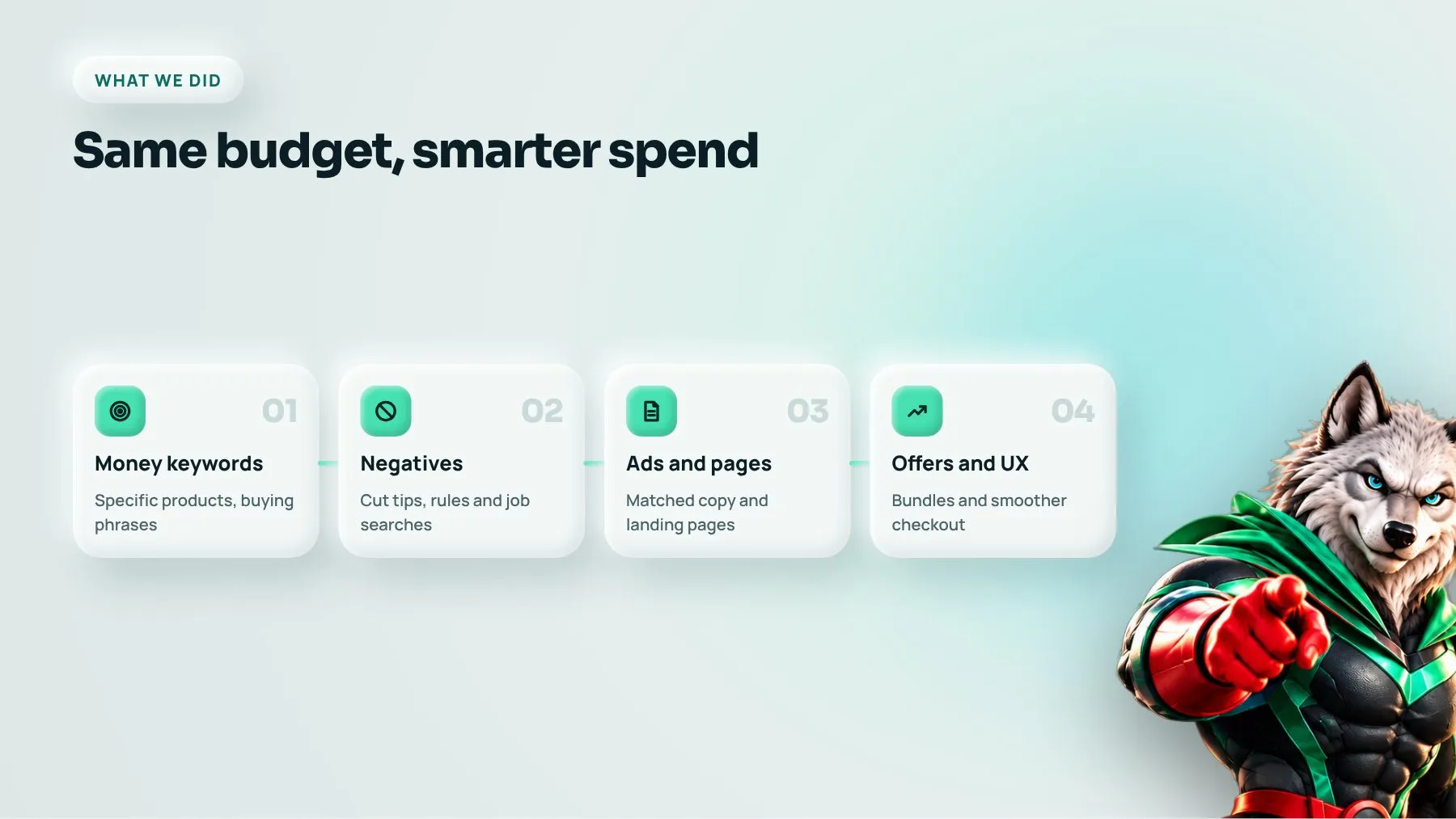
We kept the daily budget the same at $100 and focused on four areas.
Money keyword selection and optimization
“Money keywords” are the searches closest to a purchase: specific product types, models and buying phrases, rather than general golf terms. We rebuilt the account around them:
- Tight ad groups by product category, so a search for a particular club type met an ad and a page about that exact product.
- Exact and phrase match on proven buying terms, so budget was not spent on loose variations.
- Bids weighted toward terms with real purchase history, and pulled back from terms that only produced clicks.
Cutting low-quality keywords and adding negatives
Much of the old spend was going to searches that were never going to convert. We paused low-quality keywords and built negative keyword lists to block typical non-buying themes in golf, such as tips and how-to searches, rules and scores, course and tee-time searches, jobs, and “free” or “cheap” searches that did not fit the store’s range. Every dollar saved here went back into searches that sell.
Content strategy for landing pages and ad copy
Ads and landing pages have to work as a pair. We rewrote ad copy to speak to specific products and buyer motivations, such as performance, fit and value, and to set clear expectations on price and delivery. We then made sure each ad pointed to the most relevant page, not the homepage, with product information, imagery and calls to action designed to help a golfer decide.
Improving offers and user experience
This is where average sale value grew. After rebuilding the campaigns, we made improvements to the website itself:
- Stronger offers to encourage larger baskets, such as bundles or thresholds that make adding a second item worthwhile.
- Related product suggestions on product pages, so a buyer of one item sees what goes with it.
- Smoother checkout and clearer product pages, removing friction that causes shoppers to abandon.
Raising the average order from $150 to $270 changed the economics of every campaign: the store could afford to win each sale and still keep a healthy margin.
The results
Across the period reported:
- Amount spent: $2.93K
- Visitors: 4.75K
- Total conversions: 61
- Average sale value: $270
- Total sale value: $16,470
- ROI: 462%
The two numbers that matter most are the ones that started the story. Cost per sale fell from $450 to $48, and average sale value rose from $150 to $270. Where the store used to lose money on every ad-driven order, it now spent $48 to win an order worth $270, on the same $100 daily budget.
What made the difference
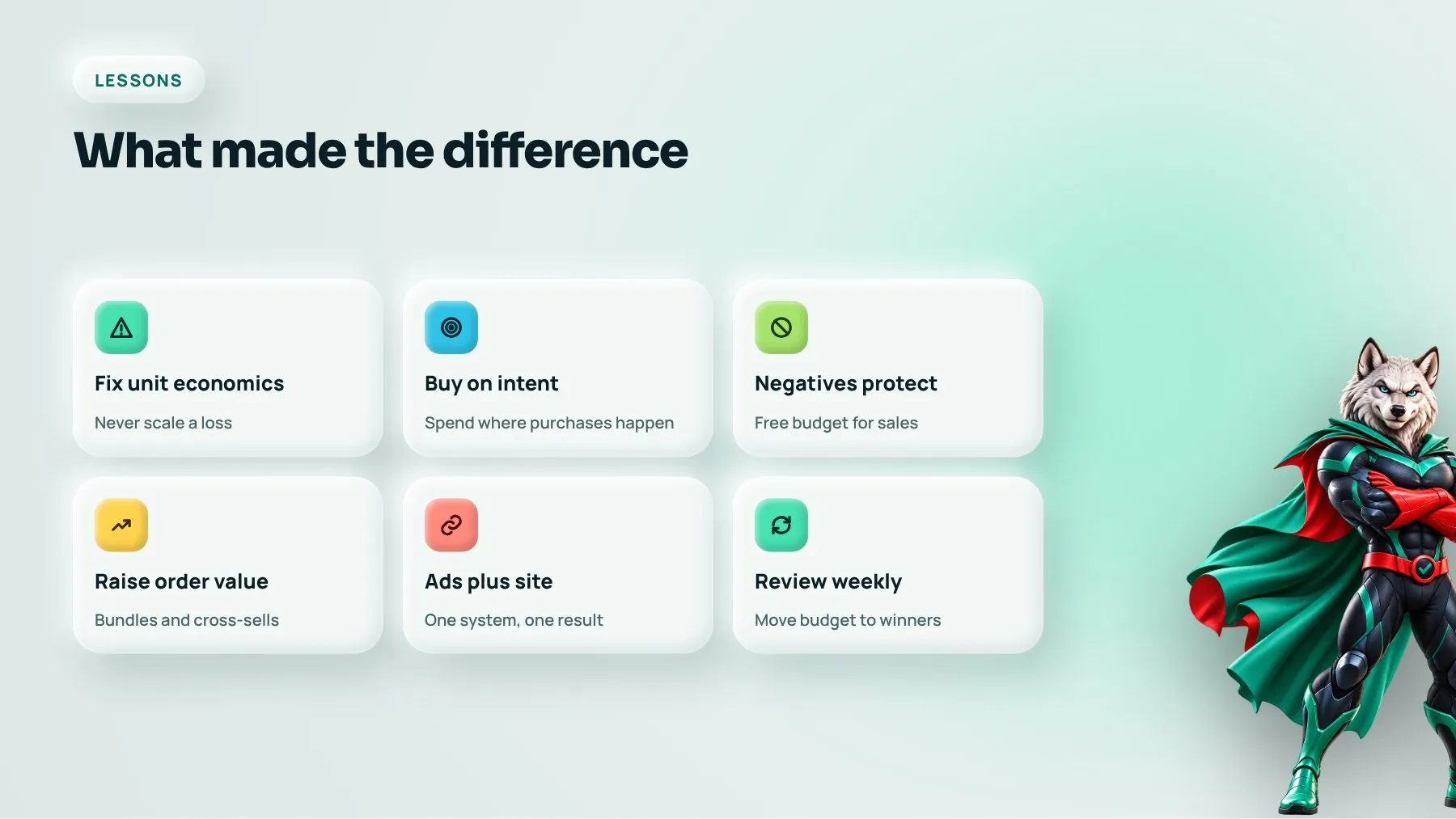
Fix unit economics before scaling
If cost per sale is higher than order value, adding budget only grows the losses. Fix the ratio first.
Spend on buying intent
Money keywords and match-type discipline put budget where purchases happen.
Negatives protect the budget
Golf attracts a lot of informational searches. Blocking them freed money for searches that sell.
Order value is a marketing lever
Better offers and cross-selling made each click more valuable, which is often easier than making clicks cheaper.
Ads and site are one system
Campaign changes and website improvements together produced the result. Neither alone would have.
How to apply this to your store
- Calculate your current cost per sale and average order value. If the first is higher, stop scaling.
- Rebuild ad groups around specific product categories and buying phrases.
- Review your search terms report and build negative keyword lists.
- Point every ad to its most relevant product or category page.
- Test bundles, thresholds and related-product suggestions to lift order value.
- Review performance weekly and move budget to what converts.
FAQ
Do I need a bigger budget to make Google Ads work for my store?
Not necessarily. This store kept the same $100 per day and transformed results by changing where the money went and what happened after the click. Budget increases make sense once the numbers are profitable.
How do I lower my cost per sale on Google Ads?
Focus on high-intent keywords, remove wasted spend with negatives, match ads closely to landing pages, and improve conversion rate on the site. Each of these lowers the cost of winning a sale.
Should I use Shopping ads for an ecommerce store?
For most product-based stores, Shopping or Performance Max campaigns are worth testing alongside search, because they show price and image before the click. They need a clean product feed and accurate conversion tracking to work well.
Want the same for your store? See our Google Ads management or book a strategy call.