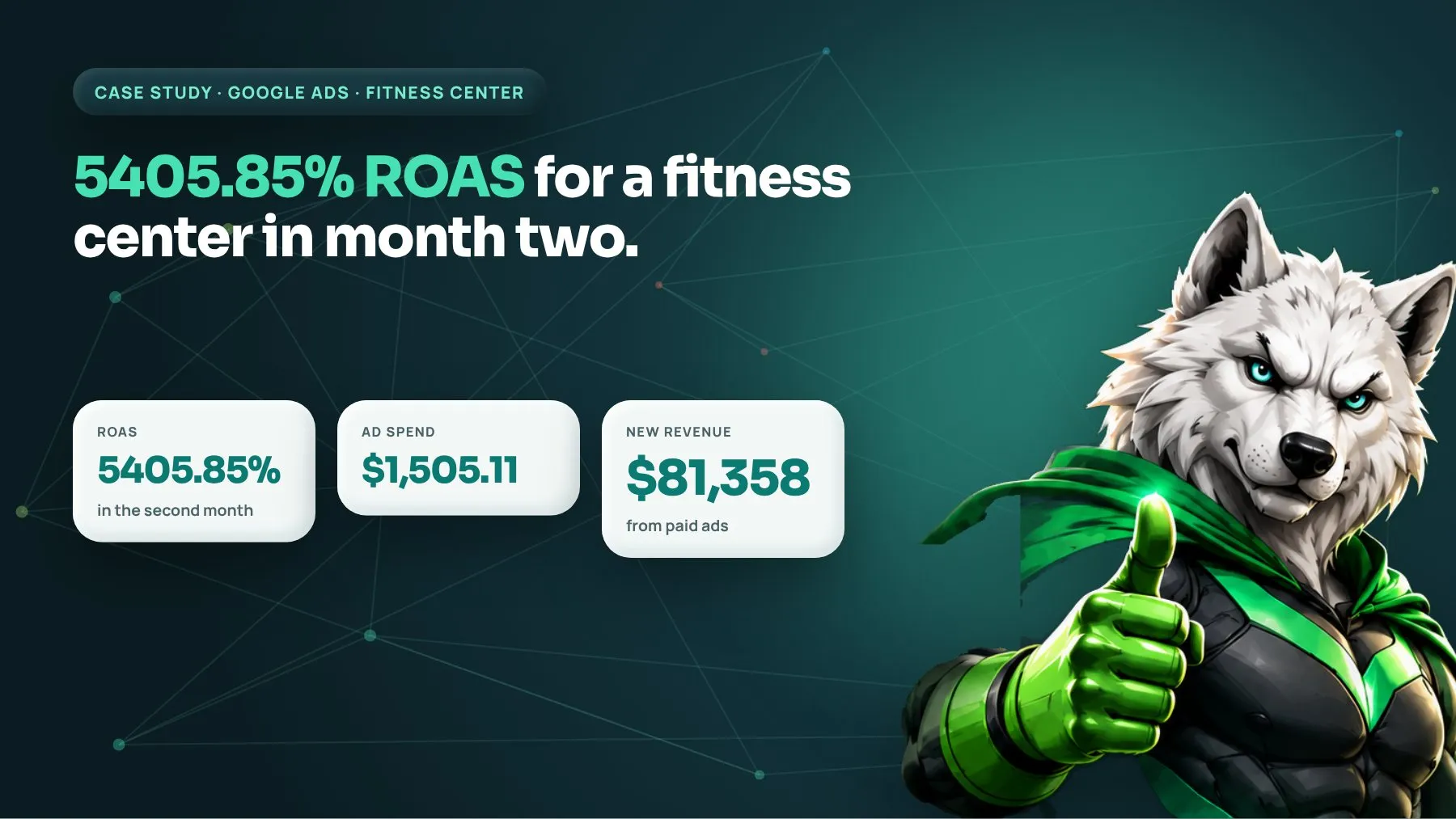
A fitness center came to us wanting to use paid advertising to expand and sell more, and with a clear benchmark in mind: beat the Google Ads numbers their previous agency had delivered. By the second month of working together, the account returned a 5405.85% ROAS, with $1,505.11 in ad spend producing $81,358.36 in new revenue.
At a glance
- Client: Fitness center
- Service: Google Ads management, Google Merchant Center setup
- Timeframe: Result recorded in the second month
- Key results: 5405.85% ROAS; $1,505.11 spent; $81,358.36 in new revenue
The challenge: paid ads that had to beat a previous agency
The client was not new to Google Ads. They had already run campaigns with another agency, so they knew what “acceptable” looked like and wanted more. That is a common and healthy position for a business owner to be in: you have a baseline, and you want proof that a new partner can move it.
For a fitness business, the commercial stakes of paid search are specific. Fitness buyers often decide quickly and locally, demand is seasonal (new-year resolutions, pre-summer, back-to-routine in autumn), and competition for attention is intense, from big-box gym chains to boutique studios to online programs. If campaigns are loosely built, spend leaks into broad, low-intent searches (“free workouts”, “how to lose weight”) that will never turn into a sale. If product and offer data is not set up properly, the business misses out on Shopping placements, which put price and image in front of a buyer before they even click.
So the brief was not simply “run ads”. It was: rebuild the foundations so every dollar has a clear route to revenue, and do it fast enough to show a difference against the old agency’s numbers.
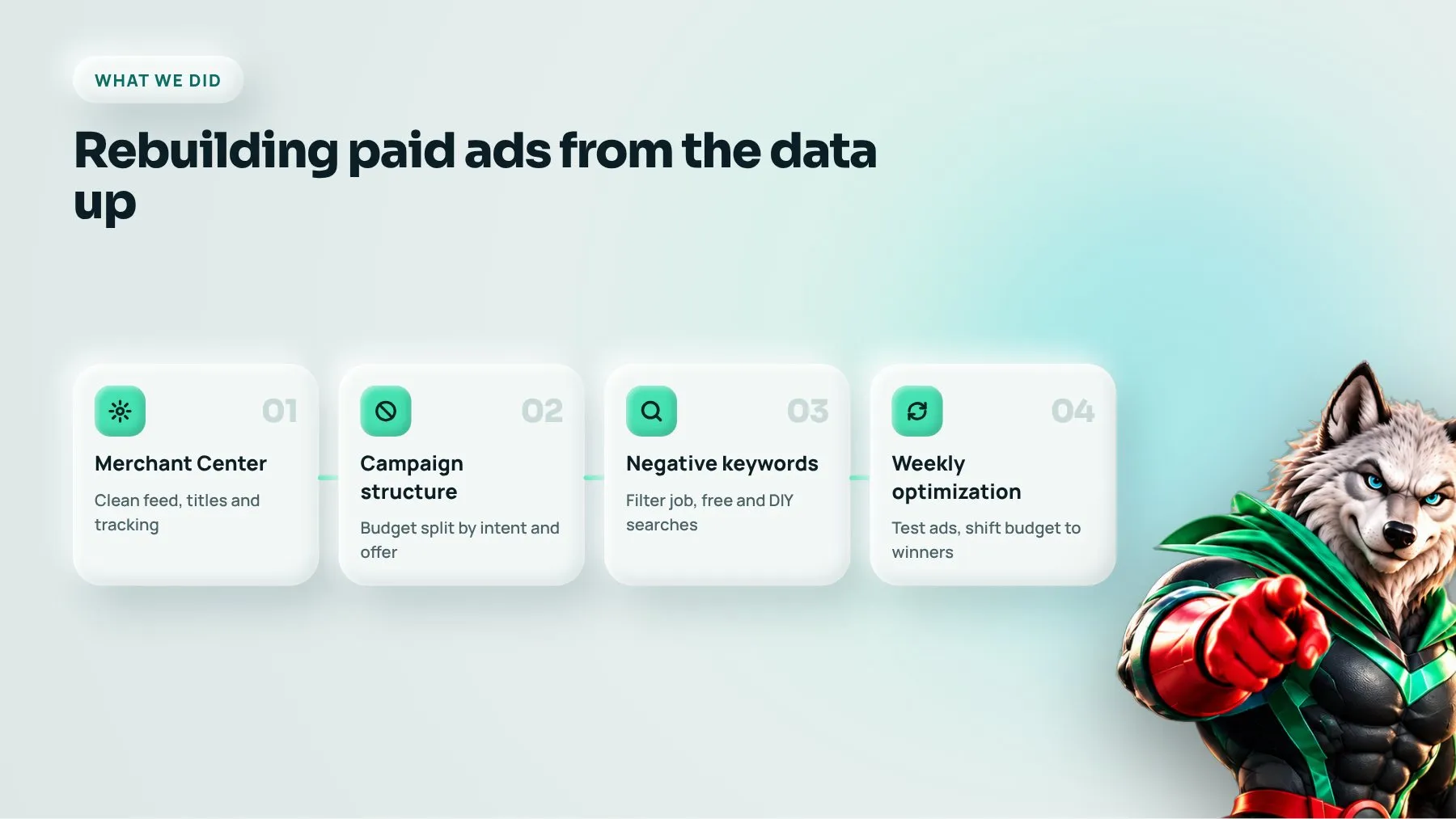
What we did: three moves, done properly
The original plan had three parts: build the Google Merchant Center, restructure the paid campaigns, and optimize them continuously. None of these is exotic. The difference is in how carefully each one is done.
1. Building the Google Merchant Center
Google Merchant Center is where a business tells Google what it sells: products, prices, availability, images and identifiers. It is the data source behind Shopping ads and product listings across Google, and it feeds Performance Max campaigns too.
We built it because a fitness business that sells products, memberships or packages online loses visibility without it. A well-built feed does several things:
- Clean, descriptive titles that match how people actually search (product type, key attribute, brand where relevant), rather than internal product names.
- Accurate pricing and availability, so ads are never disapproved and buyers never hit a mismatch between the ad and the checkout.
- Good images that meet Google’s requirements and stand out on a results page full of competitors.
- Correct categories and custom labels, so we can later group products by margin, price band or bestseller status and bid accordingly.
- Verified conversion tracking, so revenue flows back into Google Ads and the bidding system learns from real sales, not clicks.
That last point matters more than most business owners realize. Without reliable revenue tracking, ROAS cannot be measured, let alone improved.
2. Structuring the paid campaigns
Campaign structure decides where the budget goes. A flat account with one campaign and a handful of broad keywords lets Google spend money wherever it likes. We restructured the account so that spend was separated by intent and by offer:
- Separate campaigns for different goals, so high-intent buying searches were not competing for budget with general awareness traffic.
- Tight ad groups built around a single theme, so the ad and the landing page could answer exactly what the searcher typed.
- Match types chosen deliberately: exact and phrase match for the proven money terms, with broad match only where conversion data supports it.
- Negative keyword lists from day one to filter out job seekers (“gym jobs”, “personal trainer salary”), DIY searches (“home workout free”) and other searches that cost money but never buy.
- Shopping campaigns fed by the new Merchant Center, segmented so the best-selling and highest-margin items had room to spend.
3. Optimizing the campaigns
Launching a well-built account is half the job. The other half is weekly attention. Our optimization routine included:
- Reviewing the search terms report and adding new negatives every week.
- Shifting budget toward the campaigns and products with the strongest return and away from those without one.
- Testing ad copy: offers, calls to action and trust signals, keeping winners and retiring losers.
- Adjusting bids by device, location and time of day once there was enough data to show a pattern.
- Checking the feed for disapprovals and price mismatches before they cost impressions.
The results: 5405.85% ROAS in month two
In the second month, the account returned a 5405.85% ROAS. In plain money terms, the client spent $1,505.11 on paid ads and generated $81,358.36 in new revenue.
Put another way, every dollar of ad spend produced roughly fifty-four dollars of revenue. For a business owner, that changes the conversation about advertising entirely. When the return is this clear, paid search stops being a cost to be controlled and becomes a lever to be pulled carefully: the question becomes how much more budget the campaigns can absorb before returns start to fall.
It is worth being honest about what a figure like this does and does not mean. ROAS measures revenue against ad spend; it does not account for product costs, staff or overheads. And a single strong month is a signal, not a guarantee. The right next step after a result like this is to scale gradually, watch the marginal return on each extra dollar, and keep tracking honest.
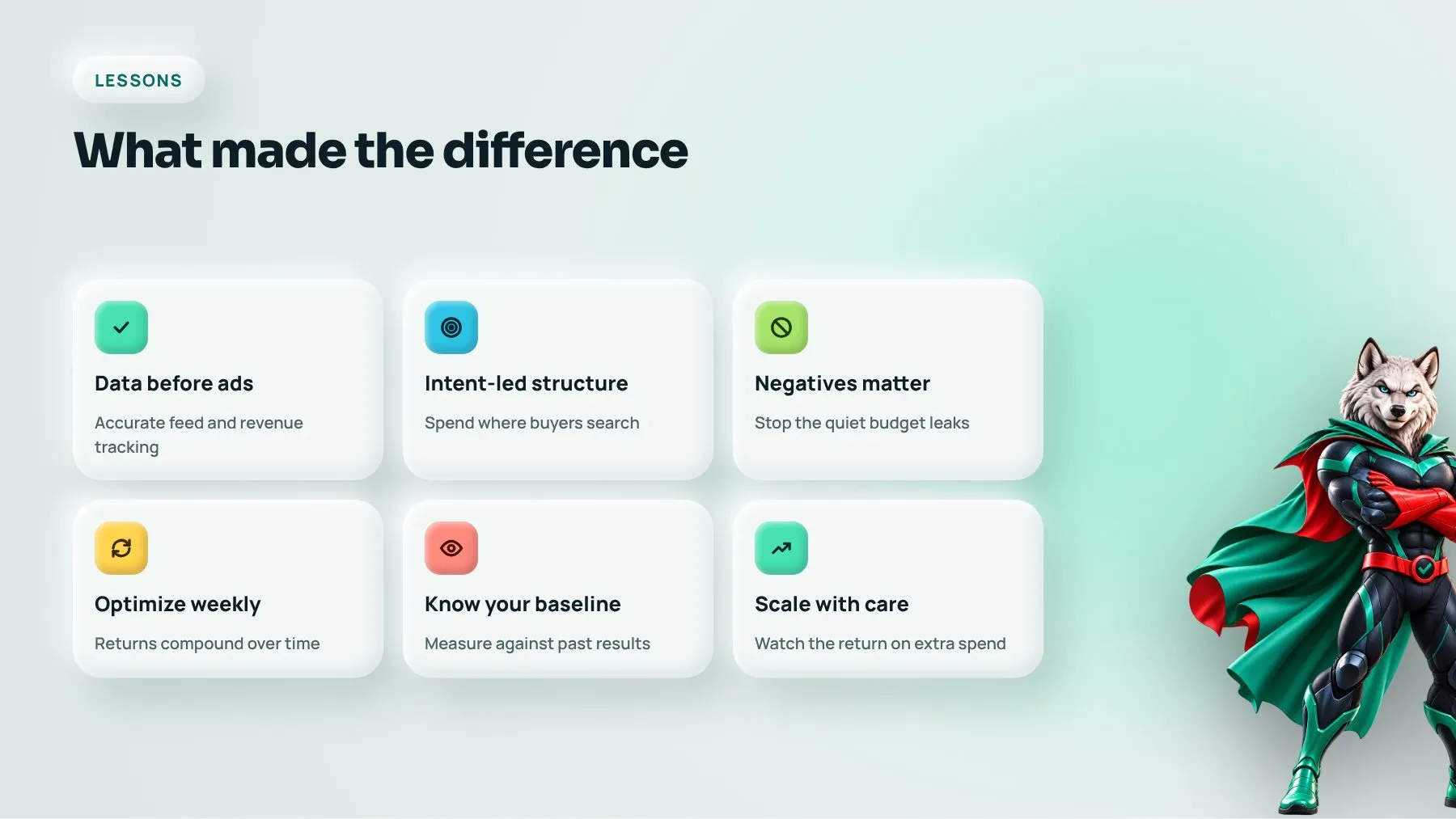
What made the difference
Data before ads
Building the Merchant Center properly came first. Ads can only be as good as the product data and conversion tracking behind them.
Structure that follows intent
Separating campaigns by intent and offer meant budget went to the searches most likely to buy, instead of being spread thin across everything.
Negatives are as important as keywords
In fitness, many searches are informational or job-related. Excluding them early stops the leak that quietly drags returns down.
Optimization is a habit, not a launch task
The return came in month two, after a cycle of testing and adjustment, not on day one. Weekly attention compounds.
Measure against a baseline
Having the old agency’s numbers gave both sides an honest yardstick. Every business should know its starting point before changing anything.
How to apply this to your business
- Confirm that conversion and revenue tracking in Google Ads matches your real sales.
- If you sell products or packages online, make sure your Merchant Center feed is complete, accurate and well titled.
- Split campaigns by intent: brand, high-intent services or products, and broader prospecting.
- Build and maintain negative keyword lists for job, free and DIY searches.
- Review search terms and shift budget every week, not every quarter.
- Agree on baseline metrics before you change agencies or strategy.
FAQ
How quickly can Google Ads produce results for a fitness business?
Paid search can produce sales within days of launch, but the strongest returns usually come after a few weeks of data and optimization. In this case, the standout result was in the second month. Expect a learning period before judging performance.
Do I need Google Merchant Center if I run a gym?
If you sell anything online, such as products, memberships, class packs or programs that can be listed with a price, a Merchant Center feed opens up Shopping placements and supports Performance Max. If you only sell in person, the priority is strong search campaigns and call or form tracking.
Is a high ROAS always good?
A high ROAS is a great sign, but it should be read alongside margins and volume. Sometimes a slightly lower ROAS at higher spend produces more total profit. A good agency will help you find that balance rather than chase one number.
Want results like this for your fitness business? See our Google Ads management, browse more case studies, or book a strategy call.