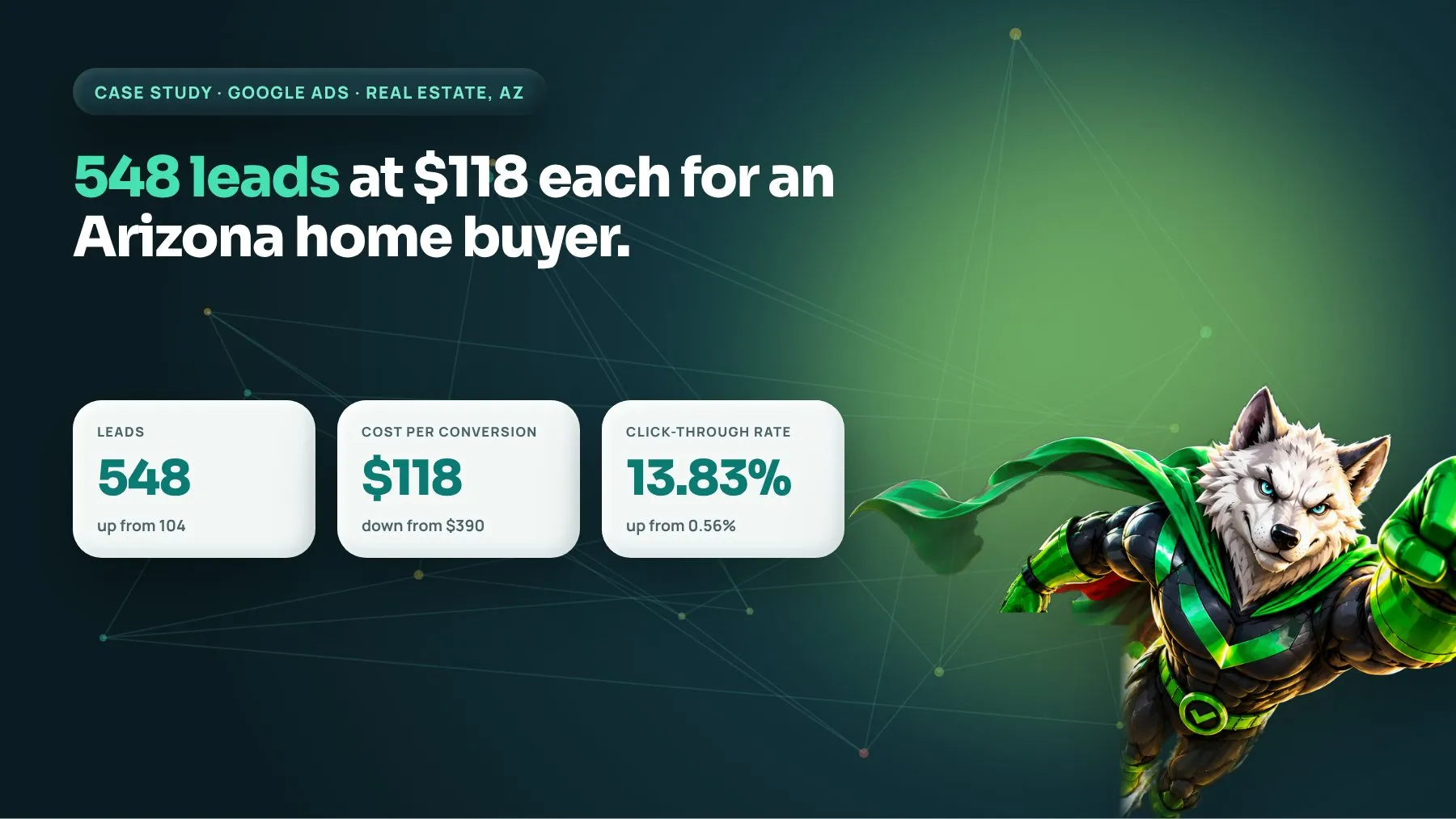
This client is an Arizona-based real estate company that buys distressed houses, targeting Arizona only. The owner had been running Google Ads himself and was paying heavily for each lead. After we took over in the first week of January 2021 and rebuilt the account, conversions rose from 104 to 548 leads, cost per conversion fell from $390 to $118, and total spend was lower than the year before.
At a glance
- Client: Real estate company buying distressed houses, Arizona
- Service: Google Ads management, landing pages, click fraud protection
- Timeframe: Started first week of January 2021; compared with January to December 2020
- Key results: Leads from 104 to 548; cost per conversion from $390 to $118; CTR from 0.56% to 13.83%; average CPC from $56.84 to $18.23; phone calls from 26 to 145; overall conversion rate from 9.10% to 19.40%
The challenge: an expensive, self-managed account
Real estate is one of the most competitive markets in paid search, and the home-buying niche (companies that buy houses quickly, often in poor condition) is especially crowded. Many investors and buyers bid on the same sellers, which drives click costs up. In that environment, a poorly built account can spend a great deal for very little.
The client had been managing the account himself and, understandably, was not across all the details of how Google Ads works. Our analysis found seven issues:
- Wrong keyword selection with the wrong approach. Keywords did not reflect motivated sellers.
- Very basic ad copy with no proper call to action.
- Self-management without the specialist knowledge needed in a competitive market.
- All keywords in a single ad group, so ads could not be matched to specific searches.
- No proper landing page.
- Display Network switched on within the search campaign, spending budget on low-intent placements.
- Click fraud, with signs that competitors were clicking ads to drain the budget.
Where the account stood: January to December 2020
- Clicks: 1,429
- Spend: $81,232
- Impressions: 256,486
- CTR: 0.56%
- Average CPC: $56.84
- Conversions: 104 leads
- Cost per conversion: $390
- Conversion rate: 7.28%
- Phone calls: 26
- Overall conversions: 130
- Overall conversion rate: 9.10%
A CTR of 0.56% told us most people seeing the ads did not find them relevant. An average cost per click of $56.84 meant every one of those weak clicks was costly.

What we changed
Keywords built around seller behavior
We have solid experience in real estate PPC and a clear sense of which searches come from motivated sellers versus curious browsers, agents or buyers. We rebuilt the keyword list around seller intent, such as wanting to sell quickly, sell as-is or sell a house that needs work, and split keywords into tightly themed ad groups. That allowed each group to have ads written for its exact searches, and it let us add negatives for searches that would never lead to a deal.
New ad copy with stronger calls to action and offers
After a detailed call with the client to understand the offer, we rewrote the ads. Strong home-buyer ads speak to the seller’s situation, make the offer concrete and give a clear next step, such as getting a cash offer or calling now. Combined with tighter ad groups, this is what moved CTR from 0.56% to 13.83%.
Four new landing pages, A/B tested
We created four new landing pages in Unbounce and tested them against each other. Home-seller landing pages need to be fast, focused and reassuring: a headline matching the search, a simple explanation of how the process works, trust signals, a short form asking only for what is needed, and a visible phone number. Testing showed which version converted best, and that version carried the account.
Age targeting
We adjusted targeting by age so budget went toward the age groups most likely to be selling property, and away from groups unlikely to convert.
Ad scheduling
We analyzed when leads actually came in and scheduled ads for the right audience at the right time, cutting spend in hours that produced clicks but not leads.
Click fraud protection
We installed ClickCease to detect and block fraudulent clicks, including competitors clicking ads to exhaust the daily budget. In a crowded niche this is a real problem, and every blocked fake click is money kept for genuine sellers.
We also removed the Display Network from the search campaigns so budget stayed on search intent.
The results
- Clicks: 3,572
- Spend: $65,125
- Impressions: 25,826
- CTR: 13.83%
- Average CPC: $18.23
- Conversions: 548 leads
- Cost per conversion: $118
- Conversion rate: 15.34%
- Phone calls: 145
- Overall conversions: 946
- Overall conversion rate: 19.40%
The business got more than five times the leads while spending less. Impressions fell sharply because ads stopped showing to irrelevant searches and placements, yet clicks more than doubled, because the people now seeing the ads were the right people. Average cost per click dropped from $56.84 to $18.23, which reflects better relevance and the removal of wasteful and fraudulent clicks. Phone calls, often the highest-quality leads in this business, went from 26 to 145.

Lessons for real estate businesses
1. Competition demands precision
Real estate is one of the most competitive paid search markets. Loose keywords and a single ad group cannot survive in it.
2. Protect your budget from click fraud
Competitors may click your ads to drain your budget. Click fraud software is a sensible defense in crowded niches.
3. Timing matters
Ad scheduling puts budget where leads actually happen.
4. Target the right age group
Age targeting helps focus spend on people likely to be selling.
5. The landing page makes or breaks the campaign
A focused, tested landing page is one of the biggest levers in real estate lead generation.
How to apply this to your real estate business
- Check whether Display Network is switched on in your search campaigns.
- Split keywords into tightly themed ad groups with matching ads.
- Rewrite ads with a clear offer and call to action.
- Build at least two landing pages and test them.
- Review performance by hour, day and age group, and adjust.
- Monitor for suspicious clicks and consider click fraud protection.
- Track phone calls as conversions alongside forms.
FAQ
Why is Google Ads so expensive in real estate?
Many companies compete for the same sellers, and each deal can be valuable, so bids are high. That makes relevance, tight targeting and strong landing pages essential to keep cost per lead under control.
Is click fraud really a problem?
In competitive local markets it can be. Competitors or bots clicking your ads waste budget without producing leads. Monitoring and click fraud tools help identify and block that activity.
How quickly can a rebuilt Google Ads account improve?
Changes such as removing Display placements, adding negatives and improving ads can show results within weeks. Landing page testing and scheduling improvements build further gains over the following months.
Want a lower cost per lead for your real estate business? See our Google Ads management, explore our lead generation services or book a strategy call.