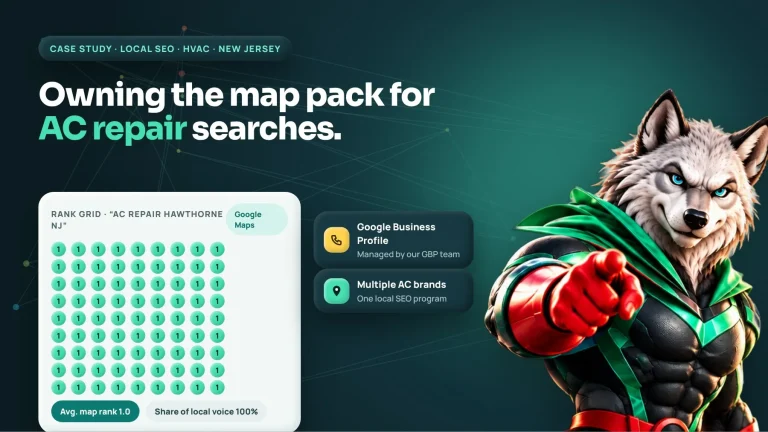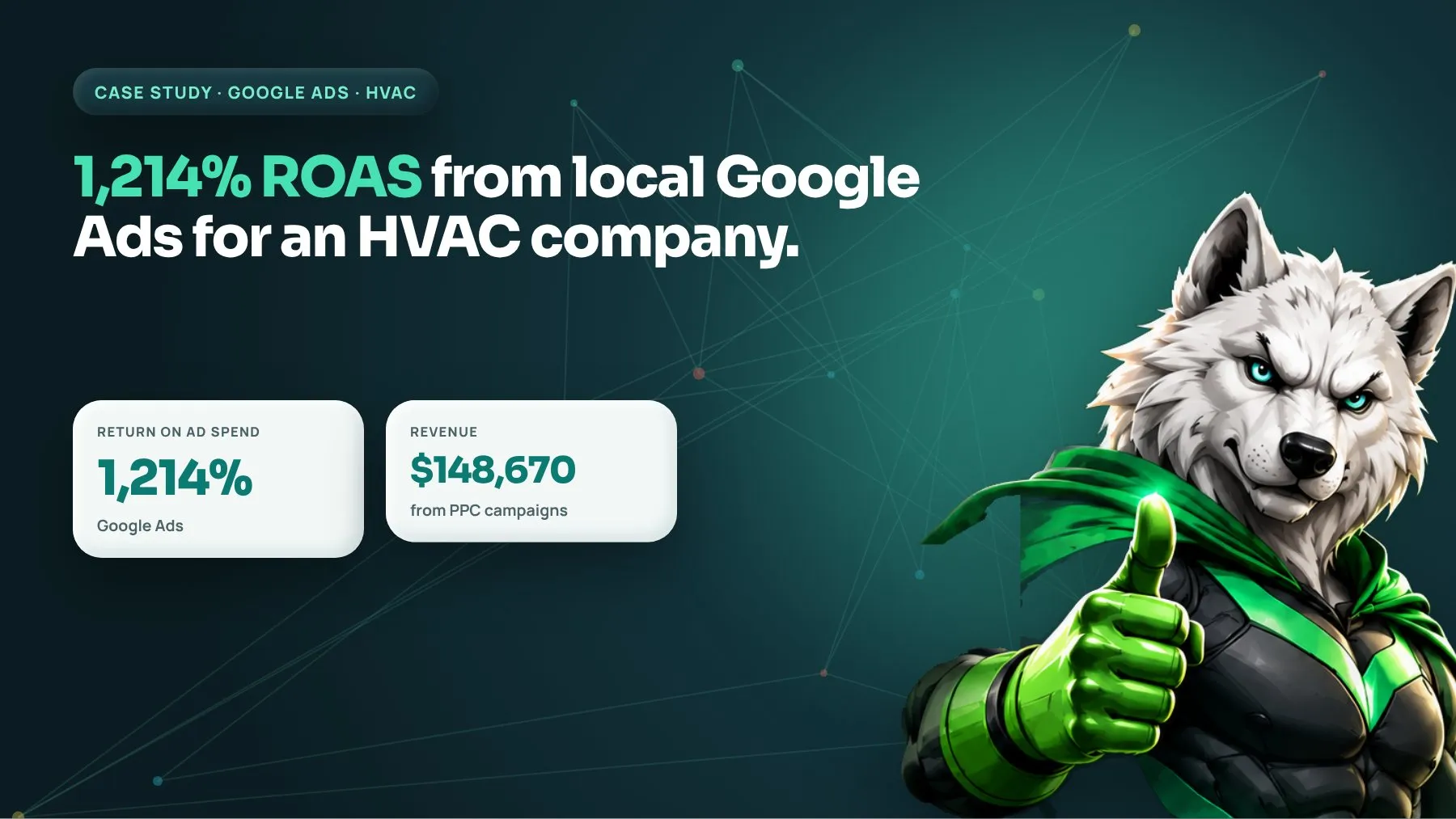
A well-known heating and cooling company wanted its website to win more customers, on top of the leads it already got from organic search. We built and managed its Google Ads campaigns from January 2021. The campaigns generated $148,670 in revenue at a return on ad spend of 1,214%, measured all the way down to revenue, not just clicks.
At a glance
- Client: Established heating and cooling (HVAC) company
- Service: Google Ads (PPC) management with call tracking
- Start: January 2021
- Key results: $148,670 in revenue from Google Ads; 1,214% return on ad spend
The challenge: no time and no in-house PPC expertise
The company already had a good reputation and was getting traffic and leads organically. It wanted more customers through its website, and Google Ads was the obvious way to get them faster. The problem was capacity. The team lacked Google Ads expertise and, like most busy trade businesses, didn’t have the time to manage campaigns properly.
That combination is costly in HVAC. Searches for heating and cooling services are urgent and local. Someone whose furnace has failed or whose air conditioning stops working in a heatwave wants a company that serves their town, today. Clicks in home services are expensive, and a poorly set-up account can spend heavily on the wrong towns, the wrong searches or the wrong hours. Without proper tracking, the owner can’t even tell which spend produced paying jobs.
The company needed someone to set up, test and manage the campaigns, and to prove they were making money.
What we did: local paid search built around revenue
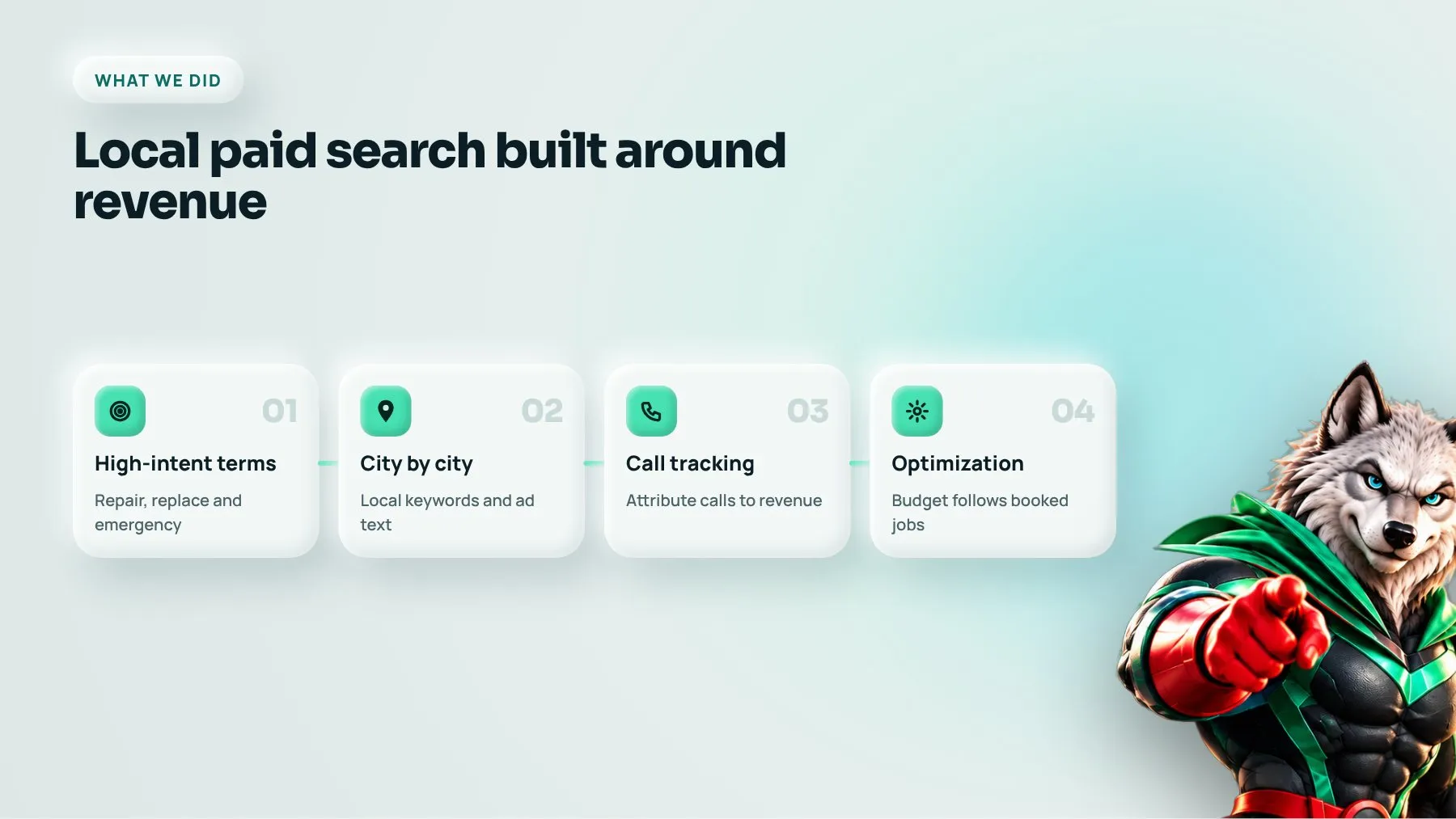
We set up and tested a Google Ads campaign for the company starting in January 2021, with five principles guiding the work.
Local paid search expertise for fast, positive returns
Paid search can work from the first day, unlike SEO, which takes months to build. To make that happen, we focused the budget on the searches most likely to turn into booked jobs: high-intent service and repair terms such as heating repair, AC repair, furnace replacement and emergency HVAC searches, rather than broad research terms. We set location targeting to the areas the company actually serves, and checked it was targeting people located in those areas, not just people showing interest in them.
A practical HVAC account also needs negative keywords from the start. Searches for jobs, training, DIY fixes, parts and manuals attract clicks from people who will never book a service call. Excluding them stops the budget leaking away.
Highly specific ad text and keywords, city by city
Rather than one generic campaign covering every location, we targeted city by city. Each area had its own keywords and ad text that named the city, so a searcher in a given town saw an ad that matched where they were and what they needed.
This matters for two reasons. People are more likely to click an ad that clearly serves their town, and relevance between keyword, ad and landing page improves Quality Score, which helps lower the cost per click. City-level structure also shows which areas produce the best customers, so budget can follow results.
Call tracking and tagging for accurate revenue attribution
In HVAC, a large share of customers pick up the phone rather than fill in a form. If calls aren’t tracked, the account is effectively blind to many of its best conversions. We put call tracking and tagging in place so that calls from ads and calls from the website after an ad click were recorded and attributed to the campaign, keyword and location that generated them.
Tagging those calls and leads, and connecting them to booked jobs, is what let us measure success in revenue rather than in clicks.
Data insights to optimize performance
With reliable tracking in place, we optimized continually: shifting budget towards cities and keywords that produced jobs, pausing or reworking those that didn’t, refining ad copy, adding negatives from the search terms report, and adjusting schedules to the hours when real customers called.
Measuring success through strategic analysis
Many companies judge PPC with standard metrics such as cost per click, cost per lead, click-through rate and conversion rate. These are useful, but none of them tell an owner whether the advertising made money. We go further and track success down to the revenue level, so the question “what did we get for our ad spend?” has a direct answer.
The results: $148,670 in revenue and a 1,214% ROAS
- $148,670 in revenue generated from the Google Ads PPC campaigns.
- 1,214% return on ad spend.
ROAS compares revenue generated with the amount spent on advertising. A ROAS of 1,214% means the campaigns returned roughly twelve times their cost in revenue. For an HVAC business, that turns Google Ads from an expense the owner has to trust into an investment with a measurable return, and gives clear grounds to scale the budget in the areas that perform best.
Because the figures are tied to real revenue through call tracking and tagging, the company knows the results are genuine rather than an estimate built on lead counts.
What made the difference: lessons for HVAC and home service businesses
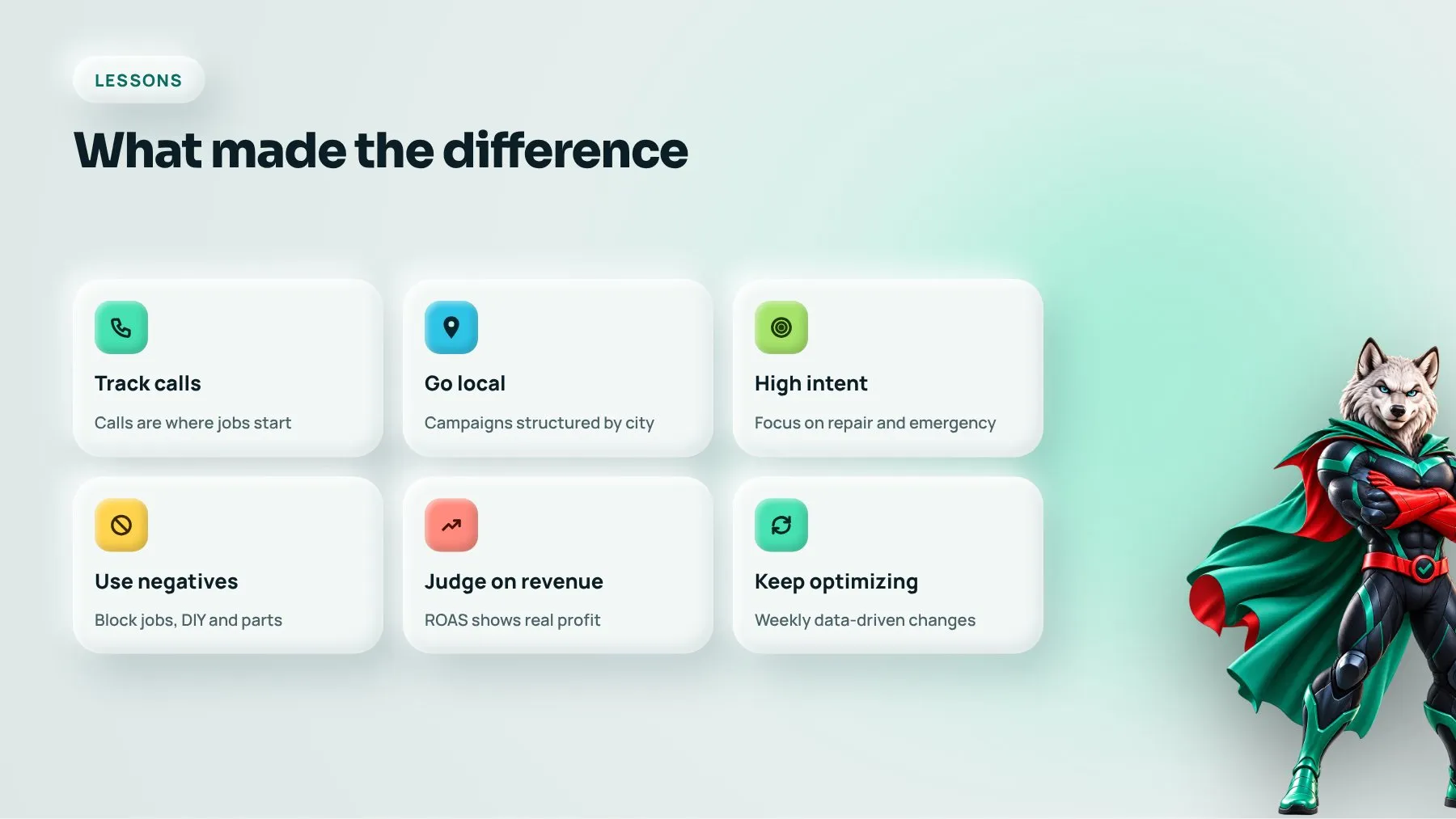
Track calls, not just forms
Phone calls are where many HVAC jobs start. Without call tracking, your best-performing ads may look like failures.
Structure campaigns by location
City-by-city campaigns and ads improve relevance and show you which areas are worth the most.
Focus on high-intent searches
Repair, replacement and emergency searches are where buyers are. Block the job seekers and DIYers with negatives.
Judge PPC on revenue
Cost per click and cost per lead matter, but revenue and ROAS show whether advertising is profitable.
Keep optimizing
Results come from regular changes driven by data, not a one-off setup.
How to apply this to your business
- Set up call tracking for ad calls and website calls before you spend.
- Build separate campaigns or ad groups for each city you serve.
- Add a negative keyword list for jobs, training, DIY and parts searches.
- Connect leads to booked jobs so you can report revenue and ROAS.
- Review search terms, locations and schedules every week.
FAQ
How much should an HVAC company spend on Google Ads?
It depends on your service area, competition and capacity to take jobs. Start with a budget you can sustain for a few months so there is enough data to optimize, then scale the cities and campaigns that show a strong return.
How fast can Google Ads produce leads for an HVAC company?
Ads can start generating calls within days of launch. Performance usually improves over the first few months as tracking data builds and the account is refined.
What is a good ROAS for home services?
There is no single figure, because margins and job values vary. What matters is that ad-driven revenue comfortably covers ad spend plus the cost of delivering the work. Tracking revenue, not just leads, is what lets you judge this.
Want results like this for your HVAC business? See our Google Ads management and lead generation services, or book a strategy call.