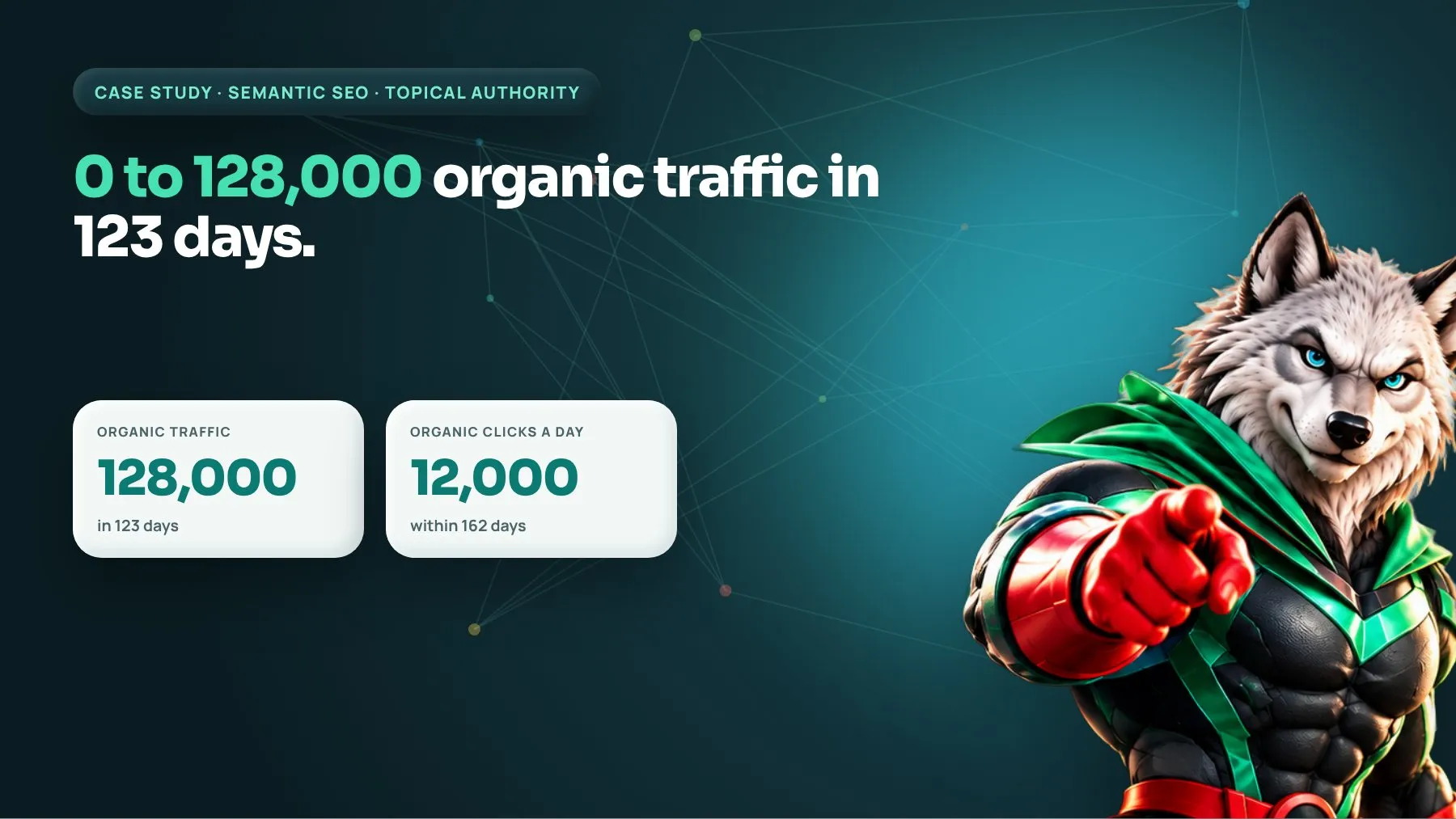
This case study shows what topical authority, topical coverage and contextual hierarchy can do for a website. Using a semantic SEO approach built on topical maps that satisfy both the main and the smaller search intents around a subject, the primary project went from 0 to 128,000 organic traffic in 123 days, and reached 12,000 organic clicks per day within 162 days. The growth came from content structure and semantic SEO, not from technical tricks, page speed work, brand power or advanced design.
At a glance
- Project: Getwordly.com (the “First Site”), the primary of four SEO projects run with the same methodology
- Service: Semantic SEO, topical authority and content architecture
- Timeframe: 0 to 128,000 organic traffic in 123 days; 12,000 organic clicks per day in 162 days
- Key results: Organic traffic roughly doubling month on month, and tripling in the latest month measured
The challenge: building authority from zero
The site started with no meaningful organic traffic. It also had a lot of technical mistakes, and it had no brand recognition, no strong backlink profile and no advanced layout design to lean on. The usual levers that help a new site compete were simply not available.
The ambition was large: to reach 1 million organic sessions within 12 months. That required a way for a new site to earn Google’s trust for a whole subject quickly, rather than slowly ranking one keyword at a time.
This is a challenge many businesses recognize. A new brand, or an established one moving into a new topic, finds that a handful of strong pages is not enough. Google ranks sites that demonstrate they understand a subject in depth, and it rewards pages that genuinely satisfy the person who clicked.
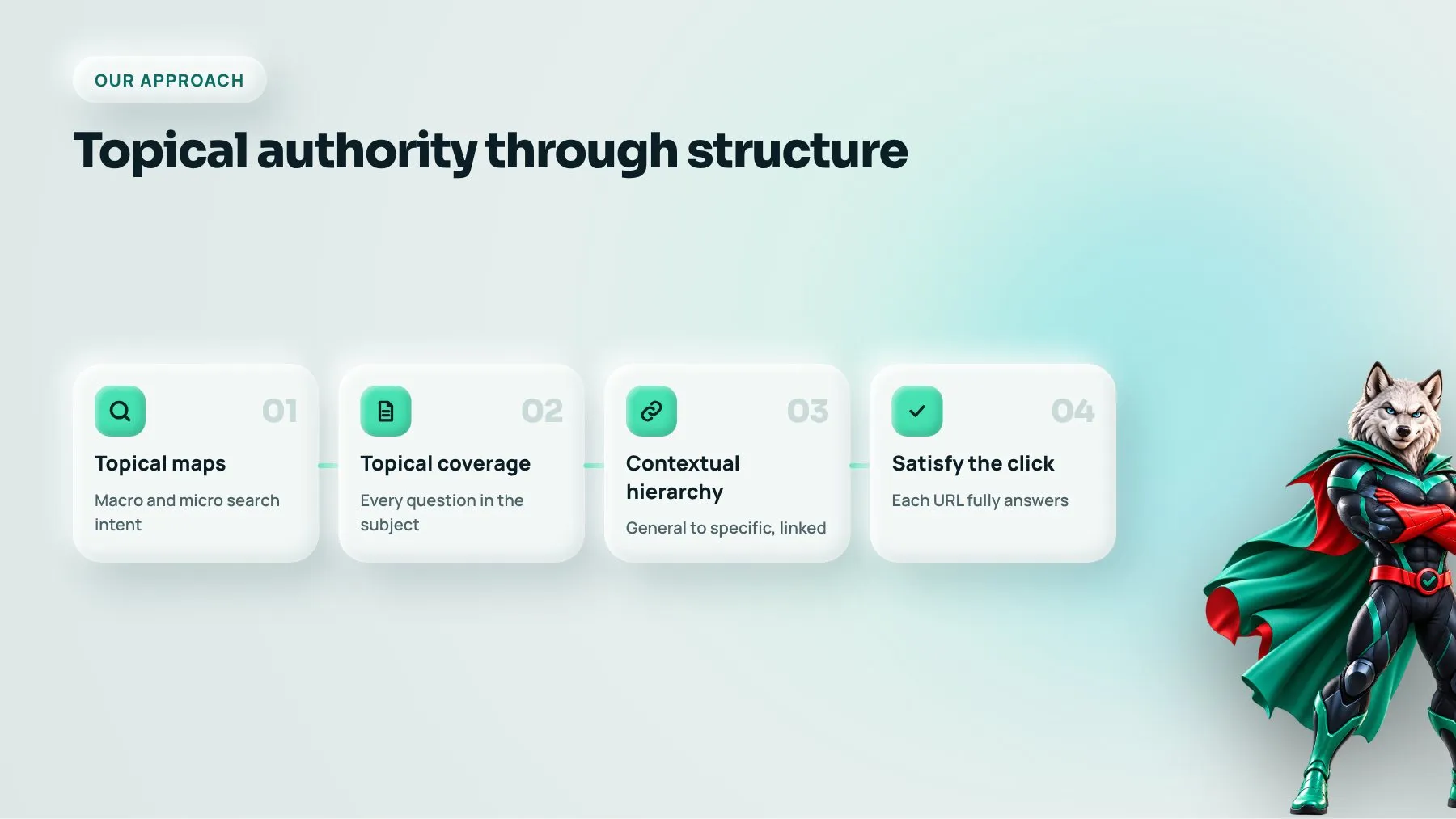
Our approach: topical authority through structure
The method rests on three connected ideas.
Topical authority
Topical authority is the degree to which a site is recognized as a reliable, complete source on a subject. Google does not judge a page in isolation; it considers whether the site as a whole covers the topic and its related questions well. A site with deep, connected coverage of a subject tends to rank more easily for every new page it publishes in that subject.
Topical coverage: satisfying macro and micro intent
Coverage means addressing all the search intents around a topic, both the macro intent (the main thing people want to know or do) and the micro intents (the smaller, specific questions that sit around it). We built topical maps listing the entities, questions and sub-topics in the subject area, then planned content so that each searcher, whatever their exact question, could find a page that satisfied it.
Contextual hierarchy
Contextual hierarchy is how that content is organized and connected. Broad pages sit above more specific ones, and internal links connect them in a way that mirrors how the concepts relate. Each page has a clear main context, supporting sections and links to related pages, so both users and search engines can follow the topic from general to specific. This structure helps Google understand what each page is about and how it fits within the wider subject, which is the basis of a semantic search network.
Satisfying users after the click
Throughout, the aim was to make each URL the most satisfying result for its query, in the information it provides and the function it serves. Google looks for signs that a user’s need was met after they clicked. A page that answers the question fully, in a logical order, and points to the next relevant question, earns those signals.
The results: traffic doubling month after month
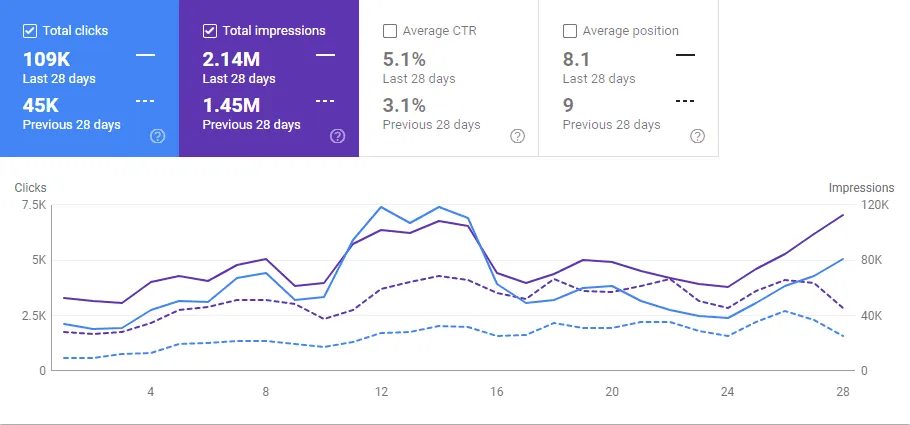
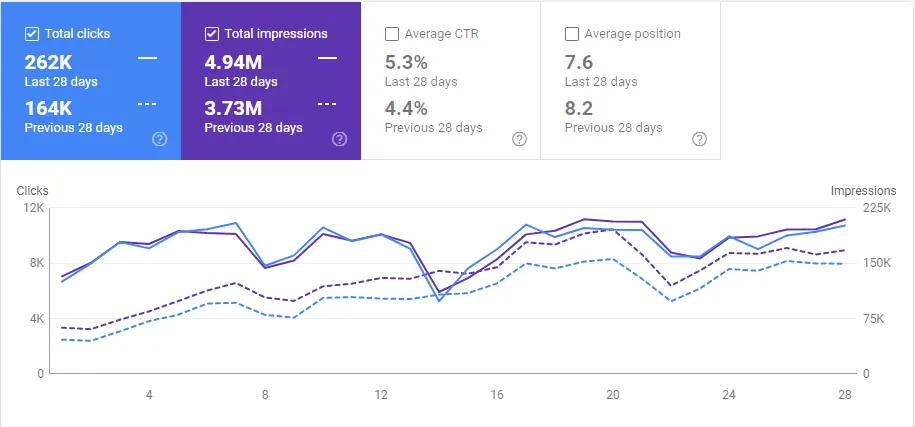
The Google Search Console data shows the growth over time. Below is the last 28 days comparison, captured on November 27:
Next, the last 28 days comparison from December 29:
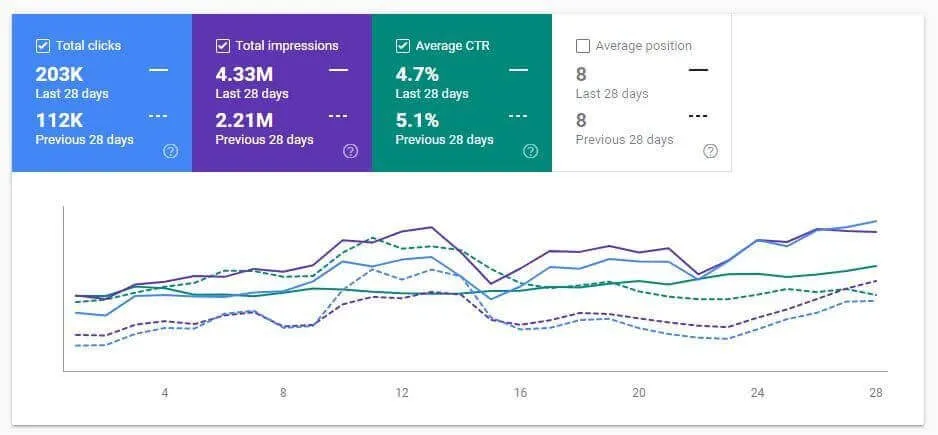
Traffic doubled every month, and in the latest month it tripled. The last 28 days comparison from January 29:
Six months of growth, including algorithm updates
The six-month view from Google Search Console shows the full journey:
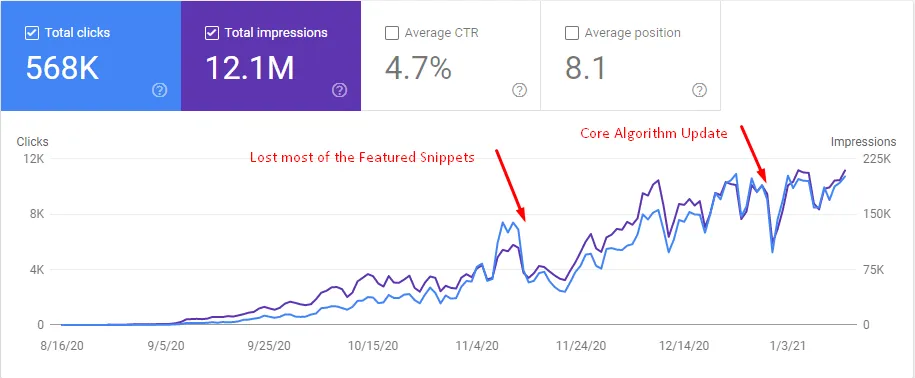
The path was not perfectly smooth. Google released two minor updates on November 14, 15 and 17. The number of featured snippets decreased by 2.5% globally, only a few positions changed, and on the same day the server crashed. The site lost all of its featured snippets in a single day. The second dip on the graph was caused by a broad core algorithm update.
Those updates, focused mainly on featured snippets and possibly the upcoming passage indexing, made the 1 million sessions goal less certain. But the site recovered. Below is a screenshot taken on December 6, 2020, two days after the December core algorithm update:
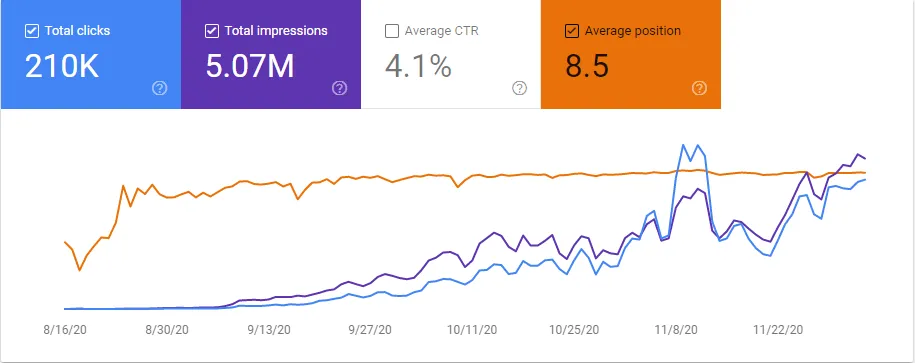
Most of the lost traffic was recovered by staying consistent with the same method.
Month-by-month organic traffic
The organic traffic comparison for November 2020:
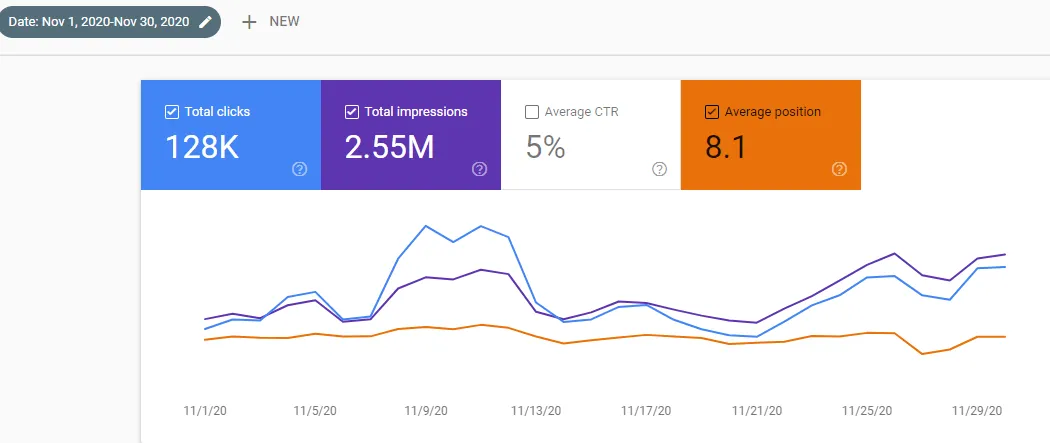
And the December 2020 organic traffic report, showing an increase of around 100% or more for the month:
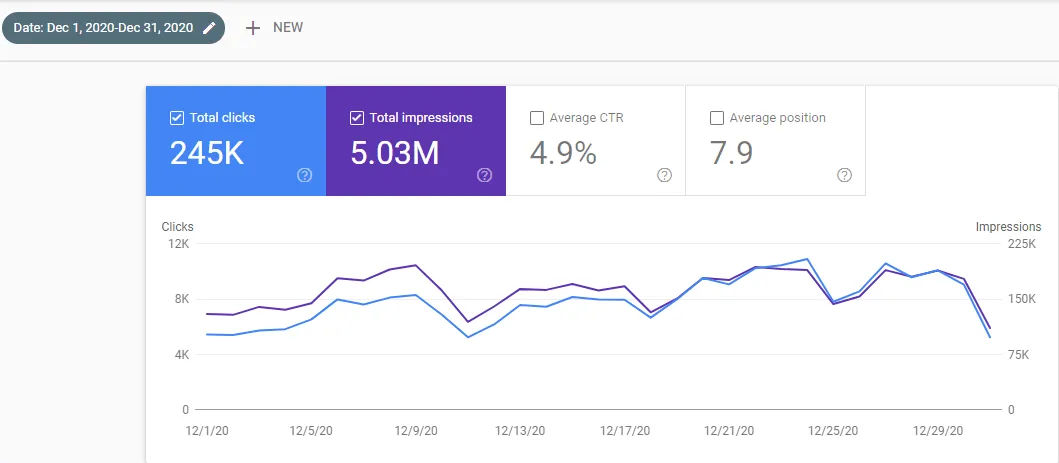
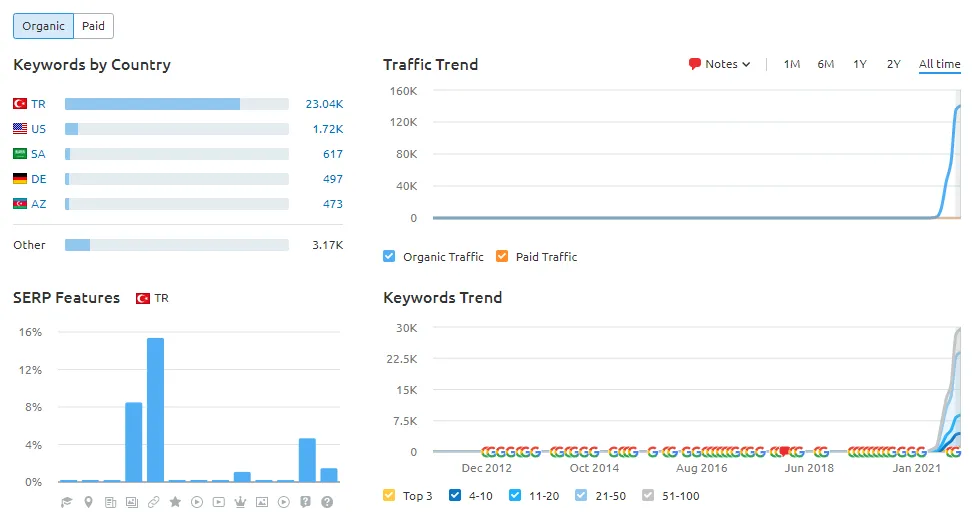
Third-party data tells the same story. SEMrush’s organic search data showed the rapid traffic increase for the First Site:
Why we named the site
Normally we would not reveal a project’s identity while the work is still growing. We named it here so the results can be verified. The site is Getwordly.com. The growth was achieved with semantic SEO alone, on a site that still had many technical errors, which shows how much weight Google places on topical understanding and user satisfaction.
What made the difference: lessons for content-led businesses
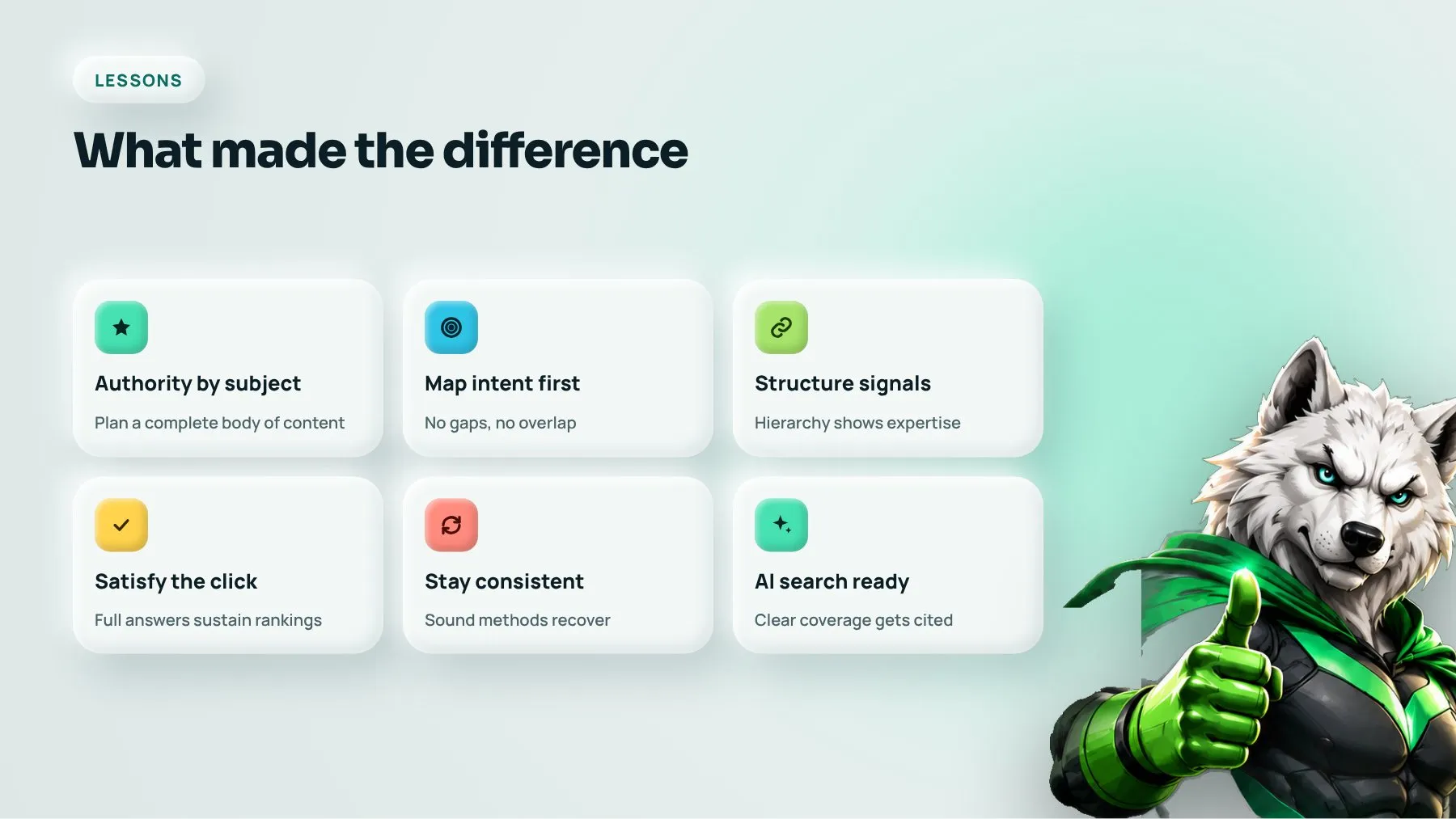
- Authority is earned by subject, not by page. Plan a complete body of content around your topic instead of isolated articles.
- Map intent before you write. A topical map of main and supporting questions prevents gaps and overlap.
- Structure is a ranking signal. A clear hierarchy, connected by contextual internal links, helps Google understand your expertise.
- Satisfy the click. Pages that fully answer the question earn the signals that sustain rankings.
- Stay consistent through updates. Algorithm updates cause dips; a sound method recovers.
How to apply this to your business
- List the core subject your business wants to be known for, and every sub-topic and question around it.
- Group those questions into a hierarchy: broad pillar pages and specific supporting pages.
- Link pages contextually, from general to specific and between closely related topics.
- Review each key page and ask whether it fully answers the searcher’s question.
- Track organic clicks in Google Search Console month on month and note algorithm update dates.
Today, the same principles also help with visibility in AI search experiences, which draw on sources that cover a topic clearly and completely. That is why topical authority sits at the heart of our AI Overviews optimization work as well as traditional SEO.
FAQ
What is topical authority in SEO?
Topical authority is how strongly search engines see your site as a complete, reliable source on a subject. It is built by covering a topic in depth, organizing content logically and connecting related pages, rather than by publishing scattered articles.
How long does it take to build topical authority?
It depends on the subject’s size and competition. This project saw rapid growth within months, but that is not typical for every site. Most businesses should expect steady gains over six to twelve months of consistent publishing.
Do I still need technical SEO if I focus on content?
Yes. This case shows that strong content structure can win even with technical issues, but fixing technical problems removes friction and usually makes good content perform better. The two work best together.
Want to build topical authority in your market? See our SEO services, read more case studies or book a strategy call.