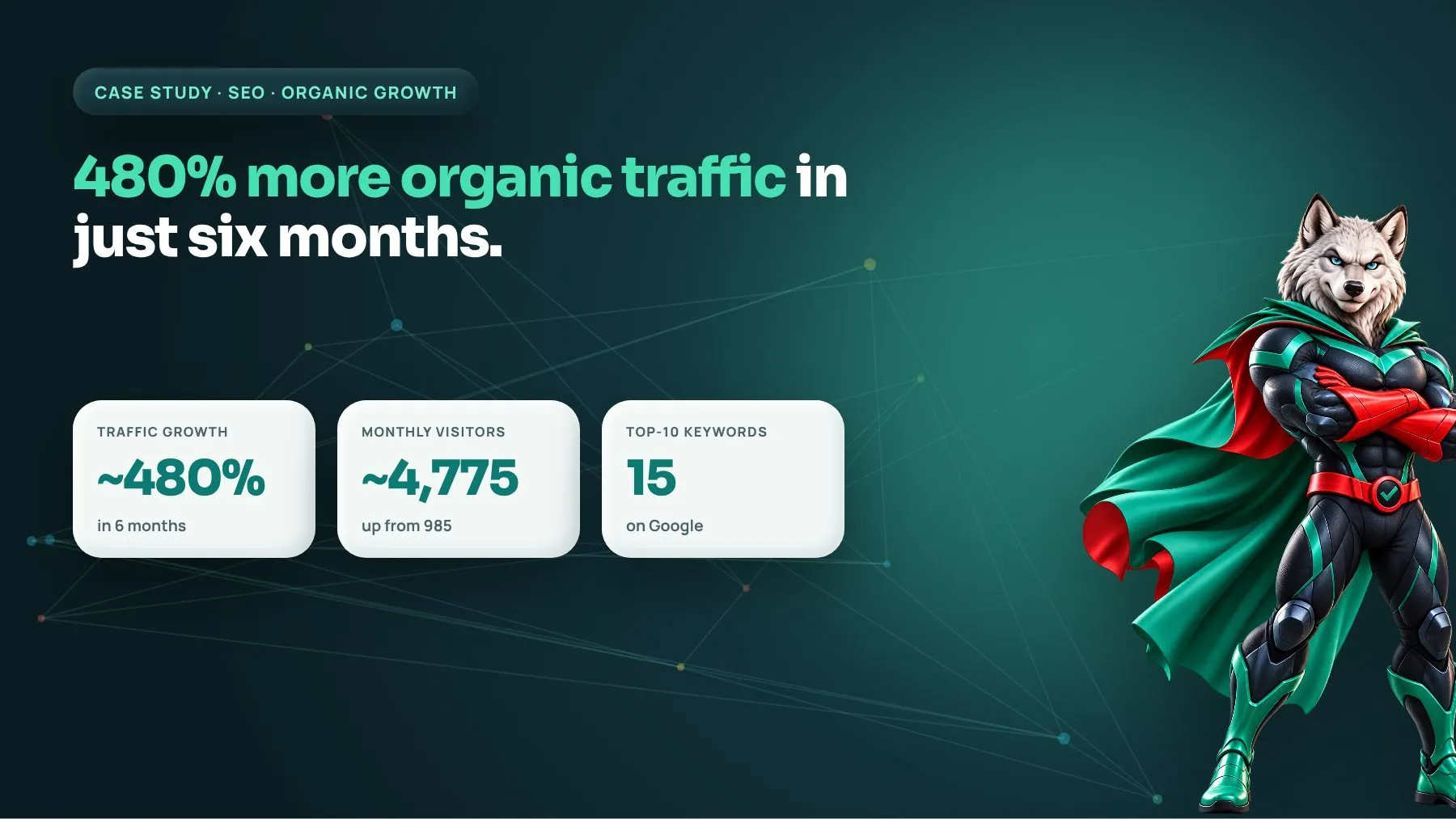
Our client’s website was not ranking on the first page of Google for the terms that mattered to its business, and traffic was well below what it should have been. Over six months, we fixed duplicate content, rebuilt the keyword strategy and added focused service pages and blog content. Organic traffic grew by almost 480%, from 985 monthly visitors to almost 4,775, with 15 key terms reaching Google’s top 10.
At a glance
- Client: Service business (sector not disclosed)
- Service: Search engine optimization
- Timeframe: 6 months
- Key results: ~480% traffic growth; 985 to ~4,775 monthly visitors; 15 keywords in the top 10
The challenge: the right pages were not ranking
Before the client approached us, its website traffic was not performing as expected. The key terms for its line of business were not ranking on the first page of Google’s results. Two problems were holding it back.
Low rankings for important keywords. Most clicks go to results on the first page. A business ranking on page two or three for its main services is, in practical terms, invisible to most of the people searching for them.
Duplicate content. Several pages covered overlapping material. When multiple pages on the same site say similar things, Google has to guess which one to rank, and it often ranks none of them well. Authority that should have been concentrated on one strong page was split across several weaker ones.
For a service business, that combination is costly. The people searching for its services were ready to buy, and they were finding competitors instead.
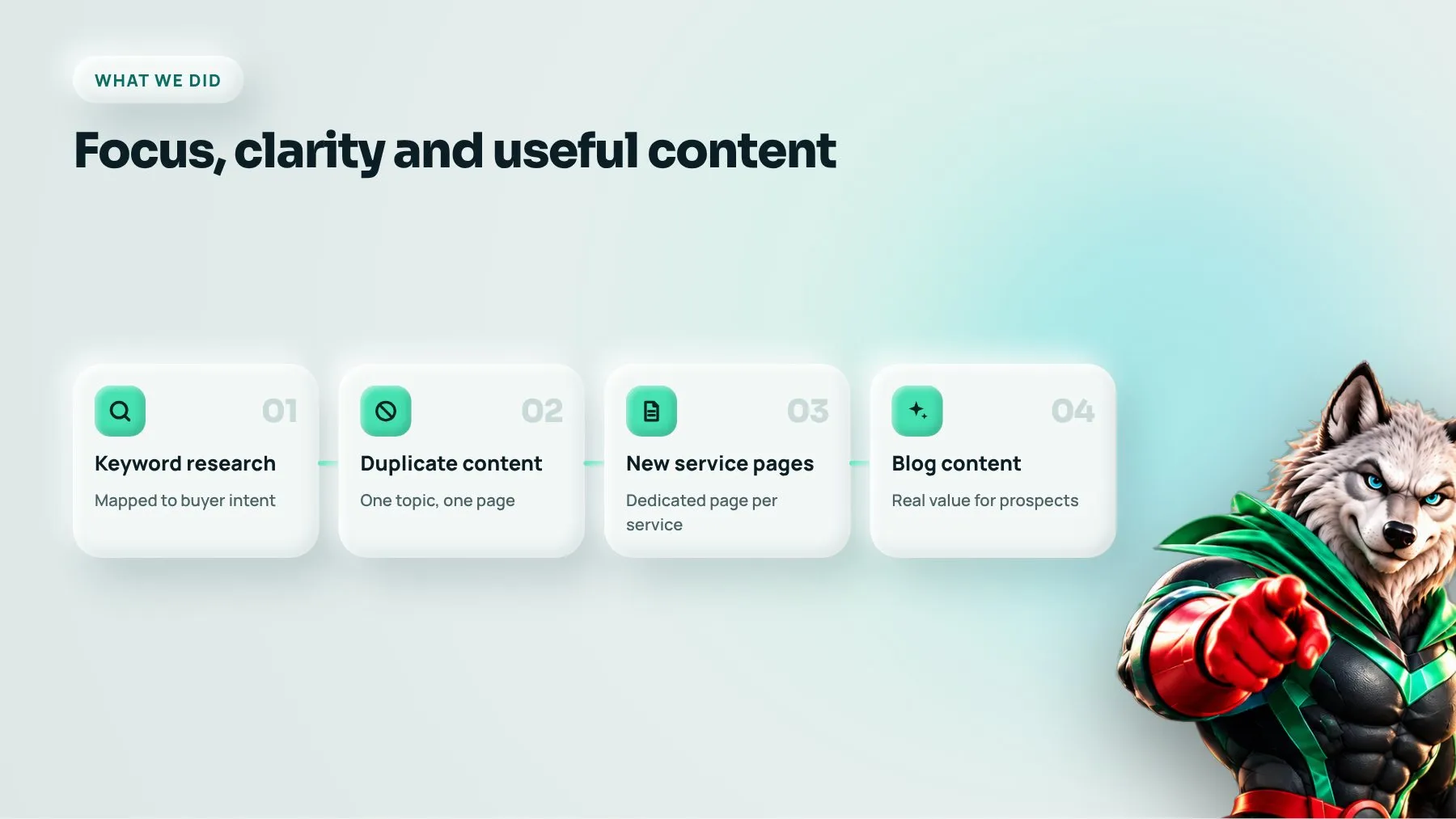
Our approach: focus, clarity and useful content
Keyword research for qualified traffic
We started with research into the terms that were genuinely relevant to the client’s services. The aim was not the biggest numbers but the most qualified visitors: people whose search showed they needed what the client sells.
We grouped keywords by intent. Searches from people ready to buy belonged on service pages. Searches from people still researching belonged in blog content. That mapping is the backbone of the whole strategy, because it decides which page should rank for which search, and it prevents the site competing with itself.
Resolving duplicate content
With the keyword map in place, we tackled the duplication. For each overlapping set of pages, we decided which page should own the topic. Then, depending on the case, we merged content into the stronger page, rewrote pages so each had a distinct purpose, or pointed search engines to the preferred version using redirects or canonical tags.
The result was a cleaner site where each important topic had one clear, authoritative page. That alone often lifts rankings, because signals that were split are now combined.
New, dedicated service pages
One of the most effective changes was structural. We took content related to a specific service that had been buried inside a broader page and created a new page for that service, elaborating on it properly.
Why this works: a page that tries to cover several services cannot rank well for all of them. A dedicated page can target that service’s keywords precisely in its title, headings and copy, answer the questions buyers ask about it, and give Google an unambiguous answer to rank. It also gives visitors a page that speaks directly to their need, which helps them convert.
Informative blog content
Alongside the service pages, we published blog posts that added real value for the client’s target audience. These answered the questions prospects asked during research, used the keywords mapped to them and linked to the relevant service pages.
Good informational content brings in visitors earlier in their decision, builds trust and gives the site more pages that can rank. The internal links pass authority to the service pages and guide readers toward an enquiry.
The results: almost 480% more organic traffic in six months
- Website traffic boosted by almost 480%
- From 985 monthly visitors to almost 4,775 monthly visitors
- 15 key terms ranking in Google’s top 10
The client came to us wanting first-page rankings for terms central to its business, and the original target list was close to 30 terms. Within six months, 15 of them reached the top 10. That is real progress on a demanding list, and it is the main reason traffic multiplied.
Going from under a thousand visitors to nearly five thousand a month changes what a website can do for a business. It becomes a meaningful source of new enquiries rather than an online brochure.
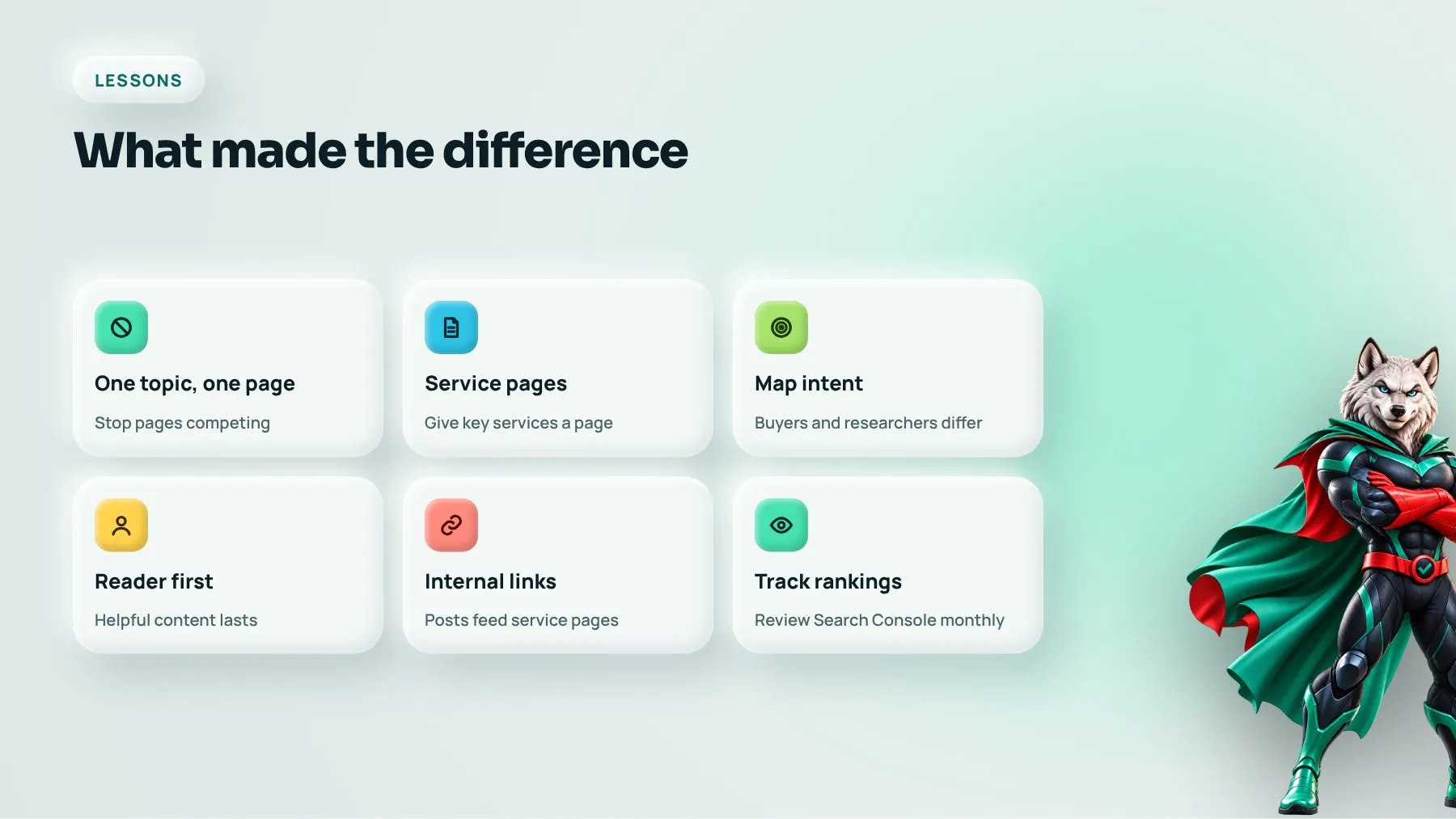
What made the difference: lessons for service businesses
1. One topic, one page
Duplicate and overlapping pages dilute rankings. Give each important topic a single, strong page.
2. Give important services their own page
If a service matters to your revenue, it deserves a dedicated page that targets it directly.
3. Map keywords to intent
Buyers and researchers need different pages. Mapping keywords to the right page type prevents cannibalization and improves conversion.
4. Content should serve the reader first
Blog posts that genuinely help the audience earn traffic and trust. Thin content written only for keywords rarely lasts.
How to apply this to your business
- Search Google for your main services and note where you appear.
- List pages that cover similar topics and decide which one should own each.
- Create dedicated pages for any important service currently buried in a general page.
- Plan blog posts around the questions prospects ask before they buy.
- Link each post to the relevant service page and track rankings monthly in Google Search Console.
FAQ
How long does SEO take to show results?
Most sites start to see movement in three to six months. Fixing technical issues like duplicate content can help sooner, while content and authority build over time.
What is duplicate content and why does it hurt?
It is when several pages contain the same or very similar content. Google struggles to choose which to rank, and the authority that should support one strong page gets split.
Will adding more pages always improve rankings?
No. More pages help only if each has a clear, distinct purpose. Adding overlapping pages can make things worse, which is why keyword mapping comes first.
Want growth like this for your website? See our SEO services, browse more case studies or book a strategy call.