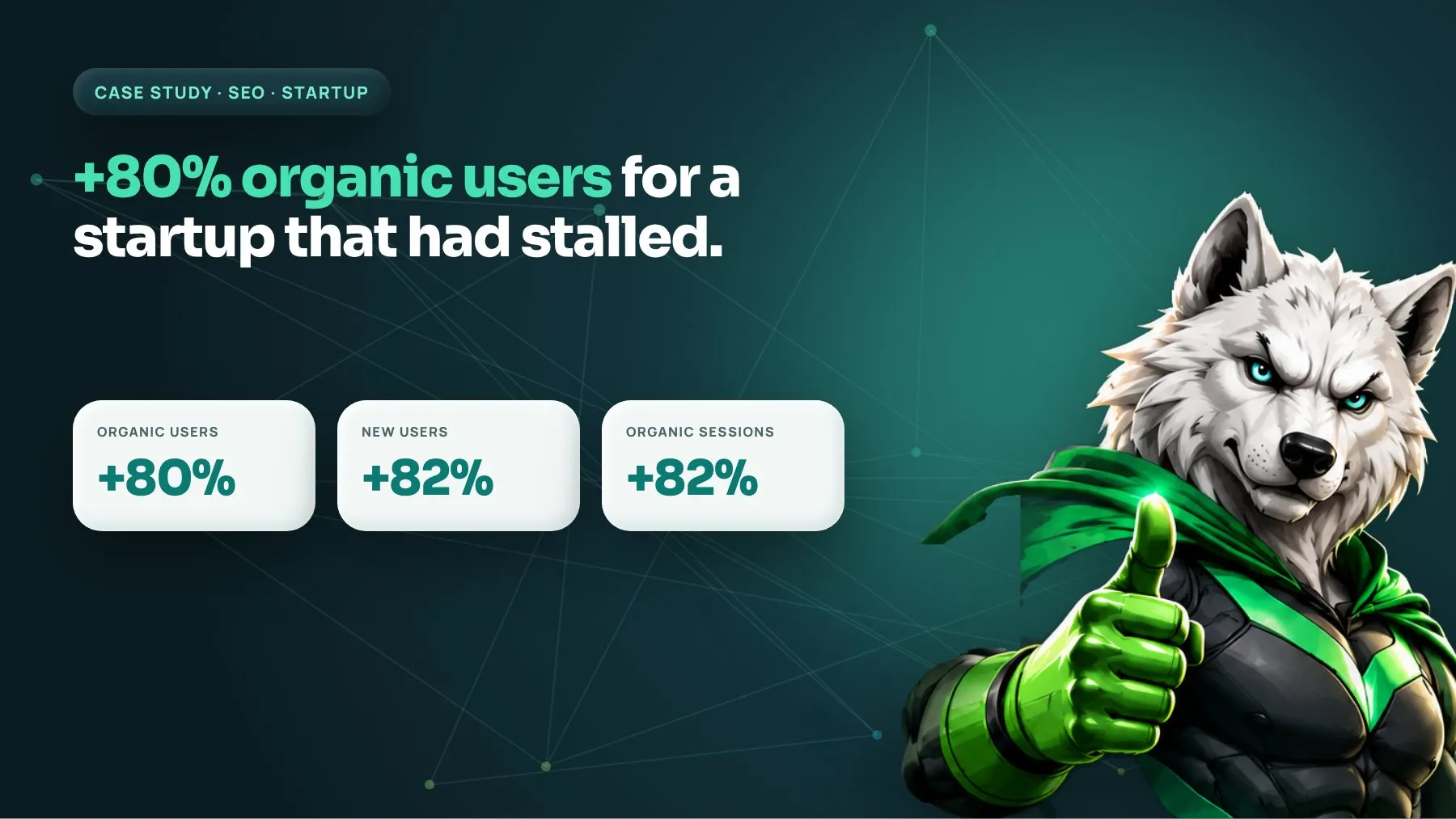
A startup came to us wanting more organic traffic. It was already creating content and spending on Google Ads, yet its organic growth had stalled. We audited the site, fixed what was holding it back and put a clear SEO process in place. The result: an 80% increase in organic users, an 82% increase in new users and an 82% increase in organic sessions.
At a glance
- Client: Startup company
- Services: SEO audit, technical and performance optimization, content guidelines, link building
- Key results: 80% increase in organic users; 82% increase in new users; 82% increase in organic sessions
The challenge: good effort, flat organic growth
This is a pattern we see often with startups. The team is doing the “right” things: publishing content, running paid campaigns, building a product people want. But organic search traffic does not move.
That matters for a young company for a simple reason. Paid traffic stops the moment you stop paying. Organic traffic, once earned, keeps arriving month after month at no cost per click. For a startup trying to lower customer acquisition costs and extend its runway, a healthy organic channel is one of the most valuable assets it can build.
When content and ads are in place but organic traffic is flat, the problem is usually one of three things: technical issues stopping Google from crawling and ranking the site properly, content that is not aligned with what people search for, or a lack of authority from other websites. In this case, it was a mix of all three.
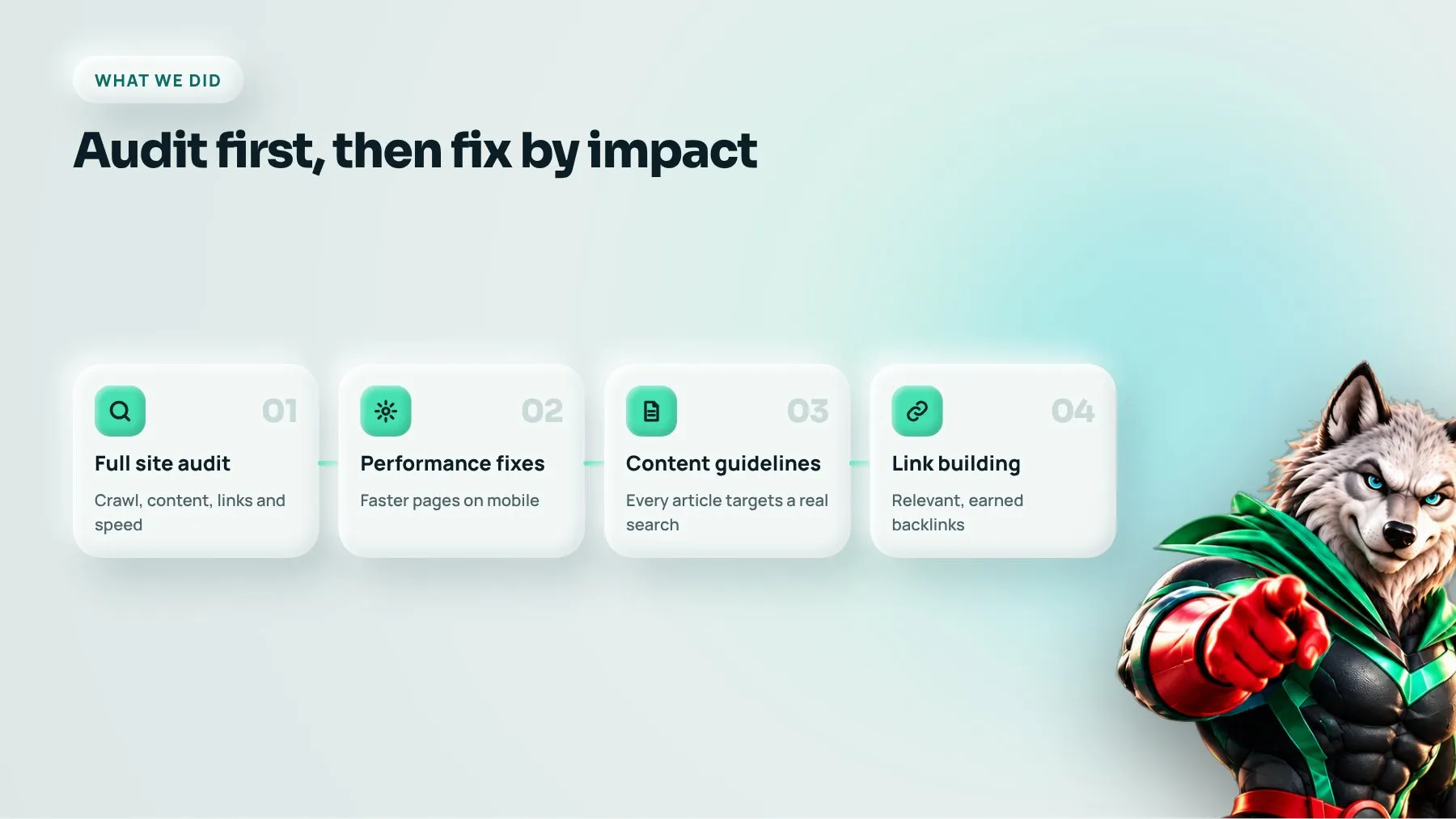
Our approach: audit first, then fix in order of impact
A full site audit to find the real problems
We started with a complete audit rather than guessing. A proper SEO audit covers:
- Crawlability and indexing: which pages Google can find and index, and which are blocked, duplicated or orphaned (no internal links pointing to them).
- Site structure: whether important pages are close to the homepage and well linked, or buried.
- On-page basics: titles, meta descriptions, headings and whether each page targets a clear topic without competing with other pages for the same search.
- Performance: load speed and Core Web Vitals on mobile and desktop.
- Content: what exists, what ranks, what is thin or outdated and what is missing.
- Backlinks: the quality and relevance of sites already linking in.
The audit gave us a prioritized list of issues. We tackled the fixes most likely to move traffic first.
Optimized site performance
Speed is both a ranking factor and a conversion factor. Slow pages frustrate visitors and make it harder for Google to crawl a site efficiently. Typical startup sites carry heavy scripts, uncompressed images and third-party tools added over time without anyone checking the cost.
Performance work usually includes compressing and properly sizing images, serving modern image formats, deferring scripts that are not needed on first load, removing unused plugins and code, enabling caching and a content delivery network, and fixing layout shifts so pages do not jump as they load. The aim is a site that feels fast on a mid-range phone on a normal mobile connection, because that is how many visitors arrive.
Established content guidelines
The startup was already producing content, but without a clear framework it was not attracting search traffic. We set content guidelines so every new piece had a job to do:
- Start with keyword research, not with a topic someone thought would be interesting. Each piece targets a search people actually make.
- Match search intent: a “how to” query needs a step-by-step guide; a comparison query needs a comparison.
- Cover the topic properly, answering the follow-up questions a reader will have.
- Structure for scanning, with clear headings, short paragraphs and summaries that both readers and search engines can parse.
- Link internally to related articles and to product pages, so authority flows to the pages that matter commercially.
- Show expertise: real examples, named authors and accurate information.
Guidelines like these turn content from a cost into an asset. They also make quality consistent when several people are writing.
Built high-quality backlinks
Links from other reputable websites remain one of the strongest signals that a site deserves to rank. We built links that were relevant to the startup’s industry, from sites with real audiences. That means outreach to publications, partners and resources in the same space, offering genuinely useful content or data, not buying links in bulk from low-quality sites, which can trigger penalties.
The results
- 80% increase in organic users. Far more people are finding the site through search.
- 82% increase in new users. The growth came from people who had never visited before, which is exactly what a startup needs: new audiences, not just the same visitors returning.
- 82% increase in organic sessions. Visits from search grew in step with users, showing the gains were broad rather than a single spike.
For a startup, this kind of organic growth reduces reliance on paid ads and lowers the blended cost of acquiring each customer over time.
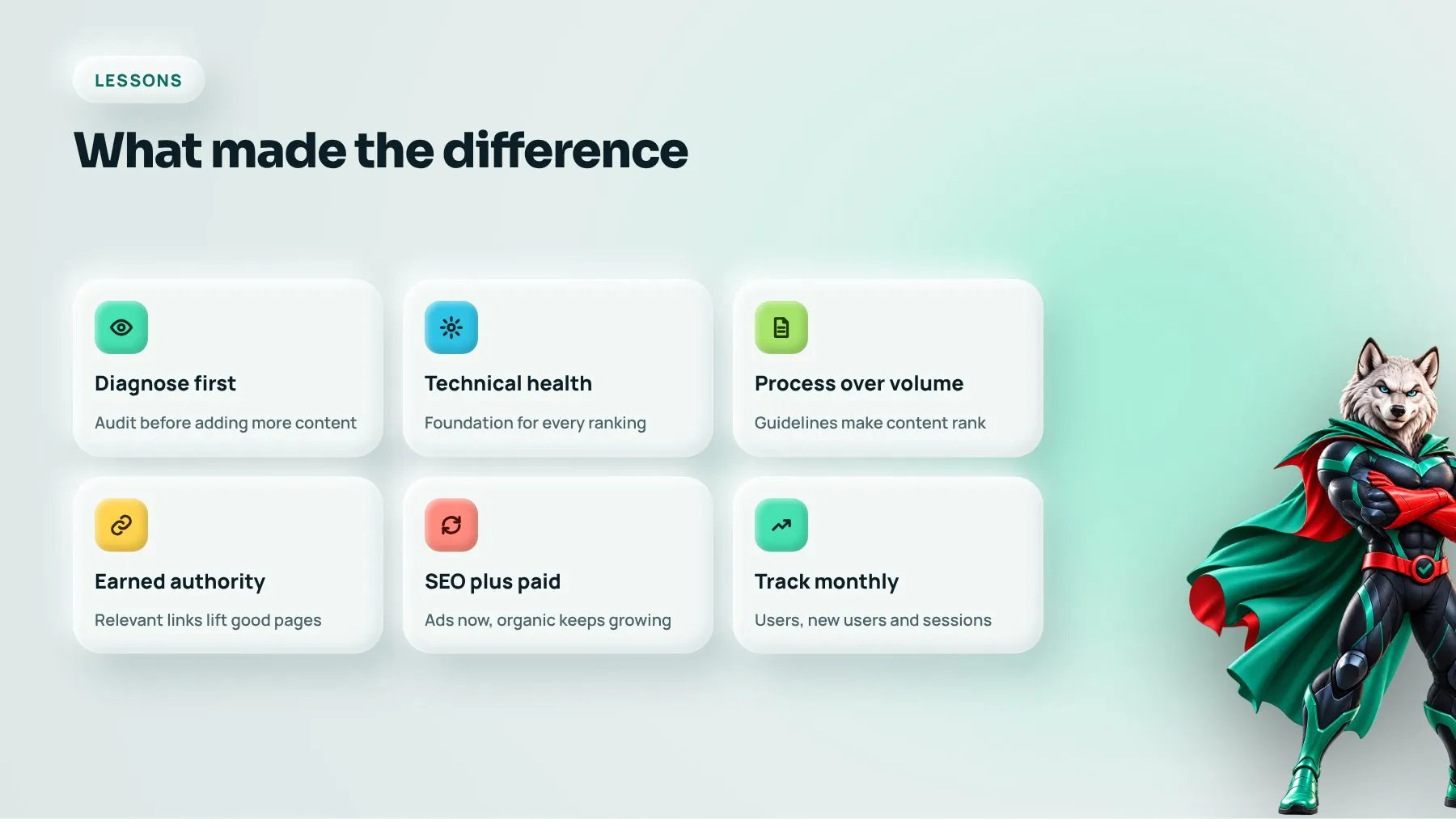
What made the difference
- Diagnosis before action. The audit showed what was actually wrong, so effort went where it counted.
- Technical health is the foundation. Great content cannot rank on a slow site Google struggles to crawl.
- Process beats volume. Clear content guidelines made every new article more likely to earn traffic.
- Authority still matters. Relevant, earned backlinks helped the improved pages climb.
- SEO complements paid. Ads bring quick traffic; SEO builds traffic that keeps coming.
How to apply this to your business
- Run a technical audit (or have one done) before producing more content.
- Test your key pages for speed on mobile and fix the biggest issues first.
- Write down content guidelines: keyword, intent, structure, internal links, author.
- Check which existing pages rank and improve those before writing new ones.
- Plan link building around genuinely useful content others want to reference.
- Track organic users, new users and sessions monthly to measure progress.
As search shifts toward AI answers, the same foundations also support visibility in AI-generated results; see our AI Overviews optimization service. For core search work, see our SEO services.
FAQ
How long does SEO take for a startup?
Most startups see early signs in three to six months, with stronger growth over 6 to 12 months. A new domain with little authority usually takes longer than an established site.
Should a startup invest in SEO or Google Ads first?
Often both, for different reasons. Ads deliver traffic and learning quickly; SEO builds a channel that grows in value over time. Many startups use ads to validate messages and keywords, then use those insights to guide SEO.
What does an SEO audit include?
A good audit covers crawling and indexing, site structure, on-page elements, speed, content quality and backlinks. It should end with a prioritized action list, not just a long report of issues.
Want to grow organic traffic without simply spending more on ads? See our SEO services or book a strategy call.