Most business owners reach the same point sooner or later: the website is live, it looks good, and yet it barely appears on Google. Ranking is hard because Google is trying to show the single most useful result for each search, and many other businesses are competing for the same spot. This guide explains the six main reasons sites struggle to rank, what has changed by 2026, and what you can do about each one.
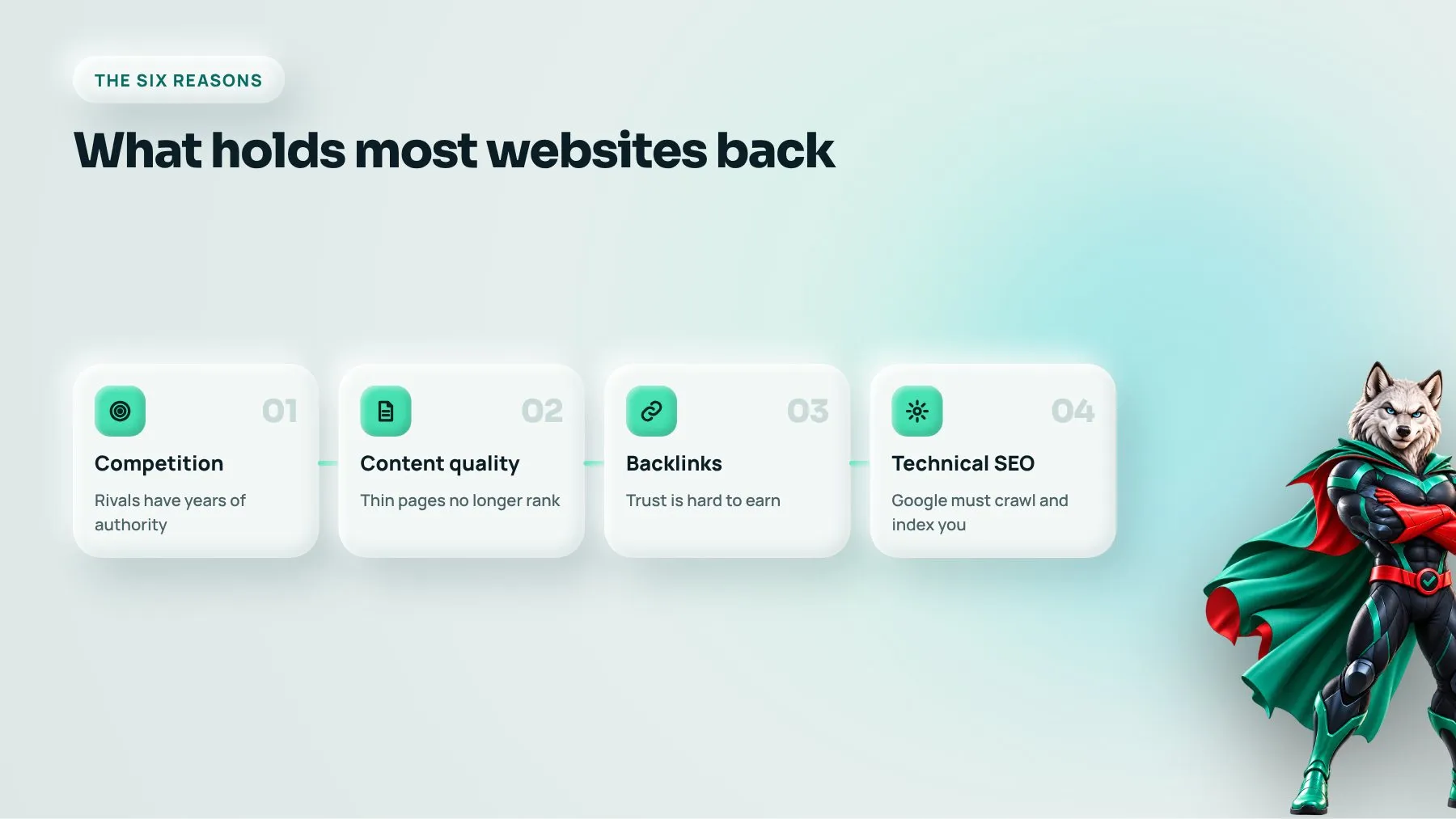
1. Competition: you are not the only one who wants the spot
For almost any valuable keyword, other websites are already competing, and many have been at it for years. They have more pages, more links and more history with Google. If you target the same broad terms they do, you are asking a new or smaller site to beat established ones on their strongest ground.
What to do instead
- Target specific, lower-competition searches first. “Commercial roofing repair in [your town]” is far more winnable than “roofing”, and the person searching it is closer to buying.
- Study who ranks on page one for your target terms. If every result is a national brand or a major publication, pick a more specific angle.
- Build authority in a narrow topic before expanding. Google trusts sites that cover a subject thoroughly.
Common mistake: choosing keywords by search volume alone. High volume usually means high competition and mixed intent.
2. Quality of content: Google rewards the most helpful page
Google’s systems favor content that is high quality, relevant and informative. Since the original version of this article, that emphasis has only grown. Google’s helpful content guidance and its focus on experience, expertise, authoritativeness and trust (often shortened to E-E-A-T) mean thin, generic or copied pages struggle to rank, however many keywords they contain.
AI tools have made generic content cheap to produce, so the bar has risen. Pages that rank in 2026 typically show real expertise: original examples, clear answers, practical detail and a named, credible author or business behind them.
What to do
- Answer the searcher’s question fully and early, then add depth.
- Use your own experience: real processes, examples and photos from your business.
- Update important pages when facts or prices change.
- Merge or remove weak, overlapping pages that compete with each other.
Common mistake: publishing lots of short posts that say nothing new. A few excellent pages beat dozens of thin ones.
3. On-page SEO: helping Google understand each page
On-page SEO means optimizing a page’s content and structure so search engines understand what it is about. That includes title tags, meta descriptions, header tags and sensible keyword placement.
The essentials
- Title tag: include the main keyword near the start and make it compelling enough to click.
- Meta description: it does not directly affect rankings, but a clear summary improves click-through.
- Headings: one main heading that states the topic, with subheadings that structure the content logically.
- Keyword use: use the main phrase and natural variations where they fit. Do not force them.
- Internal links: link related pages together so Google can find them and understand which pages matter most.
- Images: descriptive file names and alt text.
Common mistake: targeting the same keyword on several pages. They compete with each other and often none ranks well. Give each page one clear job.
4. Backlinks: earning trust from other websites
Backlinks, links from other websites to yours, remain one of the strongest signals of authority. A link from a respected site acts like a recommendation. The difficulty is that high-quality links from authoritative sites are hard to get, precisely because they are valuable.
What works in 2026
- Creating genuinely useful resources others want to reference, such as guides, tools or original insights from your own work.
- Local and industry relationships: associations, suppliers, partners, sponsorships and local press.
- Digital PR built around a real story or expert comment.
- Fixing brand mentions that do not yet link to you.
Common mistake: buying cheap links in bulk. Low-quality or manipulative links can be ignored by Google at best and lead to penalties at worst. A handful of relevant, credible links is worth more than hundreds of poor ones.
5. Technical SEO: making sure Google can crawl and index you
A well-structured, technically sound website is easier for Google to crawl, index and rank. Technical problems are often invisible to owners, yet they can stop good content from ranking at all.
Checks every site should pass
- Important pages are indexed (check the Pages report in Google Search Console).
- No accidental “noindex” tags or blocked sections in robots.txt.
- An up-to-date XML sitemap submitted to Search Console.
- Fast loading and good Core Web Vitals, especially on mobile.
- Clean redirects, with no long chains or broken links.
- HTTPS everywhere and one consistent version of each URL.
- Structured data (schema markup) for your business, products, reviews or FAQs where relevant.
Common mistake: launching a redesigned website without redirecting old URLs. This can wipe out years of rankings overnight. If you are planning a new site, involve SEO from the start; our website development team builds migrations with this in mind.
6. Google updates: the goalposts keep moving
Google updates its algorithm frequently, and some updates noticeably reshuffle rankings. Keeping up is genuinely difficult for a business owner with a company to run.
What has changed most since this article was first written is the shape of the results page itself. AI Overviews now answer many questions directly at the top of Google, and many people also ask AI assistants for recommendations. That means ranking well is no longer the only goal. You also want your business to be cited in those AI answers. The good news is that the same foundations apply: clear, well-structured, trustworthy content from a credible business. We cover this in more detail in our AI Overviews optimization and generative engine optimization services.
How to stay resilient
- Focus on what updates consistently reward: helpful content, real expertise and a good user experience.
- Avoid shortcuts that might work today and be penalized tomorrow.
- Monitor Search Console so you notice sudden drops and can investigate quickly.
- Do not panic after an update. Look at which pages moved and why before making changes.
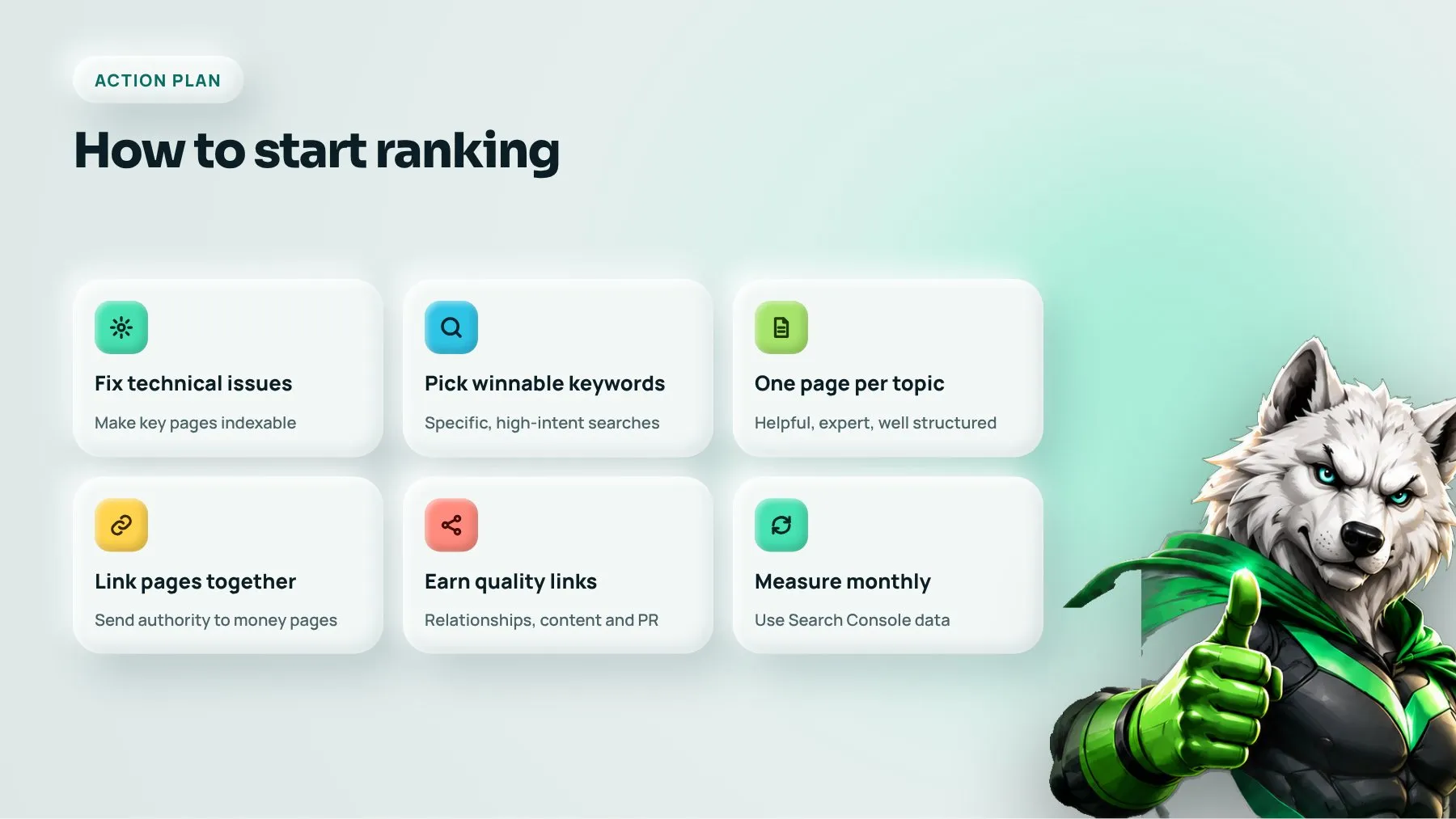
Putting it together: a practical plan
Ranking is not one task but several working together. If you are starting out or stuck, work in this order:
- Fix technical issues so Google can crawl and index your important pages.
- Choose realistic keywords with clear buying intent and winnable competition.
- Build or improve one excellent page per topic, with strong on-page SEO.
- Link your pages together so authority flows to the pages that make money.
- Earn quality backlinks through relationships, useful content and PR.
- Measure and refine every month using Search Console and analytics.
Overall, ranking a website on Google is a complex process involving many factors, and it takes time and effort. Businesses that commit to steady, quality work tend to see results compound, while those chasing shortcuts usually go backwards.
FAQ
How long does it take to rank on Google?
For most businesses, meaningful SEO results start to show in 3–6 months, with stronger results over 6–12 months. Less competitive, specific searches can move faster, while broad and competitive terms take longer.
Can I rank without backlinks?
For very specific, low-competition searches, strong content and on-page SEO can be enough. For competitive terms, you will almost always need some quality backlinks to show Google your site is trusted.
Should I hire an agency or do SEO myself?
You can handle the basics yourself, such as your Google Business Profile, titles and helpful content. An experienced agency adds value on technical SEO, strategy, link building and keeping up with changes, especially in competitive markets where mistakes are costly.
Struggling to rank? See our SEO services or book a strategy call and we will tell you what is holding your site back.