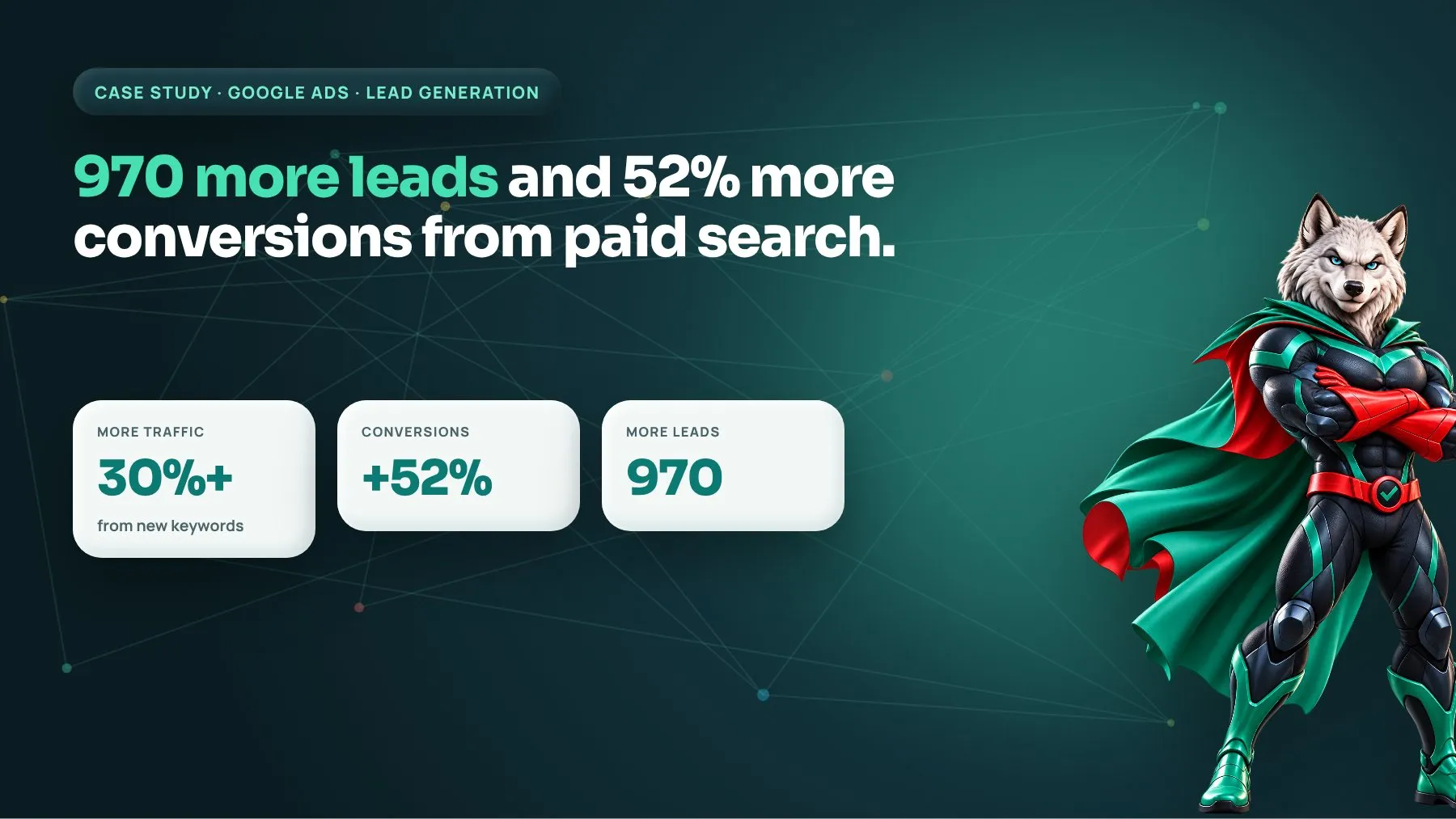
A client came to us wanting more leads and more of the right visitors on their website. By rebuilding their paid search around competitive keyword research and rewriting their ad copy, we increased their traffic by more than 30%, delivered 52% more conversions and generated 970 additional leads.
At a glance
- Client: Lead-driven business advertising on Google
- Services: PPC management, keyword research, ad copywriting
- Key results: traffic up by more than 30%; 52% more conversions; 970 more leads
The challenge: traffic that was too small and not commercial enough
The brief was clear. The client wanted us to:
- Choose relevant keywords with commercial intent.
- Bring suitable traffic to the website.
- Increase sales and reduce the cost of conversions.
Those three goals pull in slightly different directions, and that is where most paid search accounts go wrong. Chasing traffic alone fills a site with browsers who never buy. Chasing a low cost per conversion alone often shrinks an account until it stops growing. The real task is to grow the volume of qualified visitors while keeping the cost of each lead under control.
For a business that depends on leads, this matters commercially. Every lead feeds a sales pipeline. If the account cannot produce enough of them, the sales team sits idle; if it produces lots of poor ones, the team wastes time and the true cost of a customer rises.
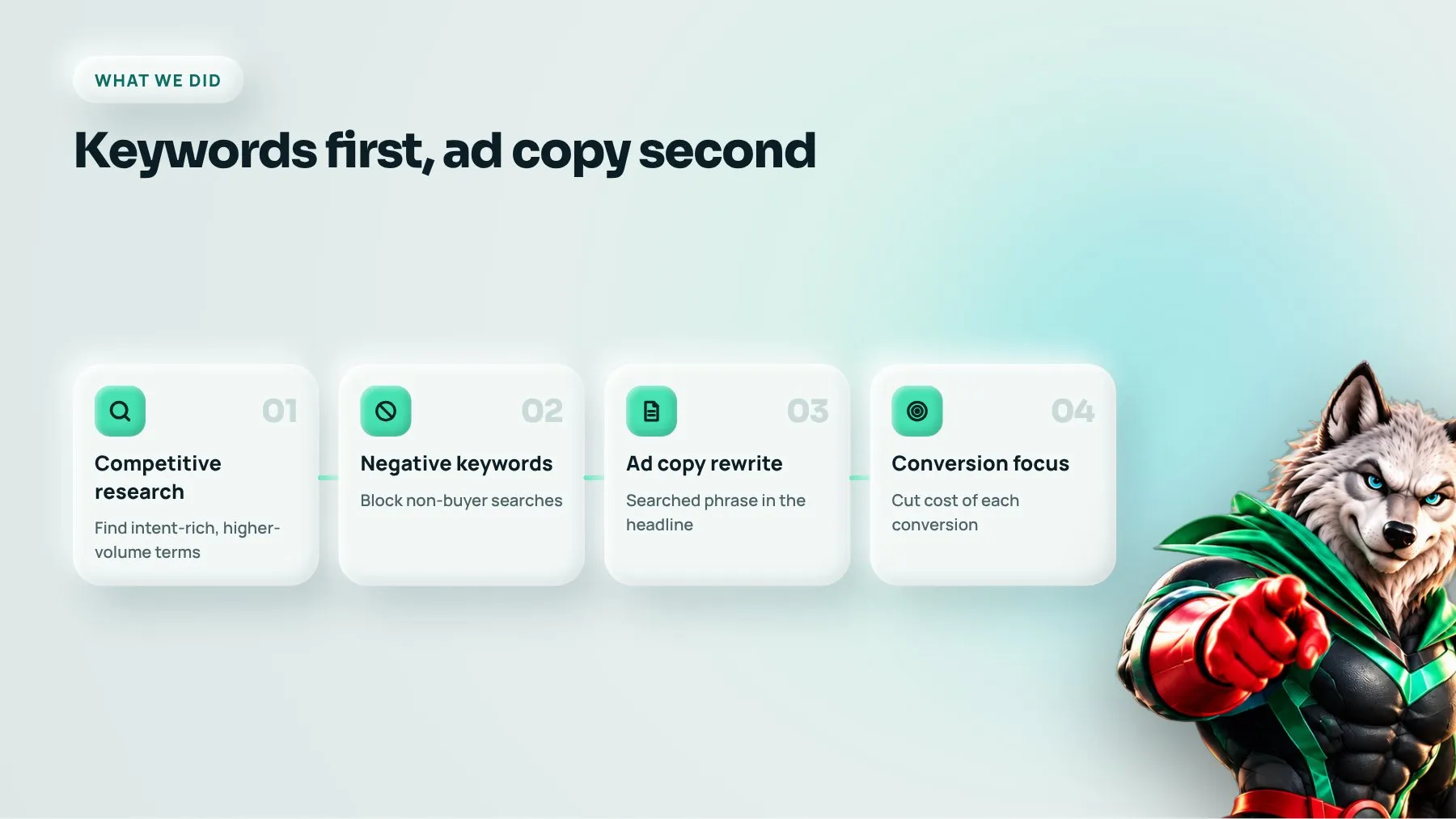
What we did: keyword research first, ad copy second
Our approach had two parts, and the order mattered.
1. Competitive keyword research to expand reach
We started with keyword research informed by competitive analysis. The aim was to find search terms that combined meaningful monthly search volume with genuine commercial intent, so that growing traffic would also grow leads.
In practice that means looking at keywords through three filters:
- Intent. Does the search suggest someone ready to enquire or buy? Terms that include a service name, a problem to solve, words like “cost”, “quote”, “near me” or “hire” usually signal intent. Terms like “what is” or “free” often signal research.
- Volume. Is there enough search demand to move the needle? The client’s existing coverage was too narrow, so we deliberately added higher-traffic keywords to increase the account’s total addressable monthly searches.
- Competition. What are competitors bidding on, and where are the gaps? Competitive analysis shows which terms are crowded and expensive and which are underused.
Adding higher-volume keywords carries a risk: broader terms attract more irrelevant clicks. We managed this with the basics done properly:
- Tight ad groups built around one theme each, so the keyword, the ad and the landing page all match.
- Match type choices that balance reach and control, using phrase and exact match for core commercial terms.
- Negative keyword lists to block searches for jobs, free resources, DIY and other non-buyer themes.
- Search term review on a regular cycle, adding new negatives and promoting good queries to their own keywords.
2. Ad copy rewritten around the higher-volume keywords
Once the keyword set changed, the ads had to change with it. An ad that does not reflect what the searcher typed gets fewer clicks and a weaker Quality Score, which raises the cost of every click.
We modified the ad copy to target the keywords with higher search volumes directly. That means:
- Putting the searched phrase in the headline so the ad looks like a direct answer to the query.
- Leading with the benefit the buyer cares about, not a generic company description.
- Clear calls to action that tell the reader what happens next, such as requesting a quote or booking a call.
- Using assets (extensions) like sitelinks and callouts to take up more space on the results page and add reasons to click.
- Testing multiple headline and description variations in responsive search ads, then keeping the strongest combinations.
Better-matched ads earn higher click-through rates. Higher click-through rates improve Quality Score, and a stronger Quality Score lowers cost per click. That chain is how relevant copy helps reduce the cost of conversions while volume grows.
The results: more traffic, more conversions, more leads
With competitive analysis guiding the keyword research, the campaign delivered:
- Traffic up by more than 30%
- 52% more conversions
- 970 more leads
The important detail is that conversions grew faster than traffic. A 30%+ increase in visitors produced a 52% increase in conversions. That tells you the new traffic was not just bigger; it was better. The visitors arriving were more likely to take action, which is exactly what the client asked for when they wanted suitable traffic and a lower cost of conversion.
For the business, 970 additional leads means a materially fuller pipeline for the sales team to work, created by the same channel the client was already using, run with more discipline.
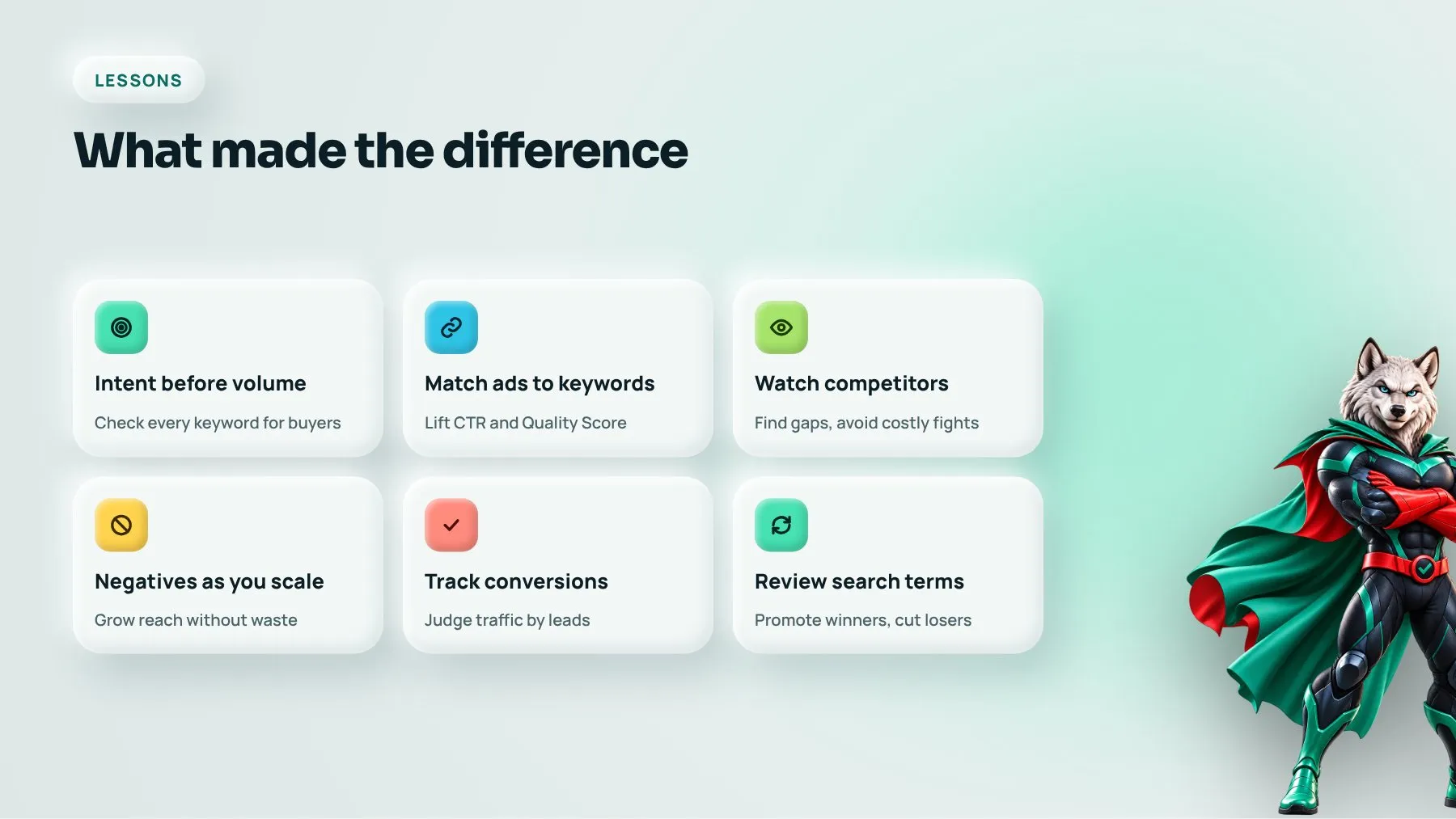
What made the difference: lessons for lead-driven businesses
Volume only helps when intent comes with it
Adding higher-traffic keywords worked because each one was checked for commercial intent first. Volume without intent just increases spend.
Keywords and ads must move together
Changing keywords without changing ads leaves a mismatch the searcher notices. Aligning the two is one of the simplest ways to raise click-through rate and lower costs.
Competitive analysis shows you where to play
Seeing what competitors target reveals both the expensive battlegrounds and the gaps. Smart accounts pick their fights.
Negatives protect the budget as you scale
Every expansion of reach needs a matching expansion of negative keywords. That is how you grow traffic without growing waste.
How to apply this to your business
- List your current keywords and mark each one as high, medium or low commercial intent.
- Use competitor research to find relevant, higher-volume terms you are not yet covering.
- Group new keywords into tight themed ad groups with matching ads.
- Rewrite headlines to include the searched phrase and a clear benefit.
- Build and maintain negative keyword lists before you widen reach.
- Track conversions, not just clicks, so you can see whether new traffic is actually valuable.
FAQ
Will adding higher-volume keywords raise my costs?
It can if done carelessly. Broader terms bring more irrelevant clicks unless you pair them with negatives, tight ad groups and regular search term reviews. Done properly, the extra reach brings more leads at a controlled cost.
How quickly can Google Ads changes show results?
Paid search responds faster than SEO. Changes to keywords and ads usually show measurable movement within weeks, though campaigns need a period of data before bids and copy can be fully optimized.
Why did conversions grow faster than traffic?
Because the new keywords and ads attracted people with stronger buying intent. When ads match what the searcher wants, more of those visitors go on to enquire, so conversion rate improves alongside volume.
Want more qualified leads from your ad budget? See our PPC management service, explore our lead generation work, or book a strategy call.