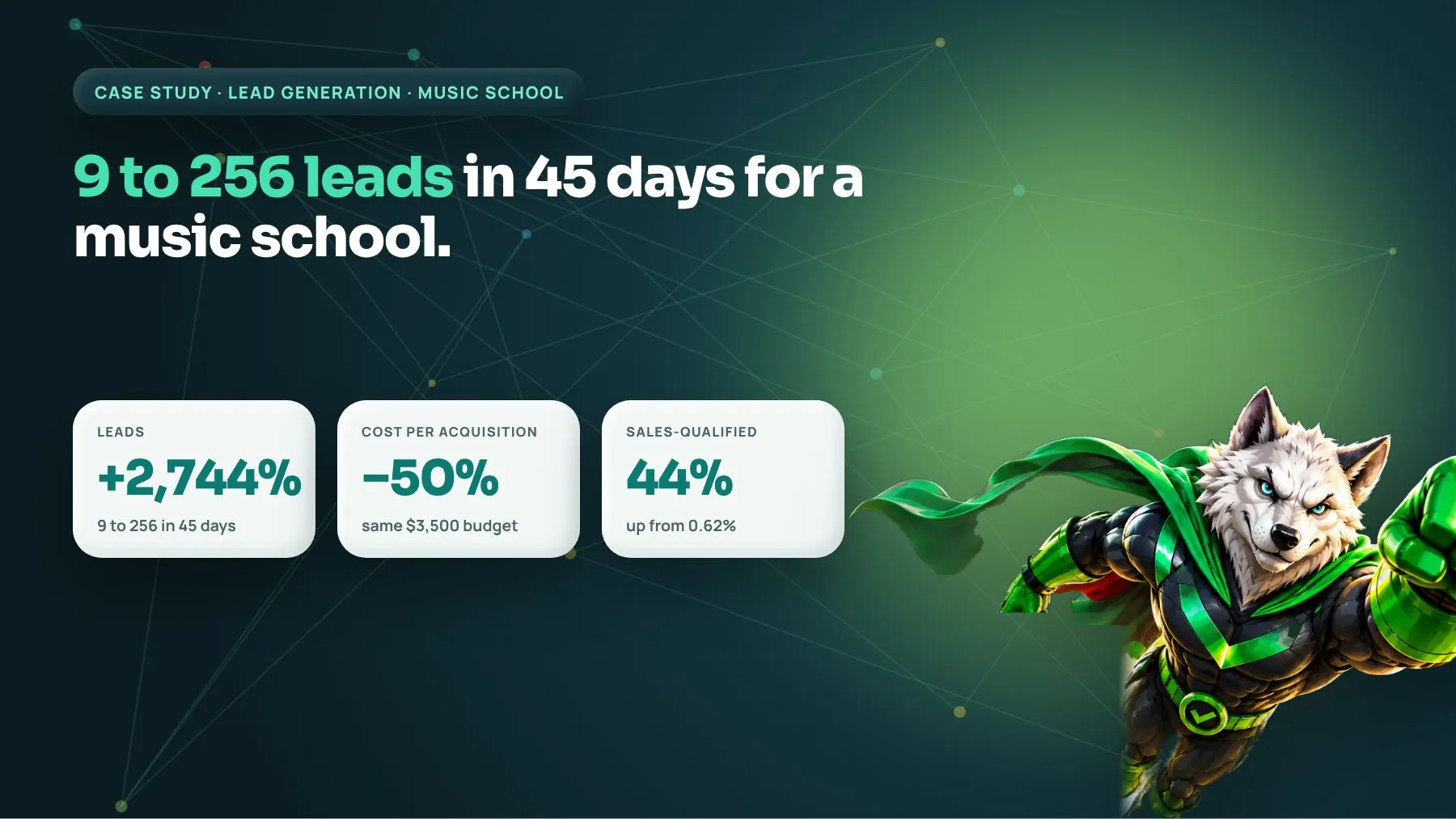
One of the largest music schools in India, teaching with expert instructors across 5 states, wanted its ads to generate more leads. Within 45 days of rebuilding its campaigns from scratch, leads rose from 9 to 256, a 2,744% increase, while cost per acquisition fell by 50% and the budget stayed the same.
At a glance
- Client: Large music school operating across 5 states in India
- Service: Paid advertising and lead generation
- Budget: $3,500
- Timeframe: 45 days
- Key results:
- Leads up from 9 to 256 (+2,744%)
- Cost per acquisition 50% lower, with a lower cost per click
- Lead-to-sales-qualified rate around 44%, up from 0.62%
The challenge: a competitive market, a small budget and a need to prove paid ads work
The school had been running its own ads, and they weren’t producing much. Nine leads was not enough to justify the spend, and it left the team doubting whether paid acquisition was the right channel at all.
Two constraints shaped the project:
- A low budget in a competitive market. The available budget was $3,500, in a market where many music schools and online learning platforms compete for the same students.
- No extra spend to prove the point. We had to improve results without increasing the ad budget. The school needed early evidence that paid acquisition could work before committing more money to it.
That is a common position for education businesses. Courses are a considered purchase, often made by parents on behalf of children or by adults fitting lessons around work. Ads that only say “music classes available” struggle to stand out, and a budget spread across broad audiences gets used up before it reaches the people ready to enroll.
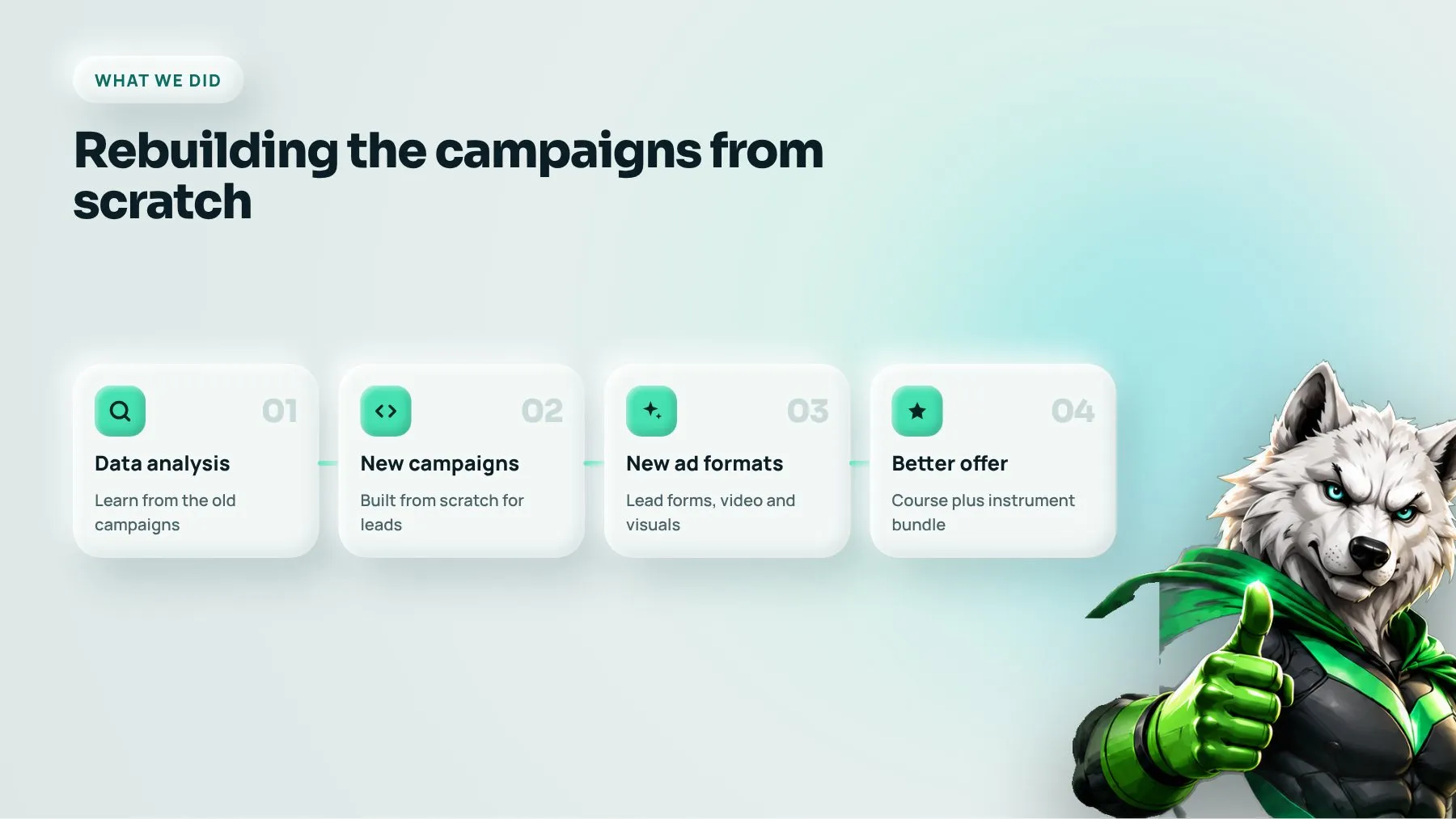
What we did: rebuilding the campaigns from scratch
Rather than tweak the existing campaigns, we started again using what the old data could teach us.
Analyzing the existing data
We reviewed the school’s previous campaigns to see which audiences, locations, ads and offers had produced any engagement or leads, and where money had been spent without return. Even a weak account holds useful signals: which courses people clicked on, which areas responded and which messages were ignored. That analysis became the basis for the new structure.
Building new campaigns and ads around the data
Using that analysis, we created new campaigns and ads, built from scratch. Budget was concentrated on the audiences and locations most likely to convert, instead of being spread thinly. Each campaign had a clear job and a clear conversion goal, so the platforms’ bidding systems optimized for actual leads rather than cheap clicks.
Taking advantage of new ad formats
We used newer ad formats that suit a business like a music school. Lead-focused formats let interested people send their details with very little effort, which matters on mobile. Visual and video formats show what learning with the school actually looks like, which builds confidence before a parent or student ever makes contact.
Finding a gap in the market
Our analysis showed a clear gap. Many competitors were selling lessons alone. Few made it easy for a new student to get started with everything they needed in one step.
Creating a stronger offer: course plus instrument
To fill that gap, we built the campaign around a combination of course plus musical instrument. A three-month course priced at $500 was offered alongside a keyboard as an upsell at $400.
This did two things. For the student, it removed a real barrier: many beginners don’t own an instrument and don’t know which one to buy. For the school, it increased the value of each new customer. A better offer is often the most powerful lever in advertising, because it raises response from the same audience at the same cost.
The results: 9 leads to 256 in 45 days
Within the first 45 days of setting everything up from scratch:
- Conversions increased from 9 leads to 256 leads, an increase of 2,744%.
- Cost per acquisition fell by 50% compared with the previous campaigns, with a lower cost per click as well.
- Around 44% of leads became sales-qualified, up from 0.62% previously.
The economics behind each lead also improved. With a $500 three-month course and a $400 keyboard upsell, each student who enrolled with an instrument represented a meaningfully higher order value than lessons alone.
The jump in lead quality is as important as the jump in volume. Moving from 0.62% to roughly 44% of leads becoming sales-qualified means the sales team spent its time on people genuinely interested in enrolling. More leads of better quality, at half the acquisition cost and on the same budget, gave the school the proof it needed that paid acquisition was the right channel.
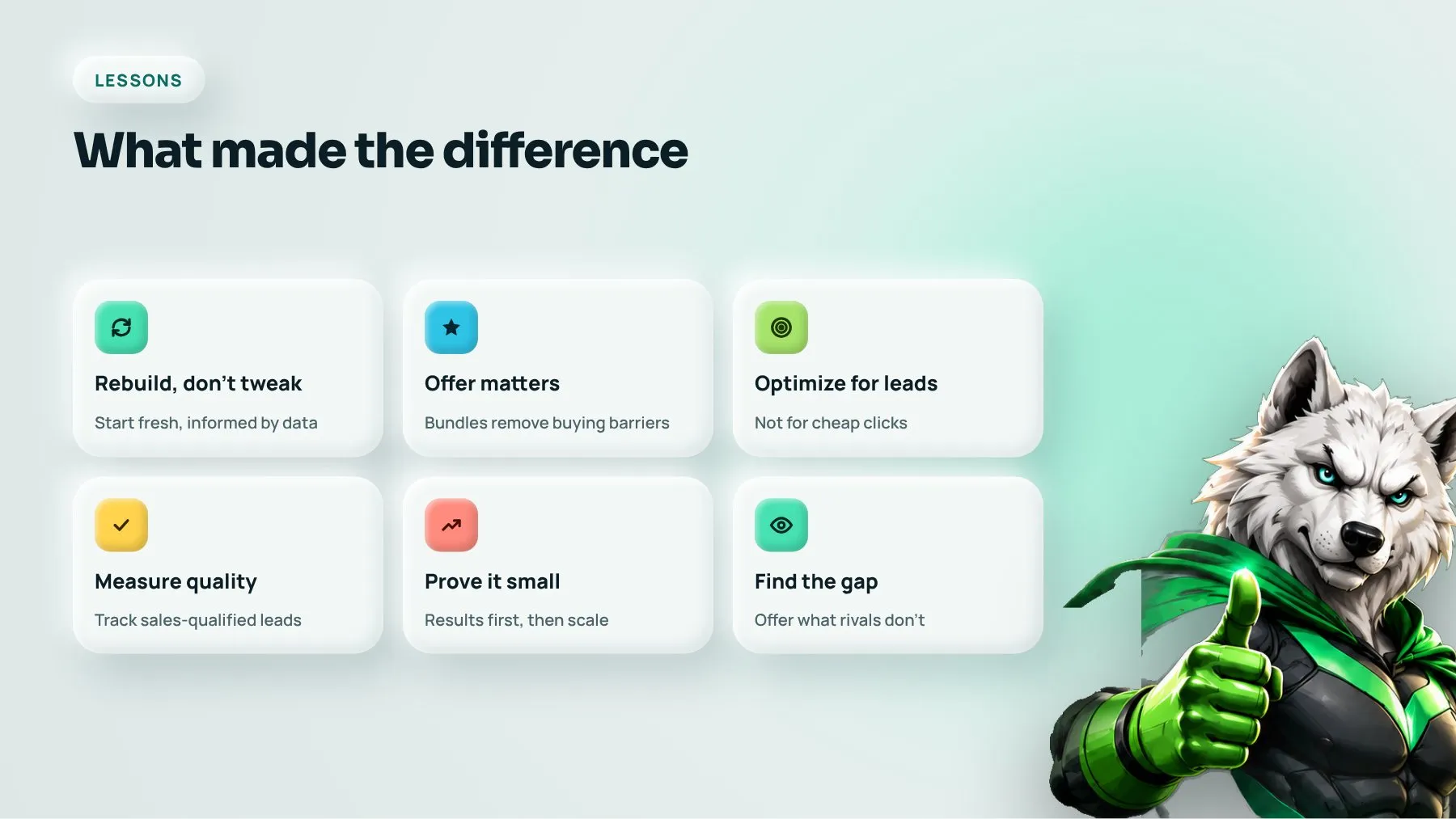
What made the difference: lessons for education and course businesses
Rebuild when the foundation is wrong
Small tweaks to a poorly built account rarely fix it. Starting from scratch, informed by the old data, was faster.
The offer matters as much as the targeting
Bundling the course with an instrument solved a real customer problem and lifted order value.
Optimize for leads, not clicks
Campaigns set to optimize for conversions find people likely to enquire, not just people likely to click.
Measure lead quality
Lead volume alone can mislead. Tracking how many leads become sales-qualified shows what the campaigns are really worth.
Prove it on a small budget first
Showing results without raising spend builds the confidence to scale.
How to apply this to your business
- Review past campaign data to find what worked and what wasted money.
- Look at competitors’ offers and find what they don’t provide.
- Build an offer that removes a barrier for new customers, such as a bundle or starter package.
- Use lead-focused ad formats and set campaigns to optimize for leads.
- Track both lead volume and the share of leads that become qualified sales opportunities.
FAQ
Can paid ads work on a small budget?
Yes, if the budget is focused. A small budget spread across too many audiences and goals rarely works. Concentrating spend on the most likely customers, with a strong offer, gives the best chance of a clear return.
How quickly can a lead generation campaign show results?
Paid campaigns can start producing leads within days. Most need a few weeks of data to optimize properly. This school saw its results within the first 45 days.
How do I improve lead quality, not just volume?
Be specific in your ads about the offer and price, ask a qualifying question in your lead form where it makes sense, and feed back which leads became customers so campaigns can be refined. Quality improves when ads attract the right people and filter out the wrong ones.
Want more qualified leads for your school or course business? See our lead generation services and paid advertising management, or book a strategy call.