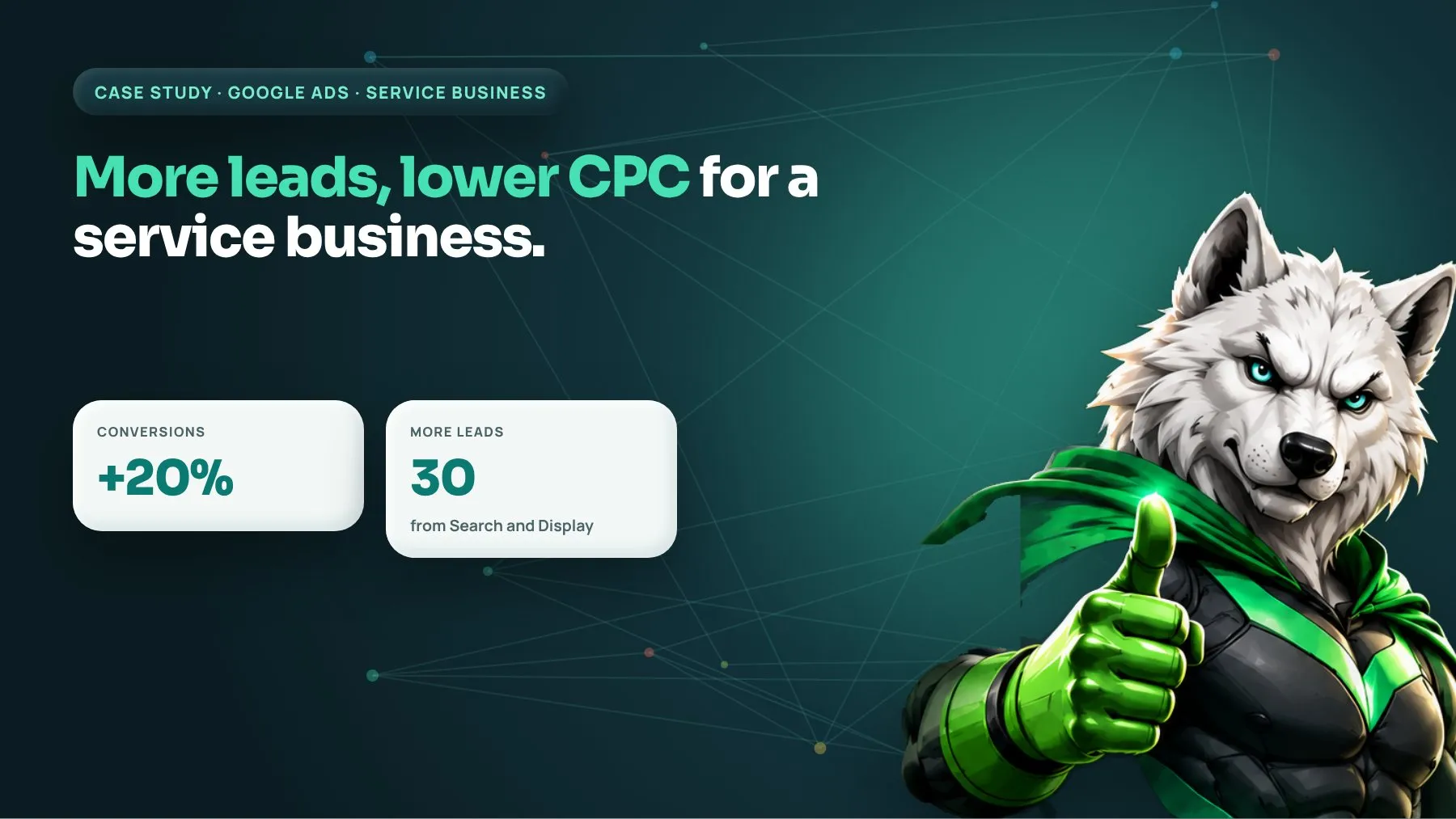
A service-based business asked us for better potential leads and a steady flow of relevant traffic, while bringing down their cost per click (CPC). We rebuilt their Google Ads around fresh keyword research, custom Search campaigns and creative Display campaigns. The result: 20% more conversions and 30 more leads.
At a glance
- Client: Service-based business with a lead-generation website
- Services: PPC management, Search campaigns, Display campaigns, keyword research
- Key results: 20% more conversions; 30 more leads; reduced CPC
The challenge: more leads, for less per click
The client’s website sold services, so its job was to generate enquiries. They wanted us to:
- Choose relevant keywords and target them to bring in the desired traffic.
- Bring suitable traffic to the website.
- Increase relevant leads and reduce the cost of conversions.
In short, the challenge was to increase potential leads and decrease CPC at the same time.
That is harder than it sounds. In most accounts, the quickest way to more leads is to spend more and bid higher, which pushes CPC up. The quickest way to lower CPC is to bid less, which usually cuts volume. Achieving both needs better targeting and better relevance, not just budget changes.
For a service business, this balance matters commercially. Each lead may represent a significant job, but the cost of acquiring it has to make sense against what the service earns. A high CPC on poorly targeted traffic quietly eats the margin on every new client.
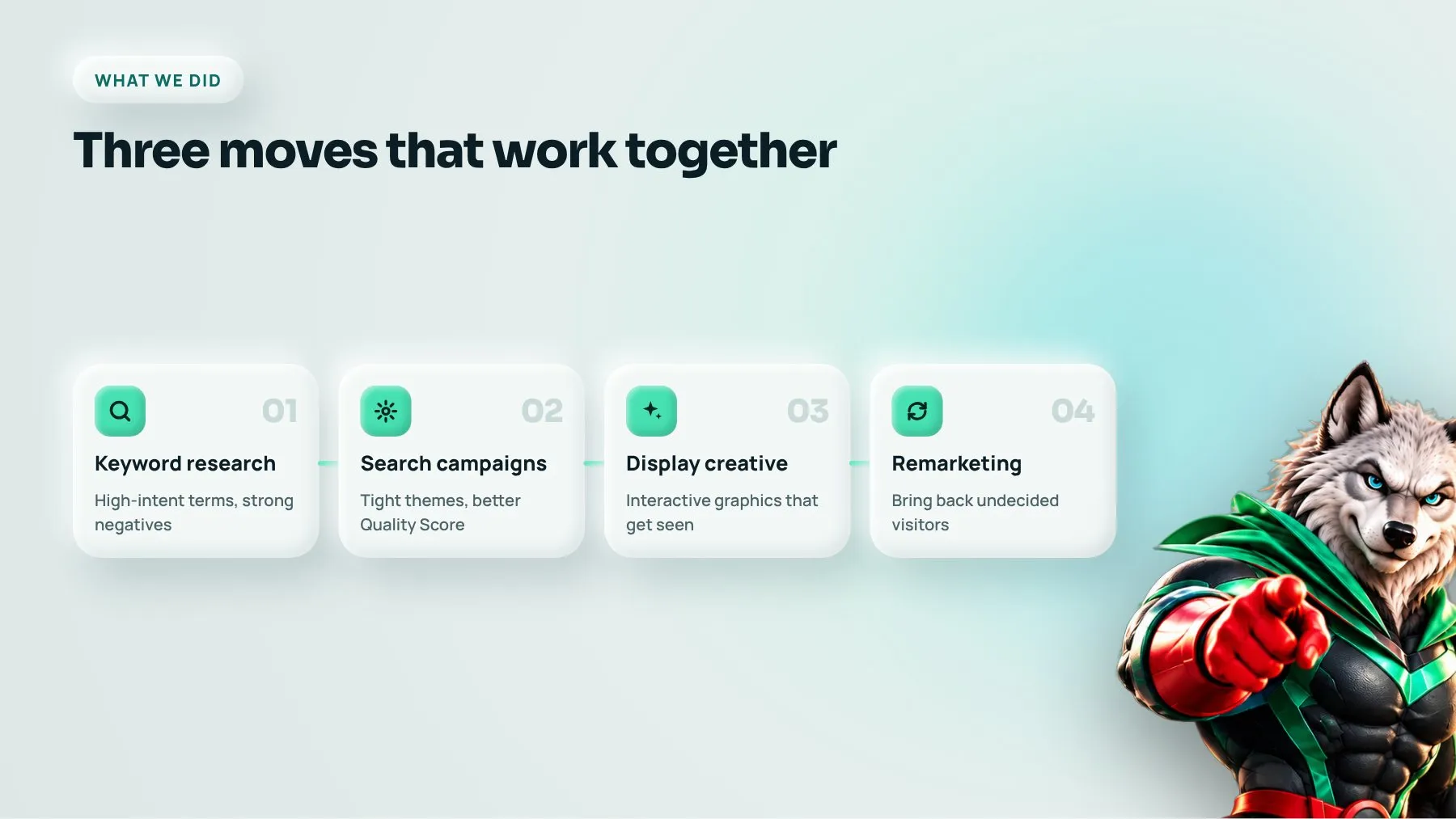
What we did: three moves that work together
1. Extensive keyword research and retargeting of high-intent terms
We performed extensive keyword research and refocused the account on keywords with higher traffic and search volumes that were also likely to deliver authentic leads.
Good keyword work for a service business looks at:
- Service and problem terms. What do prospects type when they need this service? Often it is the problem rather than the service name.
- Commercial modifiers. Words such as “cost”, “quote”, “near me”, “company” or “hire” separate buyers from researchers.
- Volume and competition. Higher-volume terms widen reach; competitive analysis shows which are worth the price.
- Negative keywords. Blocking job seekers, DIY searches, free-resource hunters and unrelated meanings is essential, especially as reach grows.
Weeding out irrelevant clicks is one of the most direct ways to reduce what you pay for each real lead.
2. Custom Search campaign strategies
Rather than one catch-all campaign, we edited existing campaigns and created new ones built around specific services and keyword themes. The aim was to bring more relevant traffic that would convert into a better return.
Structure drives cost. When each ad group focuses on one tight theme:
- Ads can match the search closely, which lifts click-through rate.
- Quality Score improves, because Google sees strong relevance between keyword, ad and landing page.
- CPC falls, since better Quality Score lets you win auctions without paying as much.
- Budgets can be set by priority, so the most profitable services get the most spend.
We used responsive search ads with headlines built around the targeted keywords, clear calls to action and assets such as sitelinks and callouts to make the ads more useful and more visible.
3. Creative Display campaigns
Search captures people who are actively looking. Display reaches people who are not searching right now but fit the audience. We designed the Display campaigns creatively, with interactive graphics, to catch the audience’s attention and keep the brand in front of them.
Display works best when it is targeted carefully. Typical approaches include:
- Remarketing to people who have already visited the site but not enquired, reminding them while they are still deciding.
- Audience targeting based on interests and in-market signals relevant to the service.
- Placement and content exclusions to keep ads off irrelevant or low-quality sites.
- Strong visuals and a clear message so the ad earns attention in a busy page.
Display clicks are usually cheaper than search clicks, so a well-run Display campaign can add lead volume at a lower average CPC across the account, and it supports Search by keeping the business familiar.
The results: more conversions and a lower CPC
The Search and Display campaigns together improved both lead flow and customer support. Precise keyword targeting and the optimized campaigns, with interactive graphics and focused messaging, helped the client turn more of their traffic into revenue.
- 20% more conversions
- 30 more leads
- Lower cost per click
For a service business, 30 extra potential customers is meaningful: each one is a conversation that could become a contract. Delivering those leads while CPC came down means the account became more efficient, not just bigger.
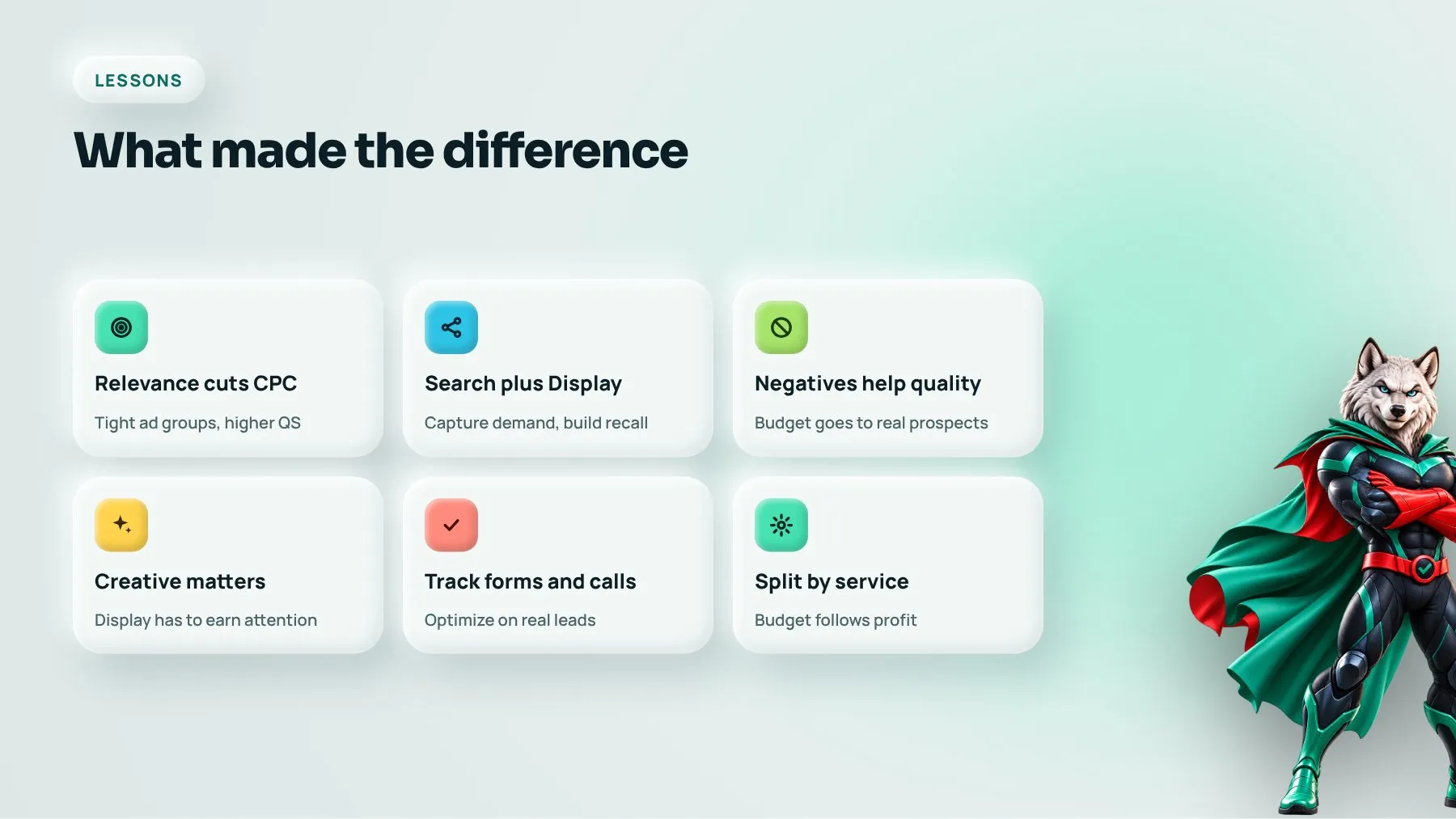
What made the difference: lessons for service businesses
Relevance is the lever that lowers CPC
Tight ad groups and matching ads raise Quality Score, and that is what reduces cost per click without losing position.
Search and Display do different jobs
Search catches demand; Display builds familiarity and brings back visitors who did not enquire first time. Used together, they cover more of the buying journey.
Negative keywords are part of lead quality
Every irrelevant click blocked is budget redirected to someone who might hire you.
Creative matters on Display
People are not looking for you on Display, so the ad has to earn attention. Good design is not decoration; it is performance.
How to apply this to your business
- Split your campaigns by service so each has its own keywords, ads and budget.
- Add negative keywords for jobs, DIY, free and unrelated searches.
- Write ads that repeat the searcher’s phrase and state a clear benefit and next step.
- Set up conversion tracking for forms and calls before you optimize anything.
- Launch a remarketing Display campaign for visitors who did not enquire.
- Review search terms and placements regularly and cut what does not perform.
FAQ
Can I lower my CPC without losing leads?
Usually, yes. Improving relevance between keywords, ads and landing pages raises Quality Score, which reduces CPC. Cutting irrelevant clicks with negatives also means more of your budget reaches real prospects.
Is Display advertising worth it for a service business?
It can be, particularly for remarketing. Many prospects visit once and leave to compare options; Display keeps you in front of them. It works best with careful audience targeting and placement exclusions.
How soon will I see results from restructured Google Ads campaigns?
Most accounts show changes in click-through rate and CPC within a few weeks of restructuring. Lead volume and cost per conversion usually settle over the following one to three months as the campaigns gather data.
Want more qualified leads at a lower cost? See our PPC management service, read more case studies, or book a strategy call.