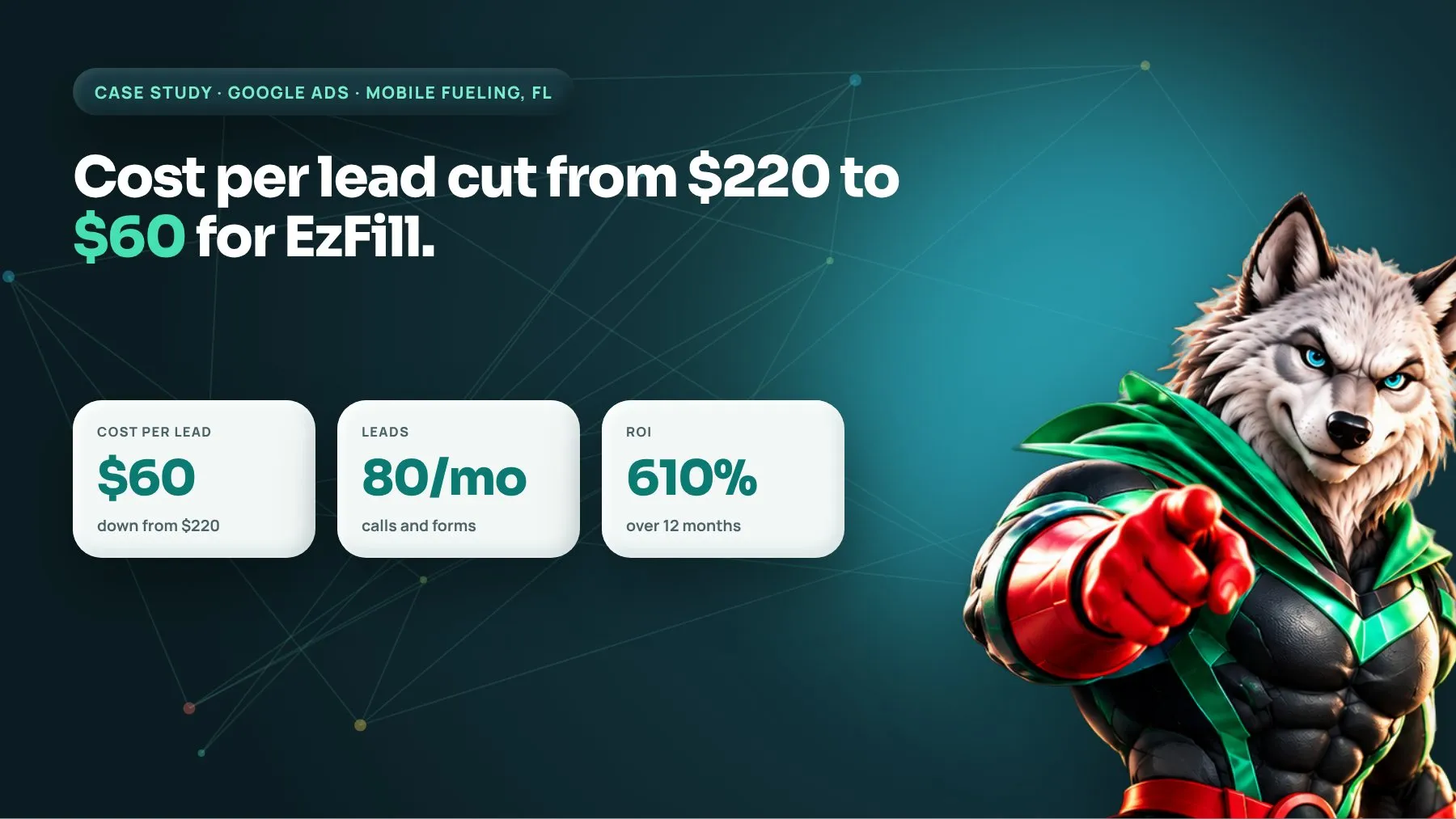
EzFill is a mobile fueling company based in Florida. When it came to us, its Google Ads were running on Smart Campaigns that were wasting budget, and its cost per lead was $220. We rebuilt the account with city-level Search and Display campaigns and targeted YouTube ads. Cost per lead fell to $60, the account averaged around 80 leads a month, and over 12 months the campaigns returned a 610% ROI.
At a glance
- Client: EzFill, mobile fueling company, Florida
- Service: Google Ads management (Search, Display, YouTube), landing page testing
- Timeframe: 12 months
- Key results: Cost per lead from $220 to $60; around 80 leads a month (calls and forms); $4.72K spent; 78 conversions; $430 average sale value; $33,540 total sale value; 610% ROI
The challenge: Smart Campaigns that were not so smart
Mobile fueling is a service many potential customers have never considered. Businesses with vehicle fleets, equipment or generators may not realize fuel can be delivered to them, so the market needs both demand capture (people already searching) and demand creation (people who need to learn the service exists).
EzFill had been running multiple Google “Smart Campaigns.” These are simplified, largely automated campaigns designed for small advertisers. They are easy to launch, but they give the advertiser very little control over which searches trigger ads, where ads appear, and how budget is split. For a specialized service, that lack of control usually means spend drifts toward loosely related searches that never become customers.
The outcome was a cost per lead of $220, which was far too high for the mobile fueling space. At that cost, each new customer had to be worth a lot simply to cover acquisition, and growth was hard to justify.
The starting setup
The account already included a mix of elements: Search campaigns, Display campaigns, YouTube campaigns, multiple landing pages for A/B testing, and experiment campaigns. The ingredients were there. What was missing was structure, targeting and control.
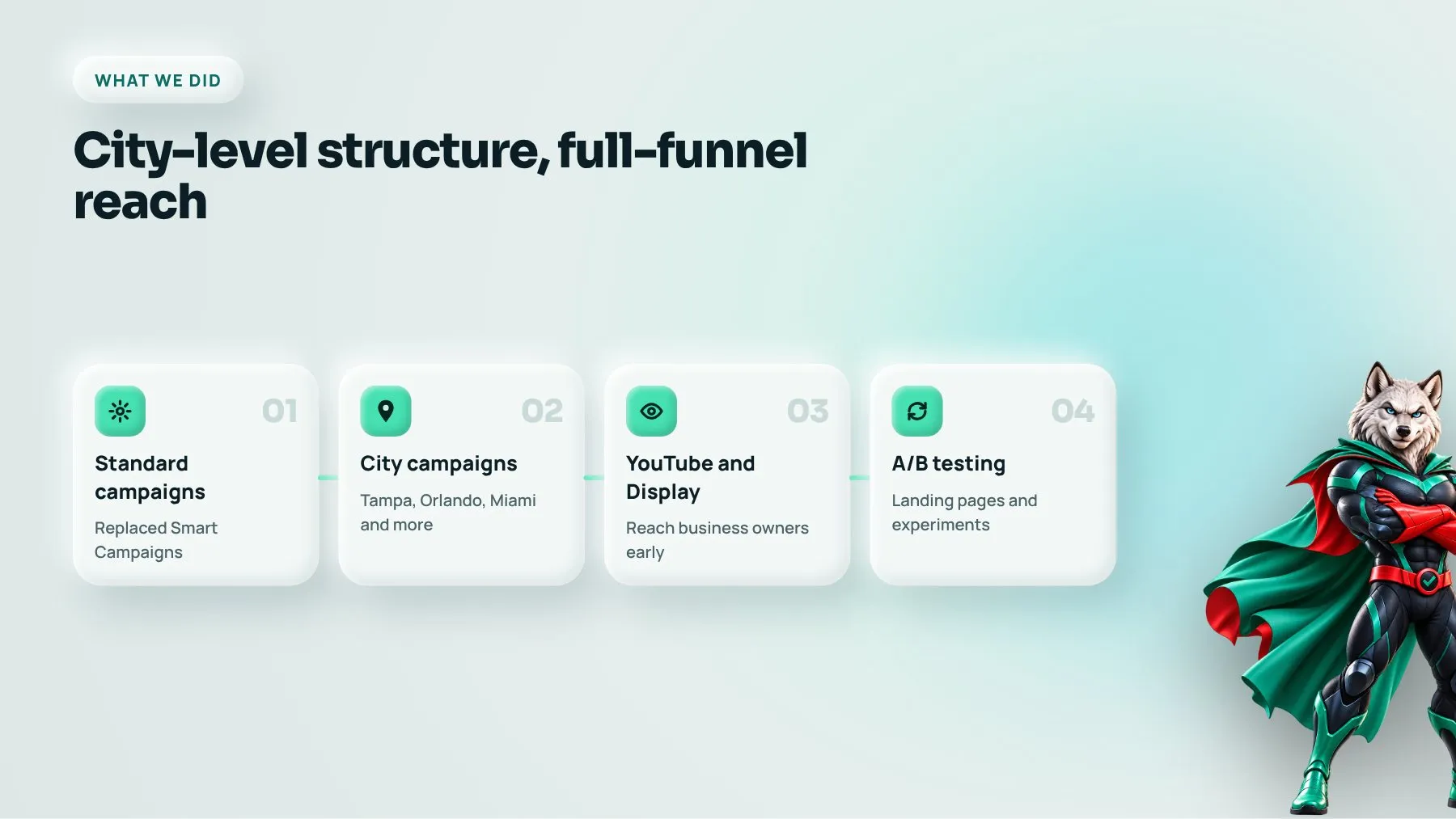
What we did: city-level structure and full-funnel reach
Moving from Smart Campaigns to standard campaigns
We replaced the automated setup with standard campaigns where we controlled keywords, match types, negatives, locations and bids. This is the foundation for everything else: you cannot optimize what you cannot see. With full search term visibility, we could cut irrelevant searches (for example, people looking for gas station prices or fuel delivery jobs) and focus budget on searches from businesses and customers who might actually book.
Search and Display campaigns for each city
We built separate Search and Display campaigns for every city EzFill was targeting: Tampa, Orlando, Jacksonville, Miami and Fort Myers. Splitting by city makes the data granular. Instead of one blended cost per lead across Florida, we could see which cities produced leads cheaply and which needed work, then shift budget, adjust bids and tailor ad copy for each market. City-specific ads also feel more relevant to the searcher, which helps click-through and conversion rates.
Expanding beyond search with Display and YouTube
Because many potential customers do not yet search for mobile fueling, search ads alone limit growth. We expanded into Display and YouTube to reach people before they search. YouTube ads were aimed at specific audiences, including business owners and companies, to build brand awareness and introduce the service to the kind of customers most likely to need it. Display kept EzFill visible to relevant audiences in each city, supporting search performance over time.
Landing pages and experiments
The account’s multiple landing pages gave us a ready-made testing framework. We used A/B testing and campaign experiments to compare page versions and bidding approaches, keeping what improved conversion rates and dropping what did not. Tracking both phone calls and form submissions as conversions meant optimization followed real leads, not just clicks.
The results: lower cost per lead and a 610% ROI
Over 12 months, the campaigns delivered:
- Amount spent: $4.72K
- Visitors: 1.42K
- Average sale value: $430
- Total conversions: 78
- Total sale value: $33,540
- ROI: 610%
On lead generation, the account averaged around 80 leads a month from phone calls and form submissions, and cost per lead dropped from $220 to $60.
For EzFill, the headline is efficiency. A cost per lead that is a fraction of where it started makes customer acquisition sustainable and gives the business room to scale spend city by city. A 610% ROI shows the advertising was not just generating interest but contributing real revenue relative to what was spent.
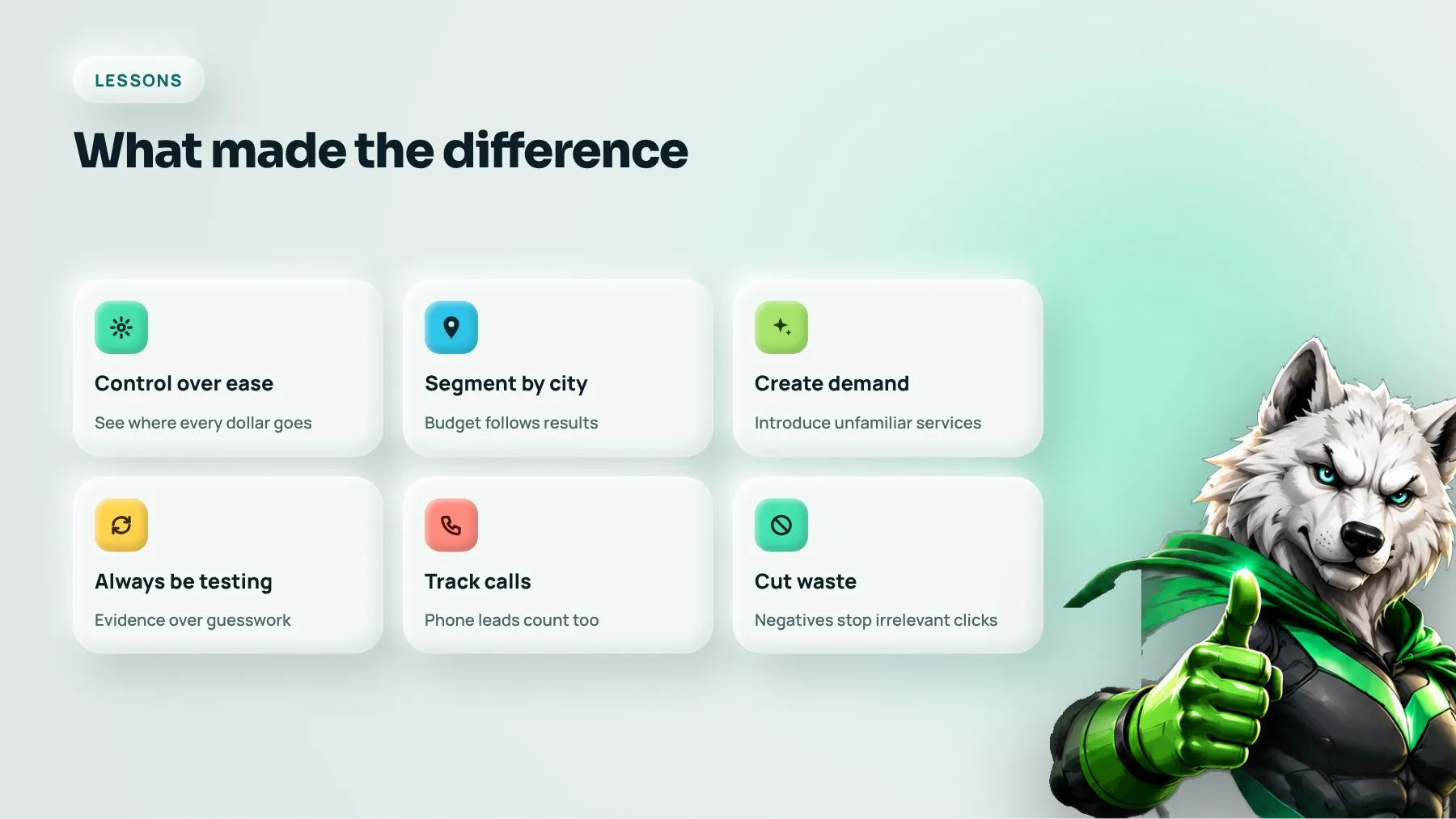
What made the difference: lessons for local service businesses
1. Control beats convenience
Automated campaign types are easy to set up but hide where your money goes. Standard campaigns give you the visibility to cut waste.
2. Segment by location
City-level campaigns reveal which markets perform, so budget can follow results instead of being averaged across a region.
3. Create demand, not just capture it
For services people do not know exist, Display and YouTube introduce the offer before anyone searches for it.
4. Test landing pages continuously
Multiple page versions and campaign experiments turn guesswork into evidence.
5. Track calls and forms
Many service leads come by phone. If calls are not tracked, optimization is based on half the picture.
How to apply this to your business
- Check whether you are running Smart or other automated campaigns and how much control they give you.
- Review your search terms and add negatives for irrelevant searches.
- Split campaigns by city or service area if you serve several markets.
- Use YouTube or Display to reach audiences who do not yet know your service exists.
- Set up call tracking and form tracking as conversions.
- Run at least one landing page test at all times.
FAQ
Are Google Smart Campaigns worth using?
They can be a starting point for very small advertisers with little time. For businesses that want efficient growth, standard campaigns usually perform better because you control keywords, negatives, locations and bids.
Do YouTube ads work for B2B or service businesses?
They can, especially when the service is unfamiliar to buyers. YouTube lets you reach specific audiences such as business owners, building awareness that later supports search and direct enquiries.
How long does it take to lower cost per lead in Google Ads?
Most accounts show clear improvement within the first two to three months as waste is removed and data builds. Larger gains come over the following months through testing and budget reallocation.
Want a lower cost per lead for your service business? See our Google Ads management, explore our lead generation services or book a strategy call.