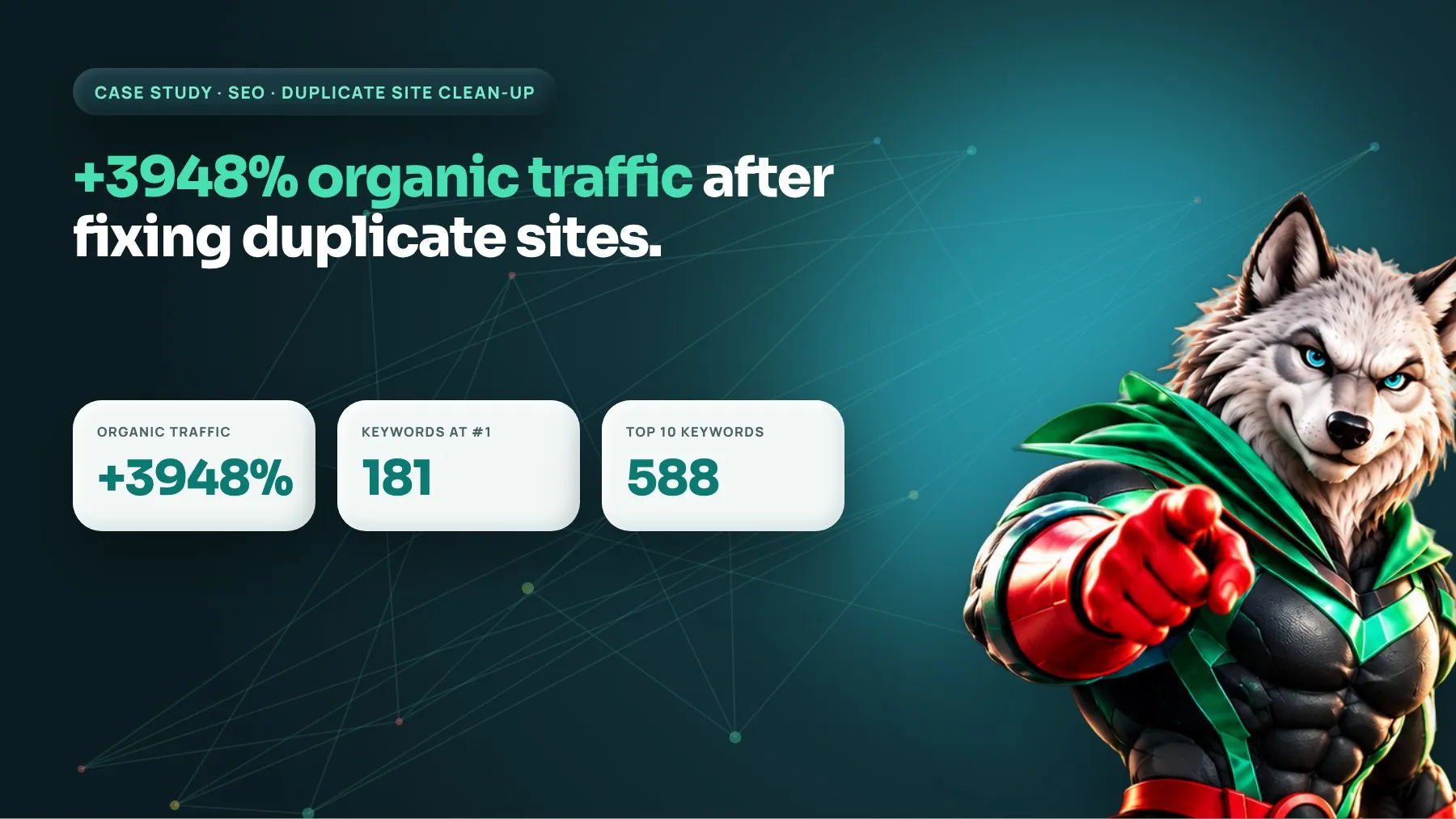
This client came to us after a previous web design company had built hundreds of auto-generated websites for them, all carrying the exact same content. Instead of helping, that setup was holding the business back in search. After a full SEO rebuild covering audit, consolidation, technical fixes, fresh content and link building, organic traffic grew by 3948%, with 181 keywords ranking at #1 and 588 in Google’s top 10.
At a glance
- Client: Business whose previous web design company had created hundreds of duplicate auto websites
- Services: SEO audit, technical SEO, content, Google Business Profile optimization, 301 redirects, link building
- Goals: Above-the-fold positions for target keywords and a large increase in organic search traffic
- Key results: +3948% organic traffic; 181 keywords at #1; 588 keywords in the top 10
The challenge: hundreds of websites competing against each other
Building many near-identical websites is an old tactic that some vendors still sell as a shortcut to “owning” search results. The theory is that more sites mean more chances to rank. In practice it does the opposite.
When Google finds the same content on many domains, it picks one version to show (or none) and filters out the rest. Hundreds of copies do not create hundreds of rankings. They split whatever authority the business has across many weak sites, confuse Google about which one is the real source, and can look like a deliberate attempt to manipulate results, which invites manual or algorithmic suppression.
For the business, that meant two things. Customers searching for exactly what they offered could not find them near the top of the page, and every dollar previously spent on those sites was producing almost nothing. The client’s goals were clear: get into above-the-fold positions for the keywords that matter, and grow organic traffic from Google and other search engines substantially.
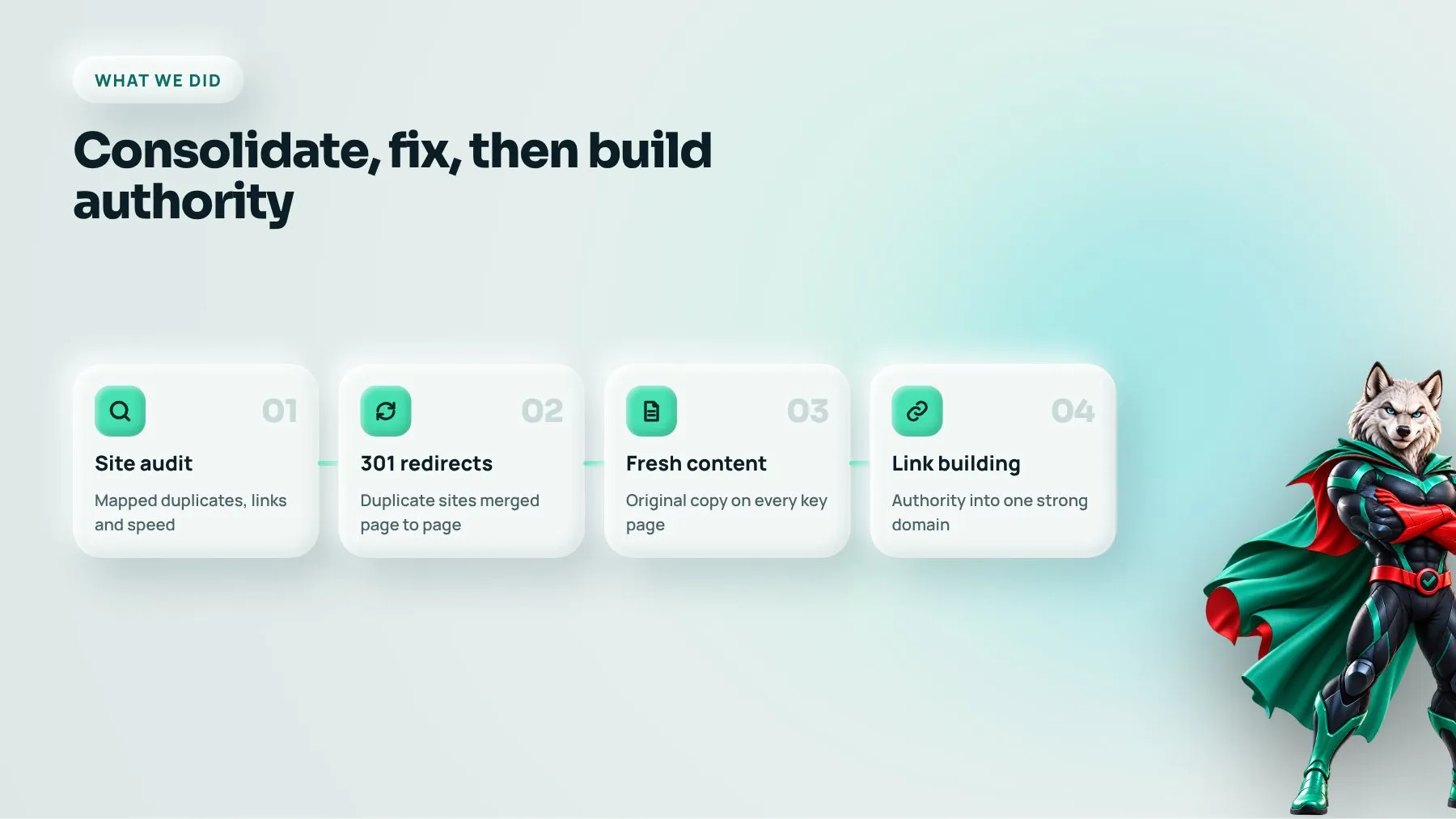
What we did: consolidate, fix, then build authority
We worked through nine tactics in a deliberate order. The early steps cleaned up the damage; the later steps built new strength on that clean foundation.
1. Site audit
Everything started with a full audit across the main site and the network of duplicate sites. We crawled them to map duplicate pages, index status, internal links, redirects, broken pages, page speed and on-page signals, and checked backlink profiles to see which domains carried any authority worth keeping. The audit turned a vague “we’re not ranking” problem into a prioritized list of fixes.
2. Keyword research
We then defined what the business should rank for. That meant grouping keywords by intent (people ready to buy or enquire versus people researching), by service, and by location where relevant, and mapping each group to one page. One page per intent is the cure for the duplication problem: each topic has a single, clear home.
3. 301 redirects
This was the turning point. Rather than leaving hundreds of copies live, we consolidated them, using permanent 301 redirects to point the duplicate sites and pages at the most relevant page on the main domain. A 301 tells Google the content has moved for good and passes the link value the old URLs had earned. Redirects were mapped page to page where possible, not dumped onto the homepage, so that users and search engines landed on the closest match.
4. Site optimization
With one authoritative site in place, we optimized its pages: unique title tags and meta descriptions built around the mapped keywords, a clean heading hierarchy, descriptive URLs, internal links between related pages, and structured data where it helped search engines understand the business. We also tidied the index so that thin and leftover pages were not diluting the site.
5. Site speed optimization
Slow sites lose visitors and rankings. We compressed and resized images, removed unused scripts, enabled caching and minimized render-blocking code, focusing on the Core Web Vitals measures Google uses to judge real-world loading, responsiveness and visual stability, especially on mobile.
6. Fresh content sitewide
Duplicate content had to be replaced with something better, not just removed. We rewrote core pages with original copy that answered customers’ real questions and gave Google a reason to prefer this site over competitors. Every important page now said something distinct.
7. Google Business Profile optimization
For local searches, the Google Business Profile (formerly Google My Business) is often what appears first. We optimized categories, services, business description, photos and contact details, and made sure the name, address and phone number matched the website exactly. Consistency between the profile and the site strengthens local rankings.
8. Link building
Once the site was clean and consolidated, we built links from relevant, reputable websites. Authority from quality backlinks is still one of the strongest ranking signals, and it compounds when it flows into a single strong domain instead of being scattered across hundreds of copies.
9. Content marketing to build social signals
Finally, we created and promoted content designed to be shared, which put the brand in front of new audiences, attracted visits and natural mentions, and supported link building.
The results: 3948% more organic traffic
- Organic traffic increased by 3948%
- 181 keywords ranking at position #1
- 588 keywords ranking in Google’s top 10
A 3948% increase means organic traffic grew to roughly forty times its starting level. The ranking numbers explain where that traffic came from: 588 keywords on page one, and 181 of them in the very first position, which typically receives the largest share of clicks on the page. That is the above-the-fold visibility the client asked for, across a wide spread of searches rather than one or two vanity terms.
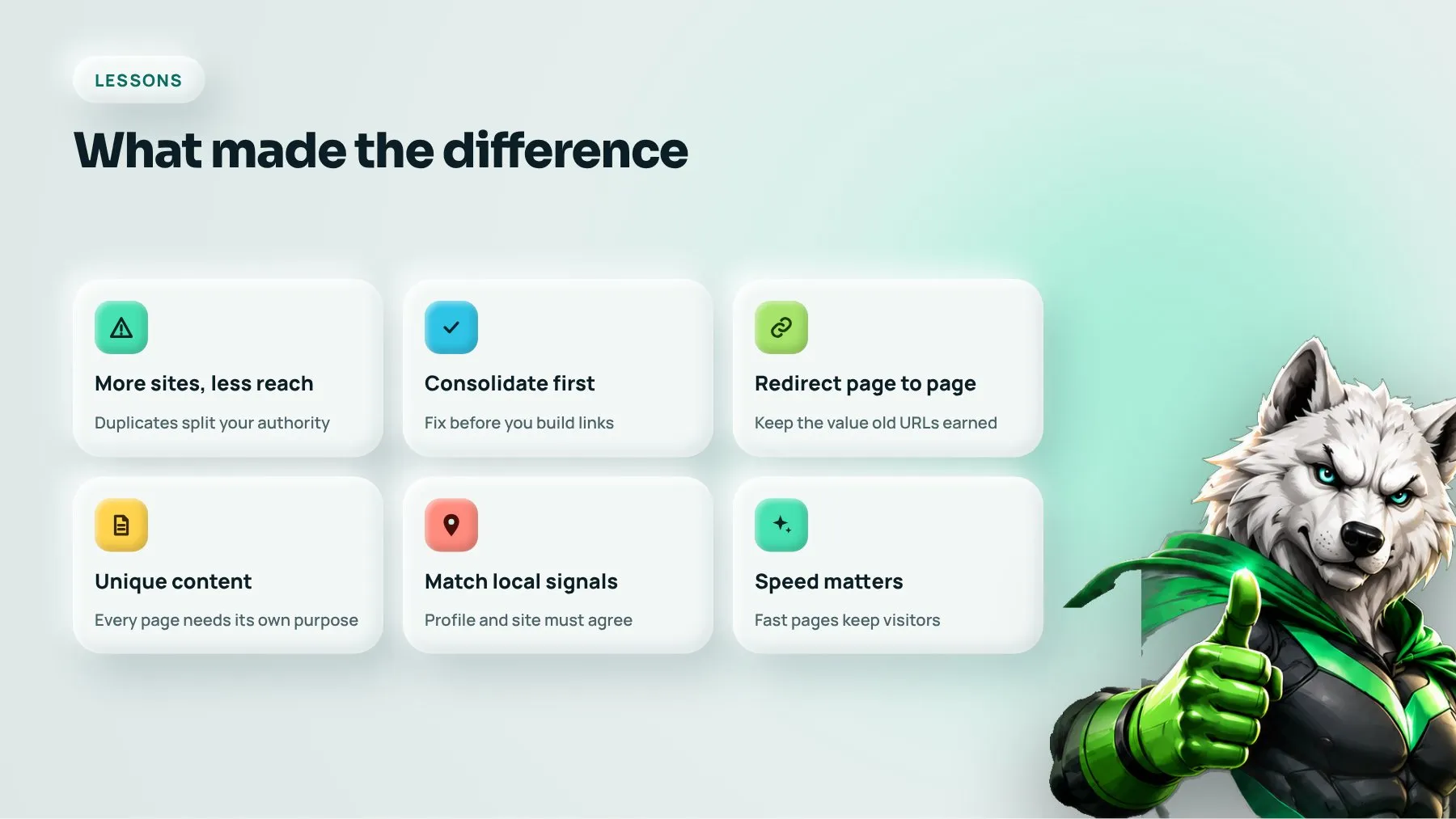
What made the difference: lessons from fixing duplicate content
- More websites is not more visibility. Duplicate sites split authority and get filtered. One strong site almost always beats many weak copies.
- Consolidate before you build. Link building and content work far better once redirects and duplicates are sorted out.
- Redirect page to page. Careful 301 mapping preserves the value old URLs earned; lazy redirects to the homepage waste it.
- Unique content is non-negotiable. Every page needs a distinct purpose and original copy.
- Local signals must match. Your Google Business Profile and website should tell exactly the same story.
How to apply this to your business
- Search Google for a distinctive sentence from your site in quotes to see if copies exist elsewhere.
- List every domain and microsite you own and ask whether each one earns its keep.
- Map each important search intent to one page only.
- Plan 301 redirects page by page before taking any site down.
- Check your Google Business Profile details match your website exactly.
- Only then invest in content and link building.
FAQ
Can duplicate content get my website penalized?
Usually Google filters duplicate pages rather than penalizing the whole site, but the effect is similar: the pages you need do not rank. Large-scale duplication designed to manipulate rankings can lead to a manual action.
Will I lose rankings if I shut down extra websites?
Not if it is done properly. Page-to-page 301 redirects pass most of the value to the destination page, and consolidation usually strengthens the main site.
How long does an SEO recovery like this take?
Technical clean-ups can show effects within weeks of Google recrawling, but strong growth from content and links typically builds over several months. Results depend on competition and how much damage there is to undo.
Is old or duplicated work holding your site back? See our SEO services, read more case studies, or book a strategy call.