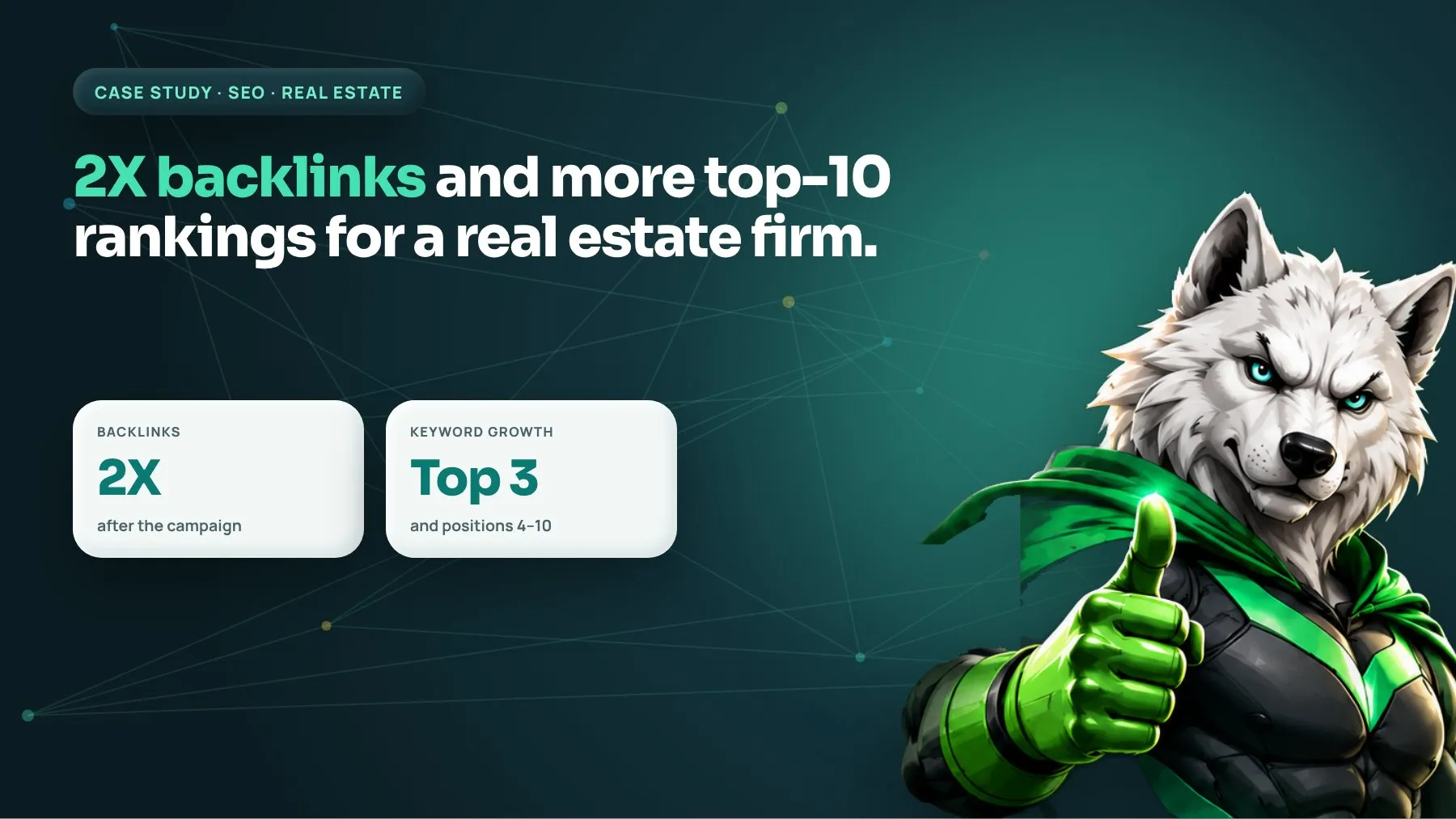
A real estate company came to us wanting more people to find them online and get in touch, by contact form or by phone. Through an audit-led SEO campaign we doubled the company’s backlinks, grew organic traffic, and moved more of their keywords into Google’s top 10 and top 3 positions.
At a glance
- Client: Real estate company generating enquiries through its website
- Service: Search engine optimization (audit, keyword research, competitor gap analysis, ongoing campaign)
- Key results: 2X backlinks, sustained growth in organic traffic, more keywords ranking in positions 1–3 and 4–10
The challenge: a property website that wasn’t bringing in enough enquiries
The company’s website already did the basics right from a conversion point of view. It had a contact form, clear phone options, and visitors could call the team directly. The problem was upstream: not enough of the right people were arriving in the first place.
In real estate, that matters more than in most sectors. A single enquiry can be a buyer, a seller, a landlord or a tenant, and each of those relationships can be worth a significant commission or a long-running management contract. The people searching are often in the middle of one of the biggest financial decisions of their lives. They search repeatedly, compare agencies, read listings and area guides, and contact the businesses that keep showing up with useful answers.
That makes organic search a natural channel for property businesses, but also a crowded one. Large portals, national brands and well-established local agencies compete for the same terms. A website without strong authority and well-targeted pages simply doesn’t appear when buyers and sellers are looking, no matter how good the contact form is.
The brief was clear: increase web traffic, reach more potential customers, and turn that visibility into enquiries through the channels the site already offered.
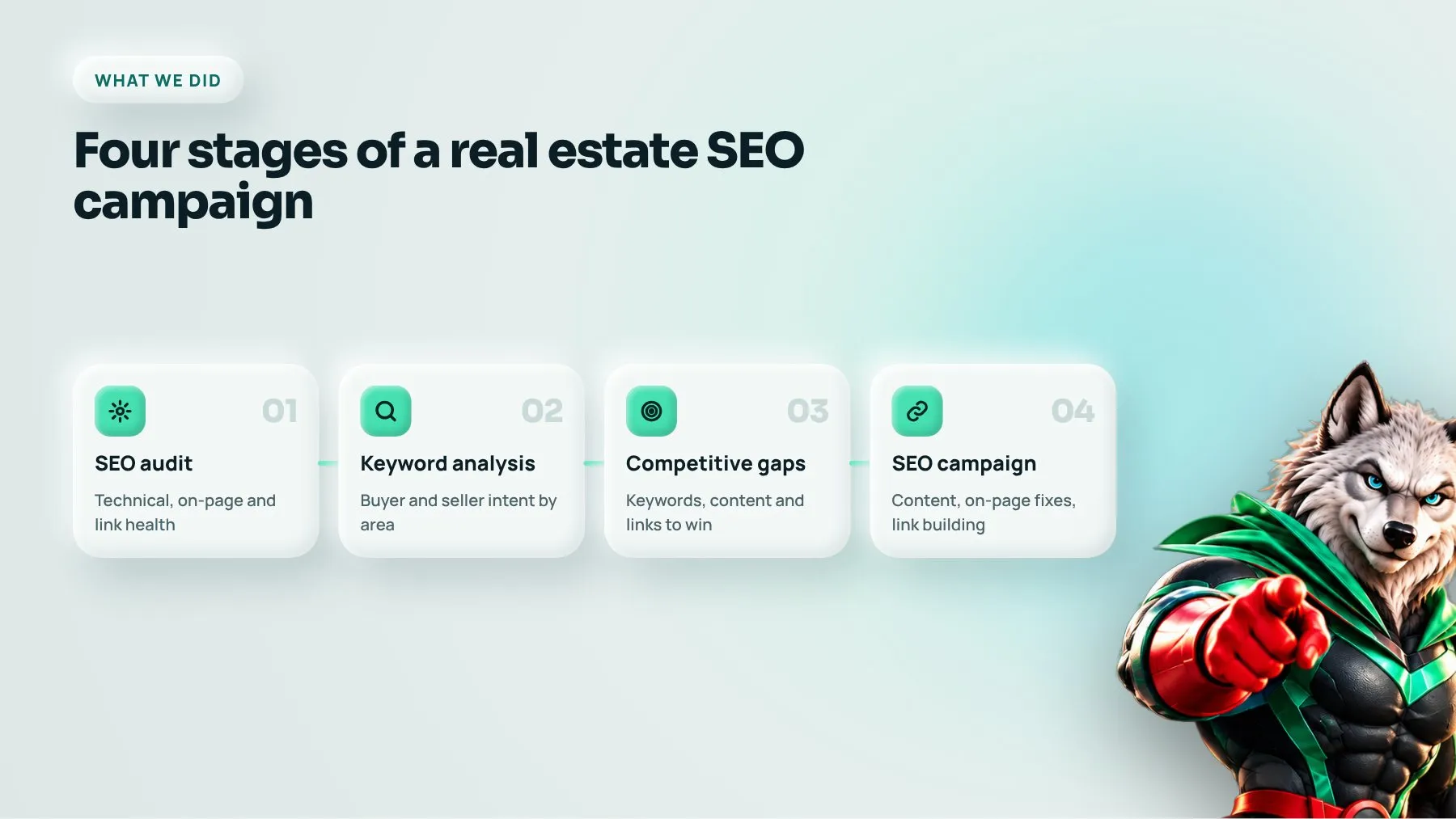
What we did: four stages of a real estate SEO campaign
We broke the work into four connected stages. Each one fed the next, so that the campaign was built on evidence rather than guesswork.
1. A full SEO audit
Every campaign we run starts with an audit, because there is no point building links or publishing content on a site with technical problems holding it back. For a property website, the audit looked at:
- Crawling and indexing: listing and property pages are often generated dynamically, which can create duplicate URLs, thin pages and sections Google never reaches. We checked what was indexed against what should be.
- Site structure and internal linking: whether important service and location pages were reachable within a few clicks and linked from relevant content.
- On-page fundamentals: title tags, meta descriptions, headings and content on key pages, checked against what people actually search for.
- Page speed and mobile experience: property searches happen heavily on phones, often on the move, so slow image-heavy pages lose visitors quickly.
- The existing backlink profile: how many sites linked to the company, how relevant and trustworthy they were, and whether any were worth cleaning up.
The audit gave us a prioritized list of fixes and a baseline to measure everything else against.
2. Keyword analysis built around buyer and seller intent
Real estate keywords split into very different intents. Someone searching for an area guide is early in their journey. Someone searching for an agent to sell their home, or for a property valuation in a specific area, is close to picking up the phone.
We mapped keywords into groups by intent and by location, then matched each group to the page that should rank for it. Where no suitable page existed, we flagged it as a content gap. This step is what keeps an SEO campaign commercially focused: the aim is not traffic for its own sake but traffic from people who are likely to become clients.
3. Competitive gap analysis
Next, we studied the competitors who were already ranking for the terms our client wanted. We looked at three things:
- Keyword gaps: valuable searches competitors ranked for where our client had no presence.
- Content gaps: topics and page types (such as area pages, guides for buyers and sellers, and market explainers) that competitors used to attract and convert visitors.
- Link gaps: the kinds of websites linking to competitors but not to our client, such as local directories, property and finance publications, and community or business sites.
This told us exactly where the client could realistically win, and what it would take.
4. The SEO campaign: content, on-page optimization and link building
With the groundwork done, we ran the campaign itself, focusing on three levers: rankings for target keywords, content, and backlinks.
- On-page optimization: we improved the pages that already had some visibility so that they better matched search intent, with clearer titles, stronger headings, better copy and tighter internal links.
- Content: we created and improved content to fill the gaps the analysis exposed, giving buyers, sellers and landlords useful answers and giving the site more pages that deserved to rank and earn links.
- Link building: we earned links from relevant, trustworthy sources rather than chasing volume from low-quality sites. Over the campaign, the company’s backlinks doubled.
Backlinks remain one of the strongest signals Google uses to judge whether a site is trustworthy. In competitive local markets like real estate, doubling the number of quality links pointing at a site is often what moves pages from page two to page one.
The results: more traffic, stronger rankings, twice the backlinks
The campaign delivered on the brief across the measures that matter for an SEO program.
- 2X backlinks: the company’s backlink profile doubled, strengthening the authority of the whole domain.
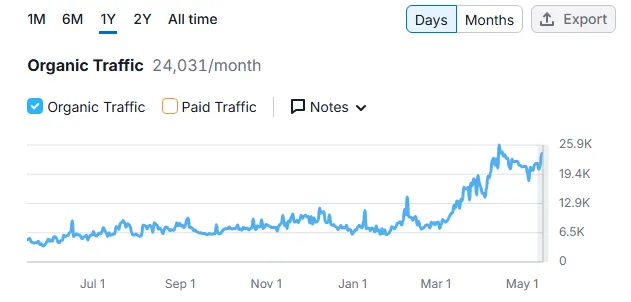
- Growth in organic traffic: more visitors arrived from Google without the company paying for each click.
- More top-performing keywords: the number of keywords ranking in positions 4–10 and in positions 1–3 increased.
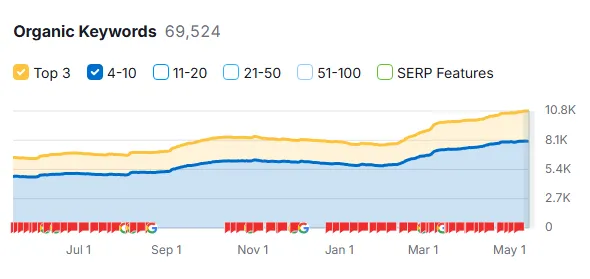
Why do those ranking bands matter? Positions 1–3 are where most clicks on a results page go. Positions 4–10 are still on page one and are often the next set of pages to push into the top three. Growth in both bands means the site is not only visible now but also has a pipeline of pages close to the top spots. For a real estate company, that translates into more people seeing the brand when they are actively looking to buy, sell or let, and more of them using the contact form or phone.
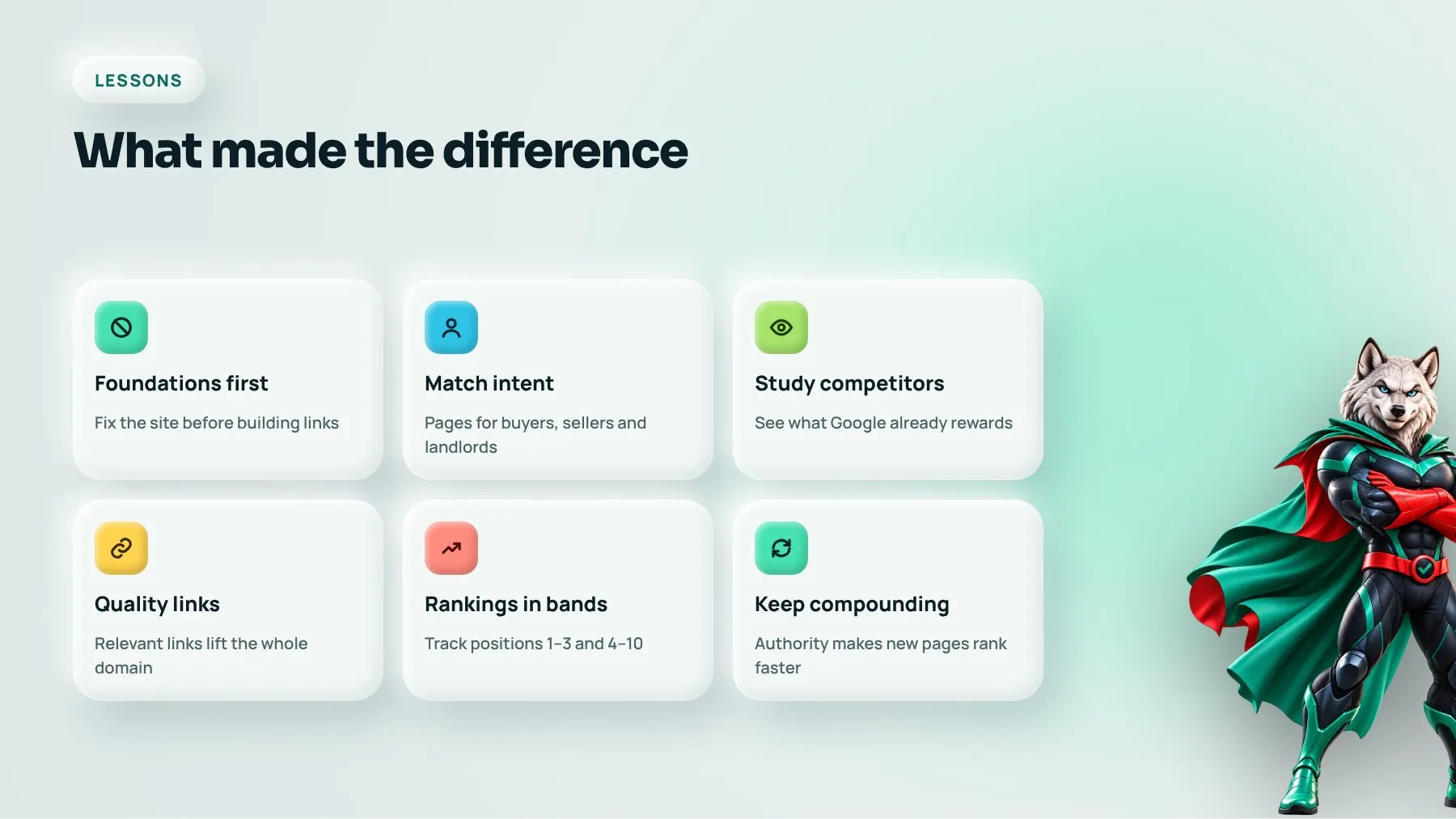
What made the difference: lessons for real estate businesses
Fix the foundations before you build links
Links pointing at a site with indexing problems or weak pages are partly wasted. The audit made sure every new link was supporting pages that could actually rank and convert.
Match pages to intent, not just keywords
Buyers, sellers, landlords and tenants search differently. Giving each group a page built for what they want is what turns traffic into enquiries.
Learn from the competitors already winning
Competitive gap analysis is the fastest way to see what Google already rewards in your local market, and where the openings are.
Quality links compound over time
Doubling backlinks from relevant sources lifts the authority of the whole domain, which helps new pages rank faster in future.
Measure rankings in bands
Tracking keywords in positions 1–3 and 4–10 shows both current visibility and the next set of opportunities.
How to apply this to your business
- Run a technical and on-page audit of your website before spending on content or links.
- List your money searches (selling, buying, letting, valuations) by area and check which page should rank for each.
- Identify the three to five competitors that dominate your local results and study their content and links.
- Create content that answers the real questions your clients ask, then promote it to earn links.
- Track organic traffic, enquiries and ranking bands monthly, not just total keywords.
FAQ
How long does SEO take to work for a real estate company?
Most real estate websites start to see meaningful movement within three to six months, with stronger gains building over six to twelve months. Competitive city markets can take longer. Technical fixes often show results first, followed by content and link-building gains.
Can a local agency compete with big property portals in search?
Yes, for many searches. Portals dominate generic listing searches, but local agencies can win searches about specific areas, selling and valuation services, and local expertise. Focused pages and local links are what give smaller firms the edge.
Is link building still important for SEO?
Yes. Links from relevant, trusted websites remain one of the strongest signals Google uses to judge authority. What has changed is that quality matters far more than quantity, and low-quality or paid link schemes can do more harm than good.
Want the same growth for your property business? See our SEO services, browse more case studies, or book a strategy call.