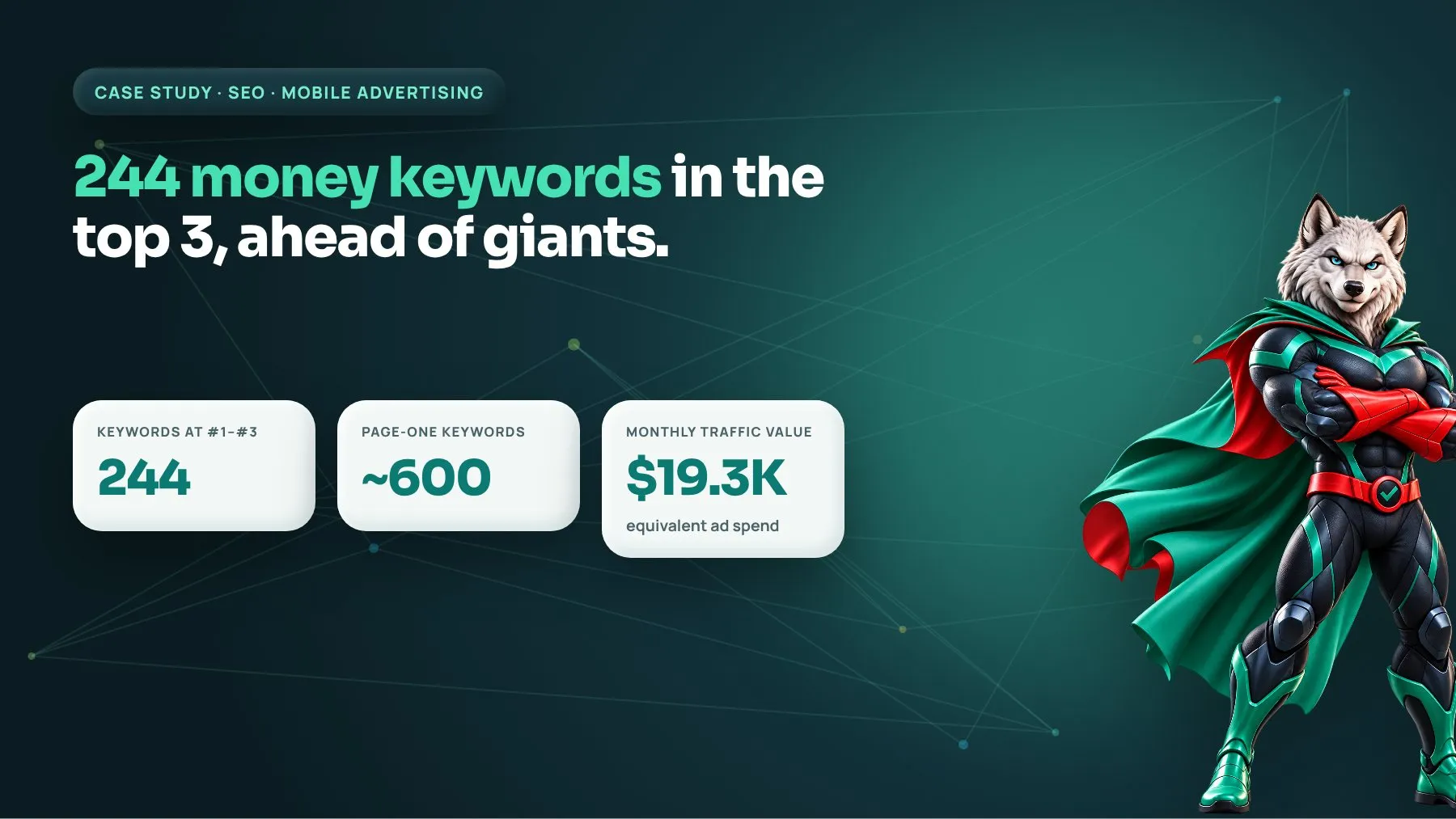
Getting onto the first page of Google is hard. Getting there in a niche like mobile advertising, where you compete with industry publishers, encyclopedias and Google itself, is harder still. This case study shows how a holistic SEO strategy built on well-researched content and topical silos put a mobile advertising company on page one for about 600 keywords, with 244 “money” keywords in positions #1 to #3.
At a glance
- Client: Mobile advertising company
- Services: SEO strategy, content development, topical siloing, on-site and off-site optimization
- Key results: 244 money keywords at #1–#3; 395 keywords at #4–#10; about 600 keywords on page one; 5,456 keywords in the index; 70% of traffic from the USA, UK, Canada and other first-tier countries; organic traffic worth more than $19.3K a month in equivalent ad spend
The challenge: competing with giants
Mobile advertising is an ultra-competitive niche. The search results are crowded with industry bodies such as IAB, trade publications such as Digiday, reference sites such as Wikipedia and Quora, and Google’s own pages. These sites have huge authority and years of links behind them.
For a commercial company, that creates a real problem. The people searching these topics include advertisers, app publishers and marketers, exactly the buyers the company wants to reach. If the top results are all publishers and reference sites, the company is invisible at the moment buyers are learning and comparing.
The traditional answer, “build more links than the giants”, is not realistic. You will not outspend Google or Wikipedia on authority. You have to win on relevance and depth.
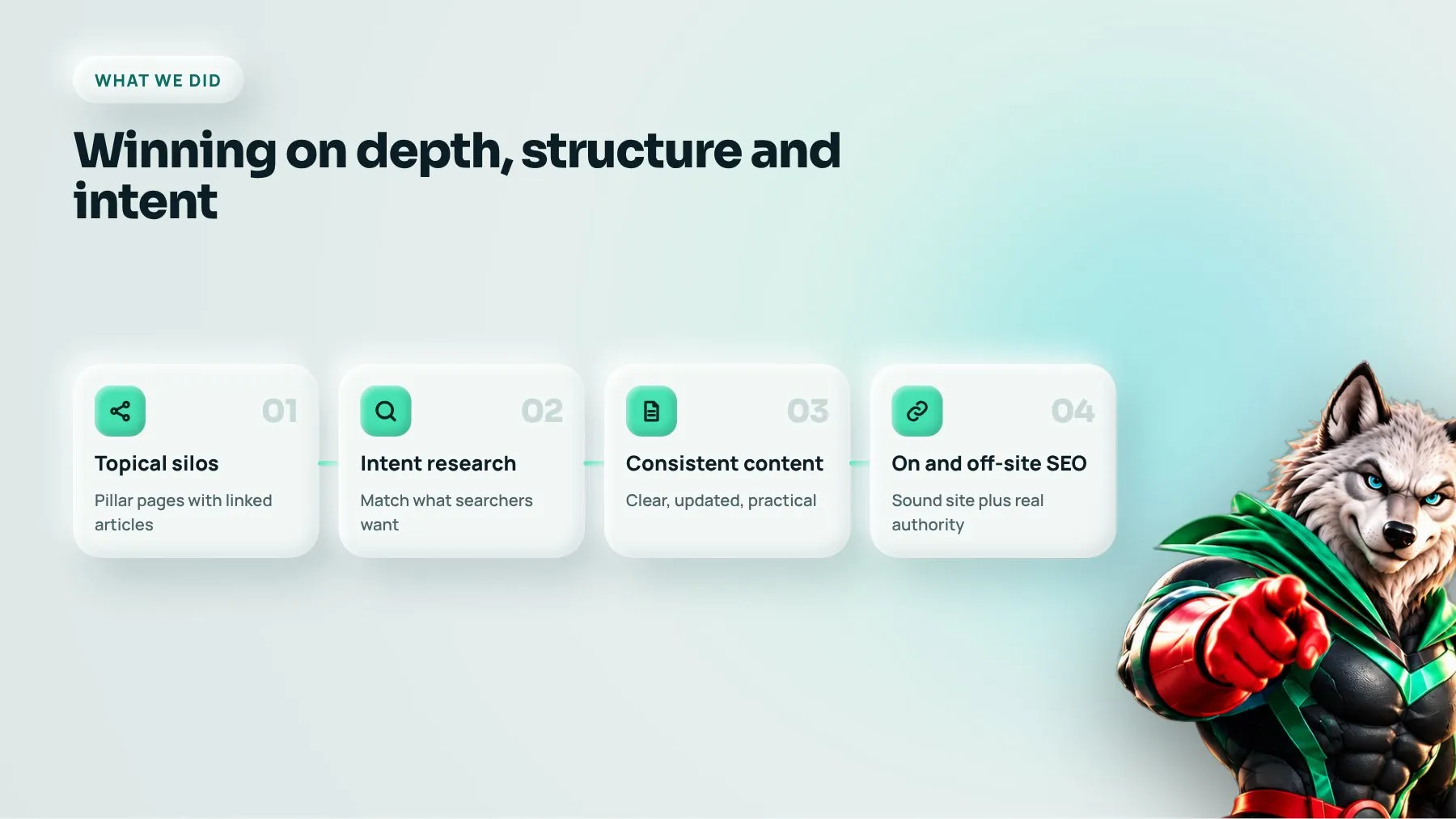
Our approach: depth, structure and intent
Topical silos
The core of the strategy was siloing: organizing the site’s content into tightly themed groups. Each silo covers one major topic in mobile advertising, with a main pillar page and a set of supporting articles that go deeper into specific questions.
Within a silo, articles link to each other and up to the pillar page. Links between silos are used sparingly and only where they genuinely help the reader. This structure does two things. It helps Google understand that the site covers each topic thoroughly, and it concentrates internal link value on the pages that matter most. Today this is often called building topical authority, and it remains one of the most reliable ways for a focused site to compete with bigger, broader ones.
Content researched for user intent
Every piece of content was researched before it was written, in three ways:
- User intent: what the searcher actually wants. Some searches need a definition, some a step-by-step guide, some a comparison of platforms or formats. The content type has to match.
- Keyword phrases: the main phrase plus the related terms and questions people use, so one strong page can rank for many variations.
- Competitor analysis: what the current top results cover, and what they miss. The goal was to produce the most complete and useful answer on the page.
Big publishers often cover a topic briefly as news, or broadly as an encyclopedia entry. A specialist site that explains the topic in practical depth for professionals can beat them because it is simply the better answer for that searcher.
Basic content development done consistently
None of this needed exotic tactics. It needed good, well-structured content produced consistently: clear headings, direct answers near the top, examples, and regular updates so pages stayed accurate in a fast-moving industry.
On-site and off-site optimization
Content alone was not enough. On-site work covered clean title tags and headings, internal linking, fast and mobile-friendly pages and a crawlable structure. Off-site work built relevant authority from industry sources so the site had enough trust to compete for the money terms.
The results
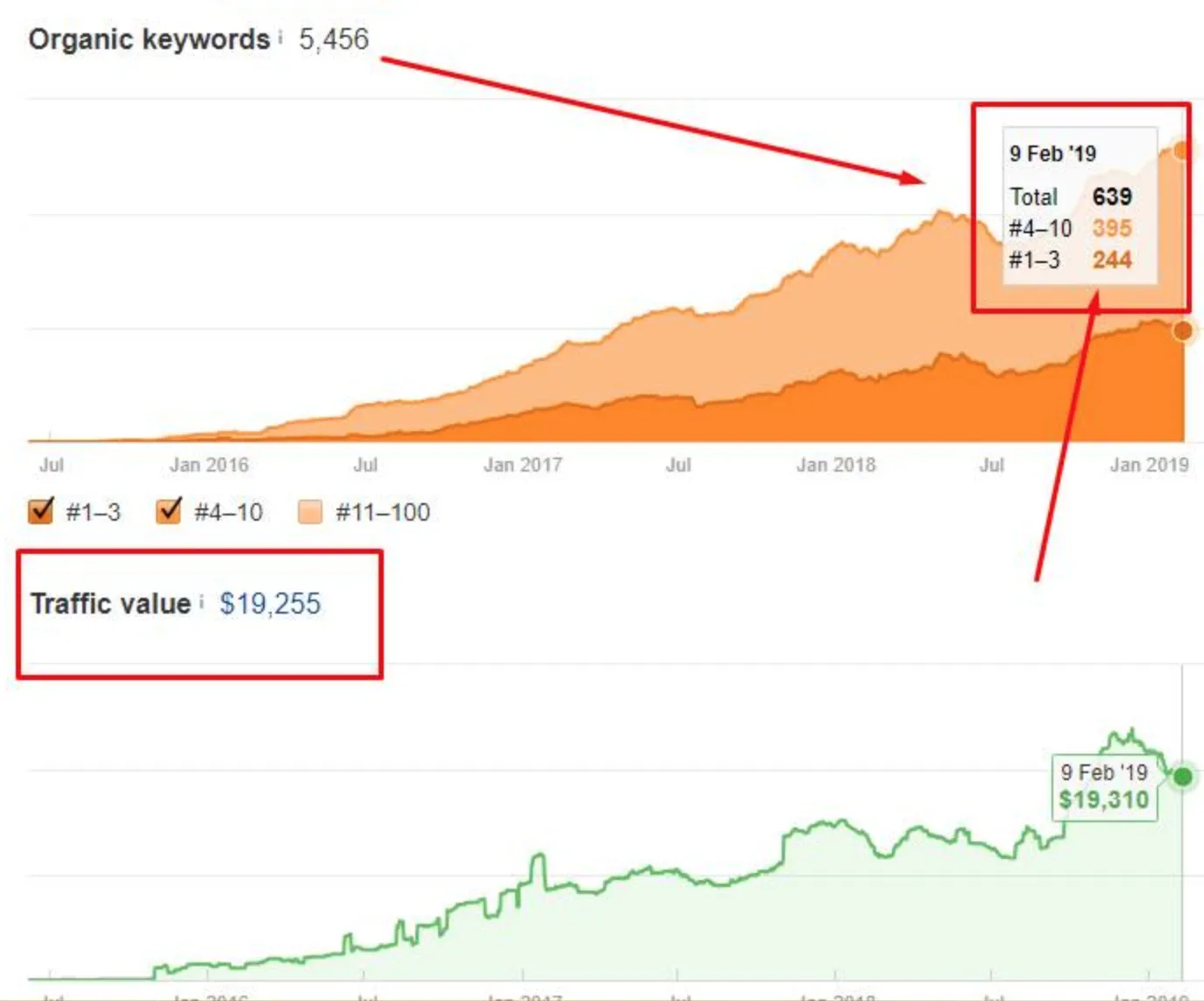
Global Google rankings:
- 244 money keywords in positions #1 to #3
- 395 keywords in positions #4 to #10
- About 600 keywords on the first page in total
- 5,456 keywords in the index
- 70% of traffic from the USA, UK, Canada and other first-tier countries
This free organic traffic is worth more than $19.3K a month, measured by what the same traffic would cost in Google Ads. That is the value of SEO in plain terms: traffic the company would otherwise have to buy, arriving every month without a cost per click.
Beating the giants:
The second chart compares the site with its biggest competitors across the keywords we track. The site ranks higher than IAB, Digiday and Wikipedia, and the nearest competitor is Google itself.
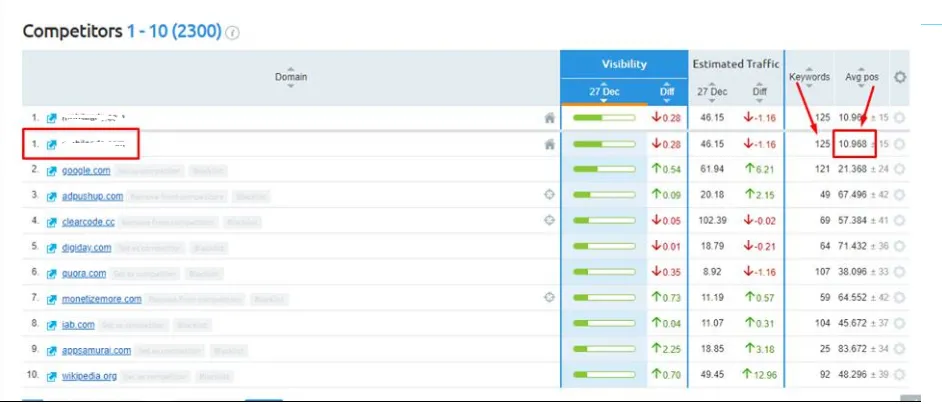
- Out of almost 200 important keywords tracked, the site’s average position is about 11, while Google’s is about 23. The site beats Google by roughly two to one.
- Among 2,300 competing sites, the website is top for about 125 money keywords, ahead of Wikipedia, Digiday and Quora, and ahead of Google in the global rankings for those terms.
- Of those 125 keywords, 48 rank #1, #2 or #3 globally, with an average position of about #10, compared with about #20 for Google.
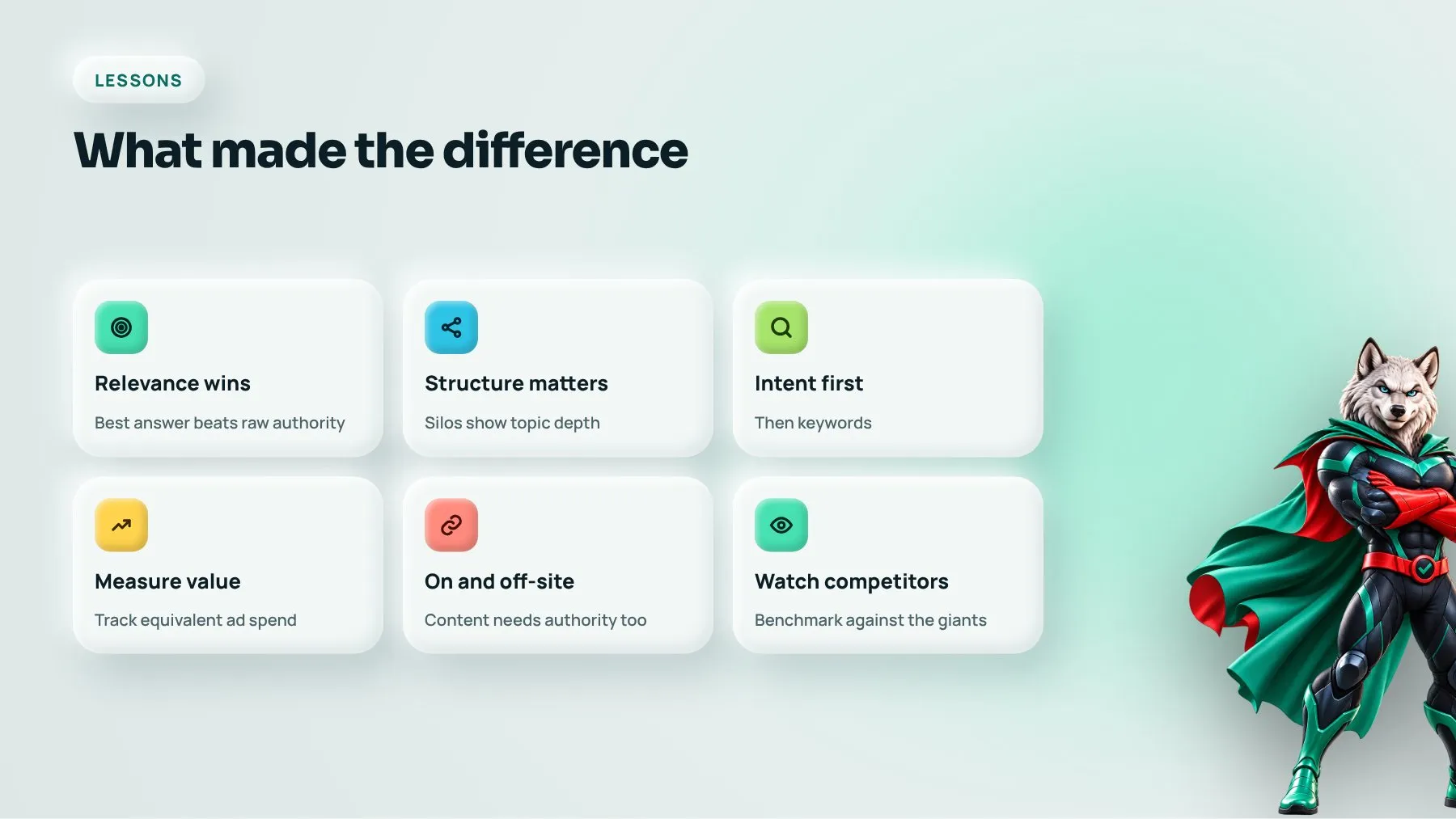
What made the difference
- Relevance can beat raw authority. A focused, expert site can outrank giants when its content is the best answer.
- Structure matters as much as content. Silos help Google understand topic depth and send link value to the right pages.
- Intent first, keywords second. Matching what searchers want is what earns and holds top positions.
- Measure value, not just rankings. The traffic’s equivalent ad value shows what SEO is worth to the business.
- On-site and off-site work together. Great content still needs a sound site and real authority.
How to apply this in a competitive market
- Map your market into a handful of core topics and plan a pillar page for each.
- Research intent and competitors for every article before writing.
- Link articles within each topic group and up to the pillar page.
- Aim to publish the most complete, practical answer for each query.
- Track rankings against your biggest competitors, not just your own positions.
- Estimate the ad value of your organic traffic to measure return.
In 2026, the same depth also helps content get cited in AI answers; see our generative engine optimization service. For core search, see our SEO services.
FAQ
Can a smaller company really outrank big publishers?
Yes, for the right keywords. Big publishers have authority, but they rarely cover specialist topics in practical depth. A focused site with better answers and a strong structure can outrank them on those topics.
What is a content silo?
A silo is a group of pages on one topic, usually a main pillar page plus supporting articles that link to each other and back to the pillar. It shows search engines that the site covers that topic thoroughly.
How long does it take to rank in a competitive niche?
Usually longer than in a local or small niche. Expect early movement in several months and significant results over a year or more of consistent content and optimization.
Competing against giants in your market? See our SEO services or book a strategy call.